This website is being migrated. In case you don't find the information you are looking for, the old website can be found here. Thank you for reporting any anomalies to communication@ill.eu.
Switch instrument:
Virtual tour
D16 High-resolution diffractometer with variable vertical focusing

Latest news related to the instrument

240701 twopopulations coverimage.jpg
July 2, 2024 Protein biopharmaceuticals: understanding the processes to take applications further
A recently published study uses neutron and X-ray scattering to deepen our understanding of freeze-drying protein stabilisation processes, widely used in biopharmaceutical applications. The results obtained for a protein relevant for pharmaceutical applications are in stark contrast with those previously obtained for lysozyme, widely used as a model protein. This highlights the importance of protein selection in such studies.
240312 HydrogenStorage.jpg
March 12, 2024 A neutron boost towards a clean energy future
The global need to transition to a sustainable and clean energy future has brought hydrogen to the forefront as a promising clean energy carrier. Efficient and safe storage is a key challenge and hydrogen storage in activated carbons is a promising option. Investigating the fundamental interactions between hydrogen and nanoporous carbon at the atomic level can provide vital information for enhancing the storage efficiency of these materials. Neutron scattering is sensitive to hydrogen, thus opening the possibility for many different insights. This paper reports on a SANS (Small-Angle Neutron Scattering) study using ILL’s highly versatile neutron diffractometer D16 to investigate hydrogen and deuterium adsorption in nanoporous activated carbon cloth as a function of (micro)pore size. These findings will contribute to a better understanding of the processes involved and will influence the design of materials for efficient hydrogen storage devices working at realistic cryogenic conditions and low pressures.
210707_PEM 1920x1031.png
July 7, 2021 Advanced neutron technologies galvanise research into advanced polymer electrolyte membranes
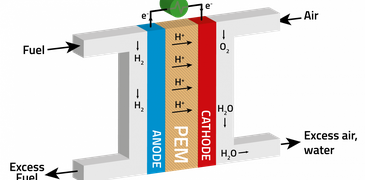
Schematic, cross-sectional view of a PEM fuel cell. Hydrogen fuel is channelled to the anode, while oxygen from air is channelled to the cathode. At the anode, hydrogen is split into protons (H+) and electrons (e-). The PEM allows the protons to cross to the cathode, while the electrons travel vi…