This website is being migrated. In case you don't find the information you are looking for, the old website can be found here. Thank you for reporting any anomalies to communication@ill.eu.

Nuclear and Particle Physics

Cosmological evolution – Theory of particles and forces – Stellar astrophysics – Quantum Mechanics - Nuclear fission – Metrology

Our views about the building blocks of Nature – fundamental particles and forces – have evolved dramatically over the past decades. We now have models that attempt to unify the forces and particles, and describe how they came into existence in the very early Universe. To test these models, particle physicists have designed experiments over a wide range of energies. 

In the sub-eV range, the cold or ultra-cold neutrons produced at the ILL can tell us a great deal about the 'symmetry' characteristics of particles and their interactions – perhaps helping to explain, for example, how the Universe came to contain mainly matter and not antimatter, even though created in equal amounts. 

Neutrons at the ILL are also used to investigate the structure and behaviour of nuclei by  generating excited nuclear states. Although atomic nuclei have a finite number of constituents – neutrons and protons – they display extremely diverse modes of excitations associated with both single-particle and collective behaviour, and can be regarded as miniature laboratories for studying complex, strongly interacting systems. The ILL is also able to create exotic nuclei with high numbers of neutrons to explore the pathways by which elements are made in the stars.

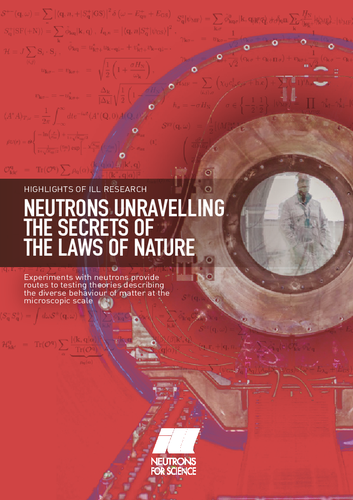
Highlights brochure on how neutrons unveil the secrets of matter:

Highlights

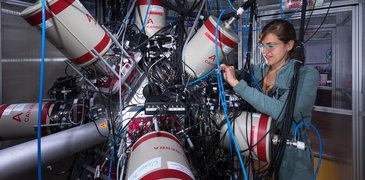
FIPPS_2019 10 21 256788_DSC2375.jpg
July 3, 2025 Exotic insights, unified aims
More than a century after the discovery of the atomic nucleus, no universal model can yet reliably predict its properties as the numbers of protons and neutrons change. Exotic nuclei – highly unstable and complex systems with unique properties – challenge and extend current nuclear theory. An additional piece of the puzzle was recently provided from the combination of experimental results from two leading international facilities and advanced theoretical calculations.
231130 MirrorNeutrons 13_vignette.jpg
Nov. 30, 2023 Do Neutrons oscillate into a hidden world?
Today, physicists can describe our world with ever increasing precision: The Standard Model of particle physics successfully describes all observation concerning three out of four fundamental interactions - the electromagnetic, the weak and the strong interaction. Gravitation, the fourth known interaction, is fully explained by General Relativity. The application of General Relativity to the enti…