

Beyond 0 and 1: a material that can store four magnetic states
12 May 2026Neutron experiments reveal how a ferrotoroidic material can store information in four distinct magnetic states, paving the way for future memory technologies with increased storage capacity.
-
 Quantum

Today’s computers store information using only two values: 0 and 1. But as electronic devices become smaller and reach their limits, scientists are searching for new ways to pack more information into the same space.
One idea is to use magnetism. In some materials, atoms behave like tiny magnets that can arrange themselves in different patterns. If each pattern represents a different value, one memory element could store more than just two possibilities.
In this study, researchers found a material in which these atomic magnets can form four different magnetic states. They showed that these states can be controlled using electric and magnetic fields and remain stable once created. Using neutron experiments at the Institut Laue-Langevin, the scientists were able to observe each of the four magnetic states that were created by applying electric and magnetic fields. This discovery hints at a future where computers might store significantly more information than today’s binary technologies.
The need for new ways to store information
Every email we send, photo we take or file we save ultimately relies on a simple principle: information is stored using two states, 0 and 1. For decades, advances in electronics have packed ever more of these bits into smaller and faster devices, following the trend known as Moore’s law (the observation that the number of transistors, the small electronic switches that process and store information, on a microchip roughly doubles every two years).
Today, however, this trend is beginning to slow as electronic components approach fundamental physical limits. As a result, scientists are exploring new ways to store and process information that go beyond conventional semiconductor technology.
One promising direction is spintronics, an emerging field that exploits the magnetic properties of electrons in addition to their electric charge to encode information. In many materials, some atoms behave like tiny magnets. Scientists describe these atomic magnets using a quantity called the magnetic moment, which tells us how strong they are and the direction in which they point. When many atoms interact inside a material, these tiny magnets can organise themselves into different patterns, each corresponding to a different magnetic state. In particular, materials known as magnetoelectrics have a remarkable property: their magnetic states can be controlled using electric fields. This coupling between electric and magnetic properties could enable faster and more energy-efficient memory technologies. Some magnetoelectric materials also display a less familiar type of order, known as toroidic order. In these materials, the atomic magnets form a vortex-like pattern, creating what is called a toroidic moment. This property allows the magnetic state to be controlled by combining electric and magnetic fields.
Even more intriguing is the possibility of moving beyond binary logic altogether. Some materials can stabilise more than two magnetic states, meaning that a single memory unit could store several values instead of just 0 or 1. Such multi-state memory concepts could dramatically increase information density, an attractive prospect as the amount of digital data continues to grow.
A crystal with four magnetic states
In a recent study, researchers investigated a magnetoelectric crystal made of lithium, nickel, iron and phosphate (LiNi0.8Fe0.2PO4). In this material, the tiny atomic magnets organise themselves in a particular pattern where neighbouring magnets point in opposite directions, a type of magnetic order known as antiferromagnetism. Their arrangement in space also creates a toroidic moment, meaning that the atomic magnets form a circulating pattern inside the crystal.
Antiferromagnetic materials are becoming increasingly interesting for future spintronic technologies. Because their atomic magnets point in opposite directions and compensate each other, they produce no overall magnetic field, which makes them less sensitive to external disturbances and allows devices to be packed more closely together. Another attractive feature is that the magnetic state can change extremely quickly in these materials, which could be useful for ultrafast information processing.
At very low temperatures, the magnetic moments in this crystal can arrange themselves in four distinct patterns, each representing a different magnetic state of the material. These states arise from a subtle spontaneous rotation of the atomic magnets inside the crystal, which allows the magnetic structure to stabilise in four distinct configurations.
Because the four states are stable and can be controlled using external electric and magnetic fields, they could in principle be used to represent four different values instead of just two (0 and 1 currently used in most data-storage technologies). This makes the material an interesting model system for exploring the concept of four-state, or quaternary, memory.
To understand how these magnetic states form and how they can be controlled, the researchers turned to a powerful tool for probing magnetism at the atomic scale: neutron scattering.
Detecting four magnetic states with neutrons
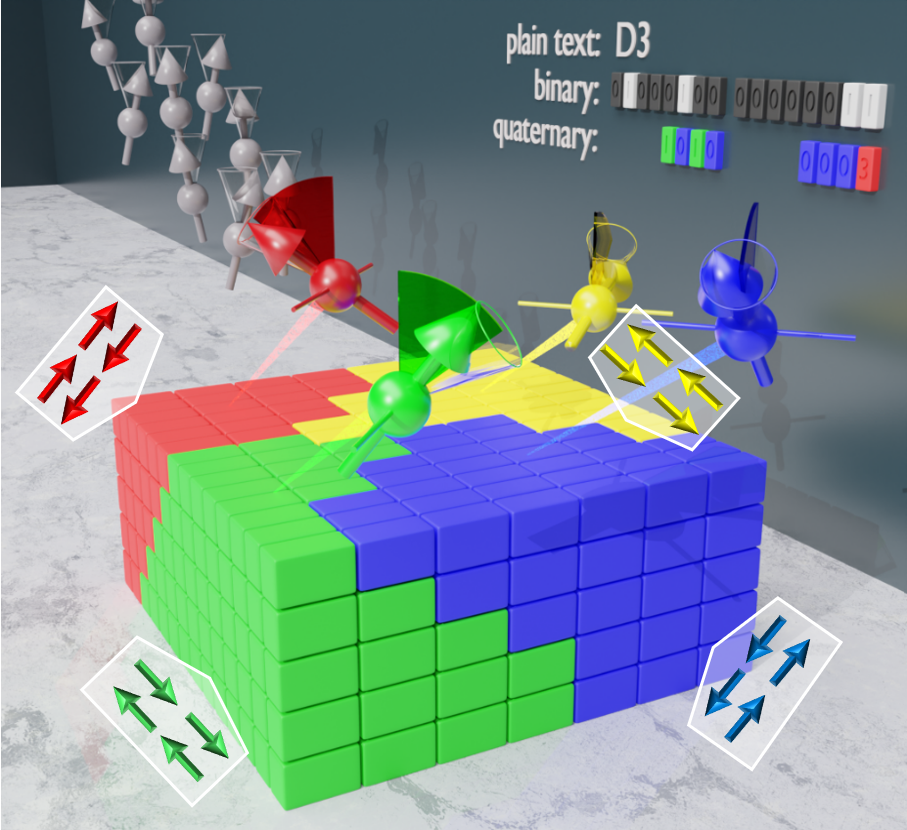
A single crystal of LiNi\(_ \mathit {0.8}\)Fe\(_ \mathit {0.2}\)PO\(_ \mathit {4}\) can host four different magnetic states (shown in red, green, yellow and blue). In each state, the atomic magnets inside the material follow an antiferromagnetic pattern, where neighbouring spins point in opposite directions (as illustrated in the zoom-in of each state), but the overall orientation of this pattern differs. The grey arrows represent the neutrons used to probe the crystal. Because neutrons behave like tiny magnetic probes, they interact with the atomic magnets in the material and are affected differently depending on the magnetic state they encounter. By analysing these changes, researchers can determine which of the four states is present. The illustration on the wall shows how a four-state (“quaternary”) memory could encode information more efficiently: the text “D3” requires eight units in conventional binary memory but only four units in a four-state system.
How neutrons reveal the magnetic structure
Neutrons are uniquely suited for studying magnetism inside materials. Although neutrons have no electric charge, they behave like tiny magnetic probes because they carry their own magnetic moment. When a beam of neutrons passes through a crystal, it interacts with the atomic magnets inside the material. Using a technique called spherical neutron polarimetry, scientists measure how this interaction changes the direction of the neutrons’ magnetic moments. This allows them to determine how the atomic magnets are arranged inside the material.
The neutron scattering experiments showed that the crystal can indeed stabilise four distinct magnetic states. Moreover, by applying electric and magnetic fields while cooling the sample, the researchers were able to control which of the four states formed.
Importantly, once a state was formed, it remained stable at constant temperature even after the external electric and magnetic fields were removed. This property, known as non-volatile behaviour, is essential for memory technologies, where information must remain stored without continuous electric power.
Although the material studied here operates at very low temperatures (below –200 °C), it provides an important proof of concept. By demonstrating that four magnetic states can be stabilised and identified in a single material, the work opens new possibilities for developing future spintronic devices capable of storing more information than conventional binary memory.
Toward memory technologies beyond binary
While practical devices based on this concept remain a long-term goal, the study highlights how fundamental research can reveal new possibilities for future information technologies. By studying magnetoelectric and toroidic materials with advanced neutron techniques, scientists can explore how magnetic states emerge and how they can be controlled at the atomic scale.
The work also illustrates the unique role of neutron scattering in studying magnetism. Because neutrons interact directly with the magnetic moments inside materials, they provide a powerful way to uncover magnetic structures that are otherwise difficult to observe.
As researchers continue to search for new materials with similar properties, ideally operating at higher temperatures, such studies may help guide the development of next-generation memory technologies with increased storage capacity.
Reference:
N. Qureshi, A. Painganoor, M. C. Larsen, M. Ravn-Feld, K. Beauvois, J. A. Rodríguez-Velamazán, D. Vaknin, P. Steffens, R. Toft-Petersen, and N. B. Christensen. Toroidicity as a route towards non-volatile quaternary memory in antiferromagnets. Nature Communications (2026). https://doi.org/10.1038/s41467-026-70767-8
ILL Instrument: D3
ILL Contact Person: Navid Qureshi
Institutions involved in the research: Technical University of Denmark, Université Grenoble Alpes, Iowa State University, European Spallation Source