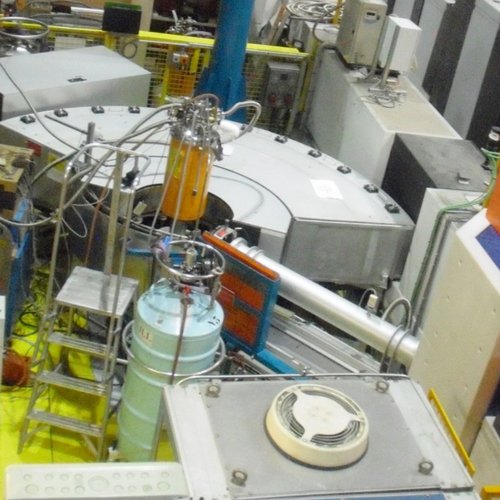
Diffraction Group
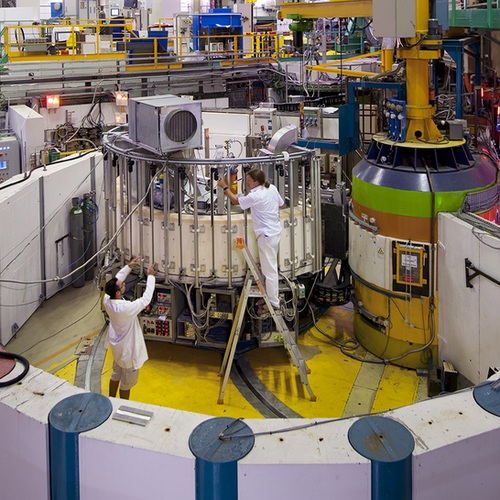
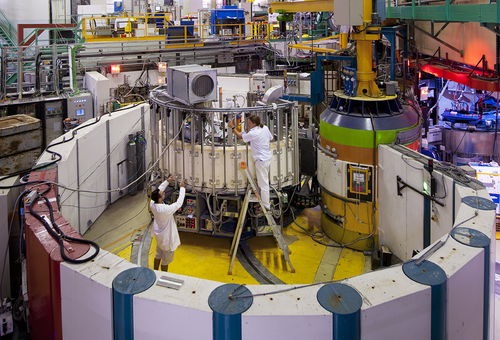
The ILL Diffraction instrument group studies the structure of a wide range of materials. The influence of structure is indeed everywhere; the properties of water and ice, the hardness of metals, the strength of magnets, and even the biology of DNA or the effect of antibodies on viruses – all depend on structure. Neutron diffraction instruments are used to provide detailed insights into the arrangement of atoms within a material, helping scientists to understand its properties and behaviour.
We generally use a large monochromator to select a particular neutron wavelength (just as the different wavelengths of light can be separated using a prism or fine grating). The material to be studied is placed in this monochromatic neutron beam, and the scattered neutrons are collected on a large 2D detector. The sample can be a liquid, a bunch of fibres, a crystal or a polycrystal. A polycrystal is the usual form of solid matter, such as a lump of metal or ceramic, and is made up of millions of tiny crystals.
How does it work? When a polycrystalline lump of material, often ground to a fine powder, is placed in the beam. Neutrons are scattered at specific angles, corresponding to the spacing between atomic planes, and by measuring these angles and intensities the atomic structure of the material can be deduced. If instead of a crystalline powder an amorphous or liquid sample is used, there are only broad peaks at specific angles corresponding to average interatomic distances. To obtain more data, short neutron wavelengths are used, and sometimes one type of atom is replaced by its isotope – chemically identical, but with a different nucleus and different neutron-scattering power – this difference then gives information specific to that atom.
Diffraction group instruments
The ILL's diffraction instruments are divided into two main groups: powder diffractometers and single-crystal diffractometers. In this page you will find a very short description of our instruments. If you are interested in more detailed information, you can consult the official page of the instrument (mantained by each Instrument Scientist).
Powder diffractometer
These two-axis diffractometers are used to investigate the structure of powders, liquids and amorphous materials. Diffraction group machines use relatively short wavelength neutrons (0.3 to 2.0 Å) to resolve structures to atomic resolution, in contrast to diffractometers in the Large Scale Structures (LSS) group that use long wavelength neutrons for lower resolution of larger structures.
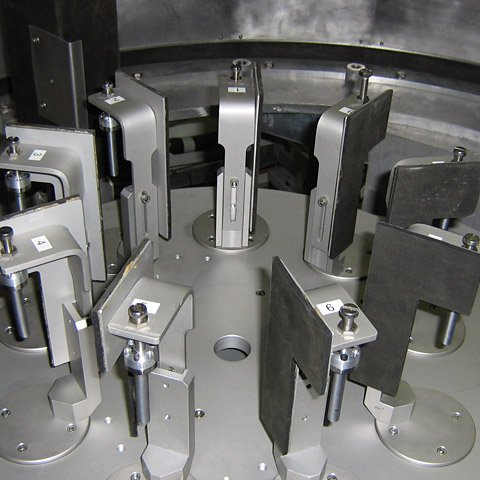
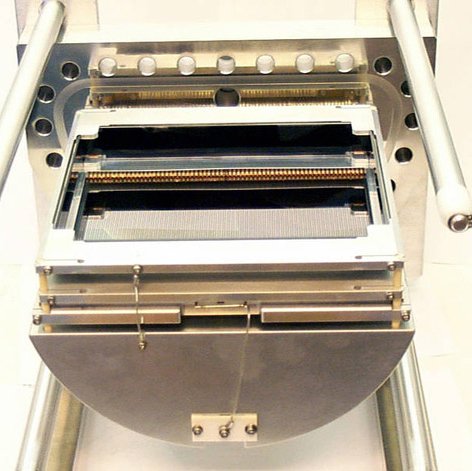
Usually a large composite monochromator, up to 300 mm high, is used to select a narrow band of wavelengths and focus it onto the sample.The monochromator may be made from several crystals of pyrolytic graphite, copper or germanium. Large multi-detectors and linear position-sensitive detectors (PSDs) cover a large solid angle for maximum efficiency.
The two high-resolution powder diffractometers D1A and D2B are used mainly for Rietveld refinement, with scans lasting from 30 minutes to several hours. They are complemented by two high-flux medium-resolution powder machines, D1B and D20, which are used mainly for temperature scans and other types of fast experiment, especially on small samples. D4, on the short wavelength hot source, is used for liquids and amorphous materials, together with D20.
- D1B 2-axis diffractometer (CRG)
- D2B high-resolution 2-axis diffractometer
- D4 diffractometer for liquids and amorphous substances
- D7 diffuse scattering spectrometer
- D20 high-flux 2-axis diffractometer
An overview of instrument parameters is provided in the table below to help you choose the most suitable instrument. By clicking on the instrument, you can go directly to the dedicated instrument pages where more information can be found, including scientific highlights and contact details for the instrument scientists.
Single crystal diffractrometers
Single-crystal diffraction is a powerful method for the investigation of structural details in condensed matter. Hot neutrons are required to uncover the finest details in the nuclear positions and neutron spin polarisation is a handle to separate mixed components (nuclear polarisation, magnetic and electronic scattering).
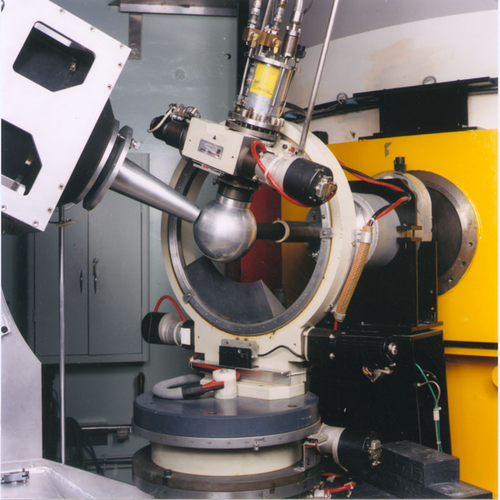
A characteristic of the four-circle diffractometers is the use of Eulerian cradles for orienting the sample crystals, with the detector moving in a horizontal plane. Normal-beam diffractometers have a mechanism for tilting the counter out of the horizontal plane, thus enabling the installation of heavy equipment for special crystal environments (cryostats, magnets, etc.).
These diffractometers can be used to find:
- average atomic positions. From these we can learn how the atoms are bound together to form molecules, and how the molecules are stacked;
- local atomic distributions. This gives information about the time averaged thermal motion or the local atomic disorder;
- magnetic structures and magnetic moment distributions.
Structural data of this kind are required for a large number of systems, ranging from organic molecules to high temperature superconductors. Often studies are made as a function of temperature, pressure and magnetic field which may lead to important modifications of the crystal structure.
- D3 polarised hot-neutron diffractometer
- D9 hot neutrons
- D10 4-circle & 3-axis
- D23 2-axis spectrometer (CRG)
An overview of instrument parameters is provided in the table below to help you choose the most suitable instrument. By clicking on the instrument, you can go directly to the dedicated instrument pages where more information can be found, including scientific highlights and contact details for the instrument scientists.