Advanced Sample Environments
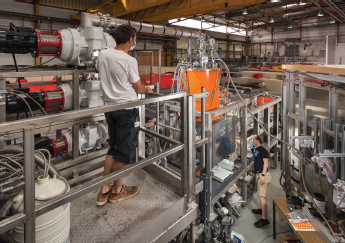
Sample environment equipment is essential for controlling the experimental conditions under which measurements are performed. User-prepared samples can take various forms, including liquid solutions, powders, interfaces, or assemblies of single crystals. The equipment must not only regulate multiple physical parameters simultaneously but, in some cases, also precisely orient the sample relative to the instrument components.
The ILL has developed a diverse range of sample environment devices, many of which have been widely adopted by the global neutron research community and are now considered standard tools in neutron science. These include:
Adsorption | Electric Field | High Pressure | High Temperature | Humidity Control | Magnetic Field | Liquid-Liquid Interfaces | Low Temperatures | Langmuir troughs | Rheometers | Stopped Flow Heads | Ultra-Cold Neutron Source | Ultra-Low | Temperatures | Uniaxial Pressure
User support
Core activites
- Provision of fluids and cryogens
- Prepare, maintain, and upgrade equipment
- Anticipate component obsolescence and plan replacements
- Manage equipment sharing across experiments
- Assist instrument teams and users with setup and operation
- Train Ph.D. and postdoctoral researchers
- Anticipate and address the evolving needs of instrument teams
- Perform finite element analysis to model mechanical, magnetic, and thermal behaviour under various conditions
- Estimate heat loads from thermal radiation, solid conduction, wiring, and other sources
- Develop CAD models, electrical schematics, and fluid diagrams
- Identify suitable materials and shielding techniques
- Improve ergonomics, modularity, and operational efficiency
- Program PLCs (Programmable Logic Controllers) and HMIs (Human-Machine Interfaces)
- Define and implement standards and libraries
- Ensure compliance with safety regulations and operational requirements
- Produce comprehensive technical documentation
- Manage version control for source code, technical specifications, and functional test scenarios
- Publish designs for novel equipment
Adsorption and Langmuir troughs
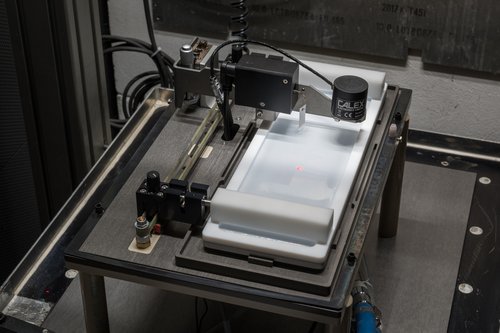
Specular neutron reflectometry is a powerful technique for studying mixtures of polymers and surfactants at the air/water interface. This method is now being extended to biological systems, including proteins, nanodiscs, and DNA, in combination with surfactants or lipids.
Our optimised adsorption trough unit, designed for neutron beam experiments, allows the simultaneous study of up to 12 samples while monitoring surface tension and regulating temperature. The system features two separate compartments, enabling the parallel investigation of different gas environments.
High pressure
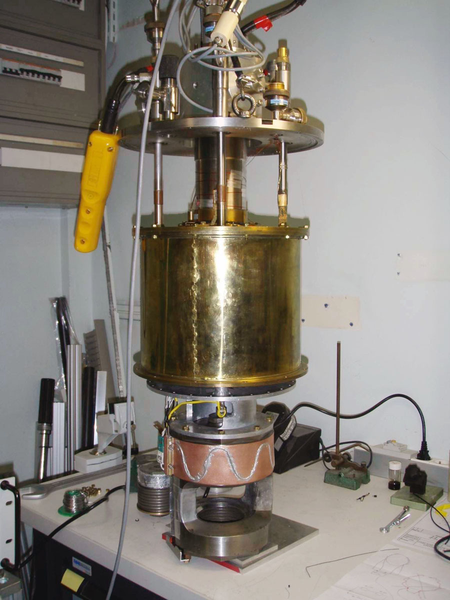
The application of high pressure influences a wide range of physical properties in solid and soft materials and plays a crucial role in chemistry and biology. It is a widely used technique for discovering new physical phenomena, studying complex mixtures, and developing novel materials.
To support these studies, we have developed high-pressure cells optimised for neutron beams, including the fabrication of specialised alloys. Many of these experiments also require cryogenic conditions, such as in the study of superconductivity, quantum phase transitions, colossal magnetoresistance, and insulator-metal transitions. To meet this need, we have designed cryostats capable of cooling a press to temperatures close to absolute zero.
Humidity control
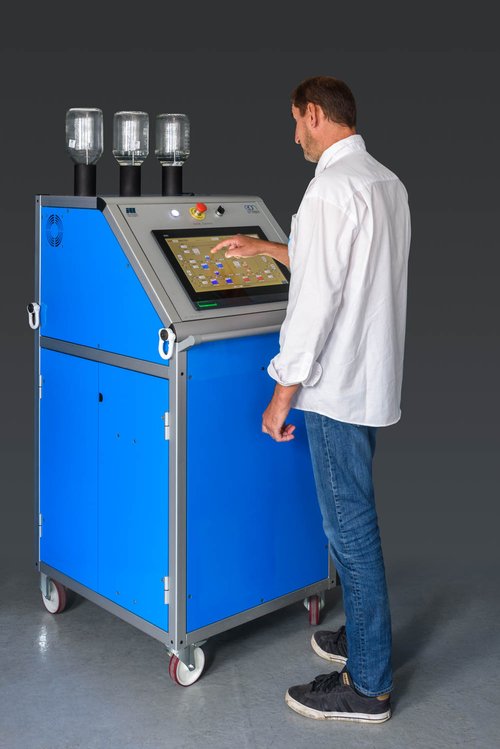
Humidity plays a crucial role in determining the chemical potential of water, influencing processes such as the swelling and deswelling of complex materials, proton rearrangement in batteries, and bilayer formation in lipids.
To overcome the limitations of conventional humidity sensors, we collaborated with colleagues from HZB (Germany) to develop a precision humidity chamber. In this system, relative humidity is controlled by a water reservoir maintained at a temperature calculated using Antoine’s equation. To prevent thermal gradients that could lead to unwanted condensation, the sample space is thermally decoupled from both the water bath and the surrounding experimental environment.
For experiments requiring rapid changes in relative humidity or the use of non-standard liquids or gases, we have developed a multi-purpose humidity generator. This system utilises mass-flow controllers to precisely mix dry and saturated gases in controlled proportions, providing a flexible and reliable solution for humidity regulation.
High temperature
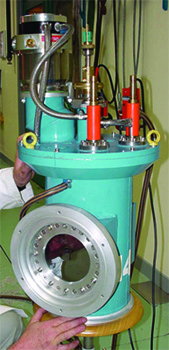
Developed in the mid-1980s, the ILL type furnace, also known as the Blue Series, was developed from experience gained working at temperatures up to 2600°C. This furnace is inexpensive, easy to operate and much easier to maintain than the record-breaking furnaces of the time. The many units delivered worldwide are still in use in numerous neutron facilities. Recently, all furnaces and automated power racks have been upgraded with a fast-cooling option reducing the cooldown time by a factor 4, thereby reducing beamtime losses. The sample is generally placed in a vacuum but a special setup has also been developed for carrying out experiments while circulating a gas mixture in the sample at elevated temperatures.
Low temperature
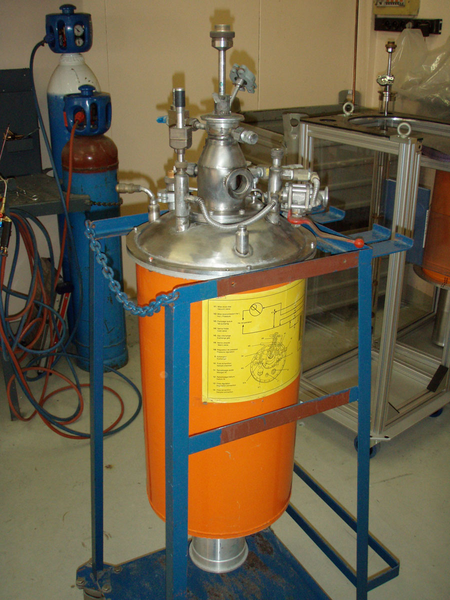
Orange Cryostats
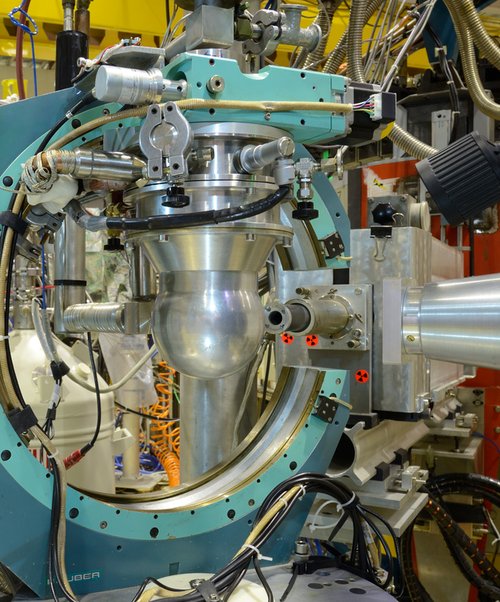
To meet the diverse needs of scientists, ILL developed the Orange Cryostat, a versatile cryostat designed for neutron beam applications allowing precise control of sample temperatures from ambient to very low. The Orange Cryostat, in use worldwide for decades, has recently been enhanced to accelerate temperature changes by a factor of three. To extend its temperature range, ILL also introduced the Orange Cryofurnace, which replaces the indium-sealed calorimeter with a friction-welded assembly. Orange Cryostats can be equipped with a variety of sample holders tailored to the specific demands of the neutron community, including options for applying electric fields both horizontally and vertically, correcting or detwinning single crystalline samples, applying pressure without freezing liquid samples, and measuring dielectric properties, among other capabilities.
Dilution Refrigerators
To investigate the fundamental ground states of quantum and magnetic systems, ILL has developed its own dilution refrigerators, including a gravity-insensitive dilution refrigerator that allows the orientation of a single crystal in space while maintaining its ultra-low temperature. This innovation has also paved the way for using cryostats in space applications. All dilution refrigerators are equipped with gas handling systems developed in-house. The control of the dilution inserts is fully automated, allowing smooth operation from room temperature to base temperature using a compact and mobile rack. As for the gravity-insensitive refrigerator, the separation of ³He and 4He isotopes is continuously maintained, with re-injection into the circuit, enabling long-duration experiments without the need for remote isotope separation after the experiment.
High magnetic field: steady-state and pulsed magnets
Neutron scattering techniques have long been essential for studying magnetism and magnetic materials due to the intrinsic spin of neutrons. Magnetic fields allow for the switching and control of material properties while simultaneously enabling neutron experiments to uncover the atomic-scale characteristics that underpin the potential of functional and quantum materials for future technologies.
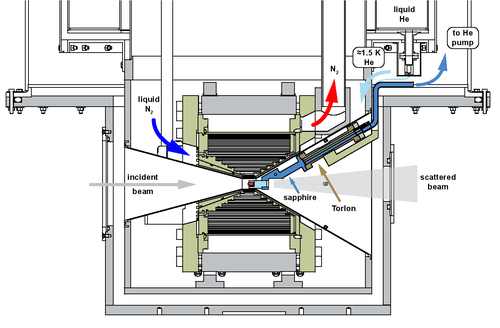
Inside the magnets, the sample temperature is precisely controlled with specially designed inserts developed by our team, ensuring high stability across the entire temperature range. These inserts are compatible with our dilution refrigerators and also reduce cooldown and warm-up times.
The ILL is the only neutron facility worldwide capable of applying a 40 T long-pulse magnetic field to a sample while maintaining a regulated temperature between 2 and 300 K. Coupled with fast ³He detectors and optical fiber connections, the electronics enable high-sampling-rate neutron data collection during magnetic field variations
Ultra-cold neutrons
Ultra-cold neutrons (UCNs) have such low energy that they can be stored in closed volumes for several minutes, making them ideal for studying a range of fundamental physics phenomena, such as testing deviations from Newton's law of gravity, probing Lorentz invariance, and searching for axion-like particles.
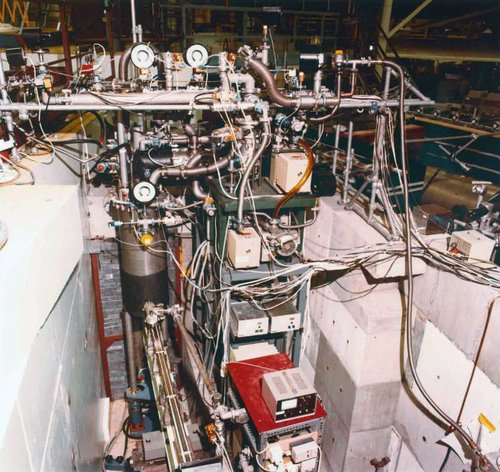
Given that most studies are statistically limited, our cryogenic team has developed a 4-meter-long source called SuperSUN, that converts cold neutrons into UCNs through inelastic scattering in isotopically pure superfluid 4He. The superfluid is maintained below 0.6 K to minimise losses due to inverse conversion processes, where UCNs gain energy from thermal phonons.
To maximise UCN production and ensure reliable operation over extended periods, a Programmable Logic Controller (PLC) supervises all components of the source, oversees the purification of the superfluid by removing the neutron-absorbing ³He isotope and maintains the superfluid level for weeks. The ³He/4He heat exchanger that cools the superfluid is made from a single crystal of copper, the same as that used for monchromators and produced and machined in-house by our neutron optics team.