

Round Table: Novel Opportunities for Cooperation between France and Germany in Neutron Science
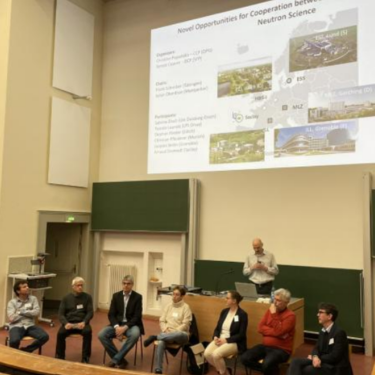
08 May 2026During the Spring Meeting of the Condensed Matter Section of the German Physical Society (DPG), held in Dresden in March 2026, a round table was held on the theme ‘Novel Opportunities for Cooperation between France and Germany in Neutron Science’. The discussion involved the participation of the directors of the French and German facilities, as well as representatives of the neutron user association in both countries, SFN and KFN.
Setting the scene
Two short presentations by the two chairpersons of the round table opened the discussion. Frank Schreiber (U. Tübingen) briefly presented the possibilities offered by neutron scattering in condensed matter physics and chemistry, as well as in biophysics. A broad field was covered: crystal and polymer structure, diffusion and dynamics, contrast matching, magnetism and skyrmions, with relevance for batteries and quantum and information technology.
Julian Oberdisse (U. Montpellier) presented the “nuts and bolts” of neutron scattering in terms of the instruments operated by JCNS, MLZ, ILL, and LLB, and introduced their directors, who were all in the room. As clearly demonstrated, these facilities offer a wide variety of Franco-German research and instrument collaborations. The European perspective offered by the facilities in Sweden, Switzerland, UK, or Spain was also underlined.
As a starting point, several of the societal challenges that can be tackled with neutrons were discussed: energy, climate and environment, health and food, mobility, cultural heritage, and innovation. This demonstrated the broad range of opportunities for young researchers trained in neutron science to make significant contributions, both scientifically and in the associated economic sectors.
The strong user base in France and Germany was explicitly highlighted to the public by KFN and SFN:
- KFN has identified a user base of around 1300 people from 230 scientific institutions.
- SFN is a learned society with about 500 members, representing a user base of around 1500 people from 300 institutes.
How to get to the neutrons
The first discussion topic concerned access to neutron beams and triggered considerable interest and questions from the audience. It became clear that researchers that do not have prior work experience in large-scale facilities do not necessarily find it easy to take the first steps – a certain barrier is perceived. In response, all the facility managers expressed their interest in attracting new users – with a view to expanding their user base, but also because new ideas and research topics are crucial for the development of the field.
The representatives of KFN and SFN underlined the existence of a variety of training opportunities – from three-day practical courses in international instruments at ILL (Collaborating Research Group instruments, CRG), to one- or two-week long schools (such as those organised by ILL/Montpellier or JCNS), or the five-week Hercules school at ILL. Some of these schools, such as the thematic schools organised by SFN, publish freely downloadable textbooks. SFN and KFN also run annual meetings, originally focused on either the French (JDN) or German (DN, SNIB) user community, but nowadays with a strong international focus.
Beamtime access practicalities
Several questions from the audience concerned the technical aspects of access to neutron beamtime. The mechanism of beamtime distribution currently implemented in virtually all facilities worldwide was outlined: the proposal system with regular calls (typically twice a year) and expert committees deciding on beamtime allocation. The drawbacks of this system were not hidden: it is relatively slow (about six months from request to experiment); decisions may come late and are not always positive, in particular when instruments are in high demand. While it was considered that a ‘normal’ oversubscription (typically a factor of around 2) usually allows the most promising experiments to be granted beamtime, this figure may nevertheless discourage new users.
Facility directors generally agreed that a period of two to three months from the proposal to the experiment is an achievable goal. Importantly, new users were strongly encouraged to team up with experienced users, or to contact directly the instrument responsible scientists for advice. It was also pointed out that all facilities offer alternative beamtime access procedures: for projects with a strong time pressure (fast or easy access) and for test measurements allowing scientists to check a hypothesis before submitting a full proposal (which can usually be performed during in-house beamtime, or using director’s discretionary time). Along the same lines, virtual instruments (digital twins) will be increasingly available to estimate measurement times and statistics for given types of samples. For future sources, facility management teams are currently rethinking how to allocate beamtime, taking into account new and emerging ways of doing research. Given the increasing data production rates, the question of the management of big data is becoming increasingly relevant.
But why neutrons?
An aspect addressed in the discussion with the audience was the potentially lengthy data acquisition times, in particular in comparison with X-ray scattering. Indeed, due to the underlying physics, incoming neutron fluxes are orders of magnitude lower. It was emphasised that some measurements, in particular those sensitive to hydrogen atoms or magnetic moments, can only be done with neutrons. Moreover, modern sources aim at higher and higher brilliance – there is “plenty of space at the top”, creating many opportunities for young scientists.
The round table participants emphasised that experiments that are feasible with X-rays should be done with X-rays, leaving the most important neutron applications to this rarer resource. In some cases, the complementarity between X-rays and neutrons is beneficial or even key to the success of the experiments, as they may highlight different aspects of the same process or structure (e.g. exact positions of heavy vs. light elements).
The challenge of data analysis
Owing to the nature of the processes involved, conclusions are usually inferred indirectly in scattering experiments. Data analysis is thus part of the experimental workflow. Users should leave with pre-treated data, enabling them to focus on the science rather than in solving technical issues.
Moreover, powerful data analysis programs are available, and considerable efforts are being made at the sources to implement more efficient data reduction and processing. Artificial intelligence is expected to become increasingly useful and is being actively explored at the facilities. Given the increase in computing power, “on-the-fly” data analysis may become feasible in specific applications.
Finally, dedicated workshop and schools for data analysis are regularly held in the Franco-German research landscape. Once more, the importance of adequate training and of collaborating with experienced groups was emphasised in the discussion.
A wealth of opportunities
The remainder of the discussion, focusing on ‘international jobs in neutron facilities, now and in the future’ and ‘scientific and instrumental collaboration between France and Germany' was relatively brief due to time constraints. The specific question to be answered by the panel was ‘Could there be a job for me in neutron scattering?’
The international nature of such jobs and working environments was emphasised – increasingly, not only for scientists but also for technicians and engineers. In this context, it was emphasised that Franco-German partnerships are in place not only in the sources represented in the discussion but also at ESS, where common beamlines exist. The potential for opportunities in rapidly growing fields, such as neutron imaging, was also stressed. On the scientific project side, two opportunities were mentioned in the discussion.
Firstly, the new Science Strategy developed by ILL. Leveraging on recent and major instrument and facility upgrades, the Science Strategy proposes to focus efforts on specific topics of societal relevance by using different types of project organisation, such as hubs and showcase experiments. Secondly, the well-known ANR-DFG joint research programme. Over the last 10 years, the programme has made it possible to fund about 60 projects per year involving at least one French and one German institution, with a total budget of around 200 M€ in each country.
The final message seems clear: there are many opportunities in neutron science for young researchers - both in scientific projects and in instrument development; in France and in Germany; in existing facilities, on ESS beamlines with French/German participation, or in future facilities, such as ICONE and HBS-1.