


Neutron science in a nutshell
The ILL is a user facility welcoming scientists from all around the world to perform cutting-edge experiments fostering progress in a variety of scientific and technological domains. Neutrons are used at the ILL to probe the microscopic structure and dynamics of a broad range of materials at molecular, atomic and nuclear level. The impact of the neutron science carried out at ILL ranges from scientific discovery and excellence to addressing societal challenges in the fields of health, the environment, energy, computing technologies, and in exploring the mysteries of the Universe we live in. For an introduction to neutron science, see below in this page.
As a service infrastructure, ILL makes its facilities and expertise in neutron science and technology available to its 'scientific users' (visiting scientists). ILL scientists, engineers and technicians and administrators are organised in 'science groups', according to the instrument and support facilities they operate for the benefit of the users. Go to ILL's Science Groups page.
Scientific life at the ILL is organised in 'colleges', each dealing with a particular field of research. The areas covered include condensed matter physics, chemistry, biology, materials science and engineering, Earth sciences, and nuclear and particle physics. ILL scientists belong to one or more colleges, depending on their personal research interests. Each college is animated by a 'college secretary' elected amongst college members. Colleges play an important role in the scientific life of the ILL, including in the proposal evaluation scheme. More on the ILL's college organisation.
To learn more about the technologies that make all this possible, go to Neutron technologies at the ILL.
To learn more about the ILL facilities and instrumentations, go to A unique facility.
Introducing neutron science
From fundamental research to tackling the major challenges of the 21st century, neutrons play a key role in the European science and technology ecosystem.
Alongside other tools for the characterisation of matter, such as X-rays, nuclear magnetic resonance and infrared and Raman spectroscopy, neutrons make an invaluable contribution to our knowledge of materials and our understanding of the processes at work on different time and length scales. The unique properties of neutrons make them a powerful tool for unlocking the secrets of matter.
In this page, we give a brief introduction to neutron science - the uniquess of neutrons, neutron scattering techniques and what can they do for science.
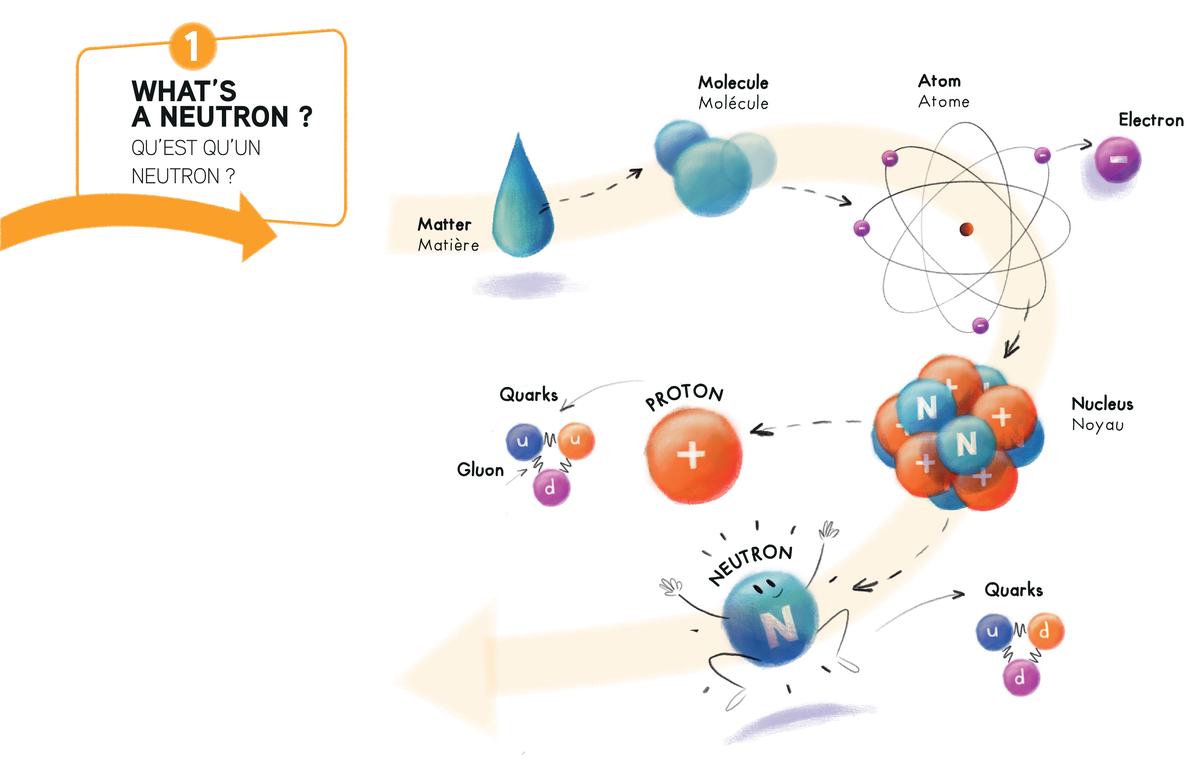
What is a neutron?
The uniqueness of neutrons
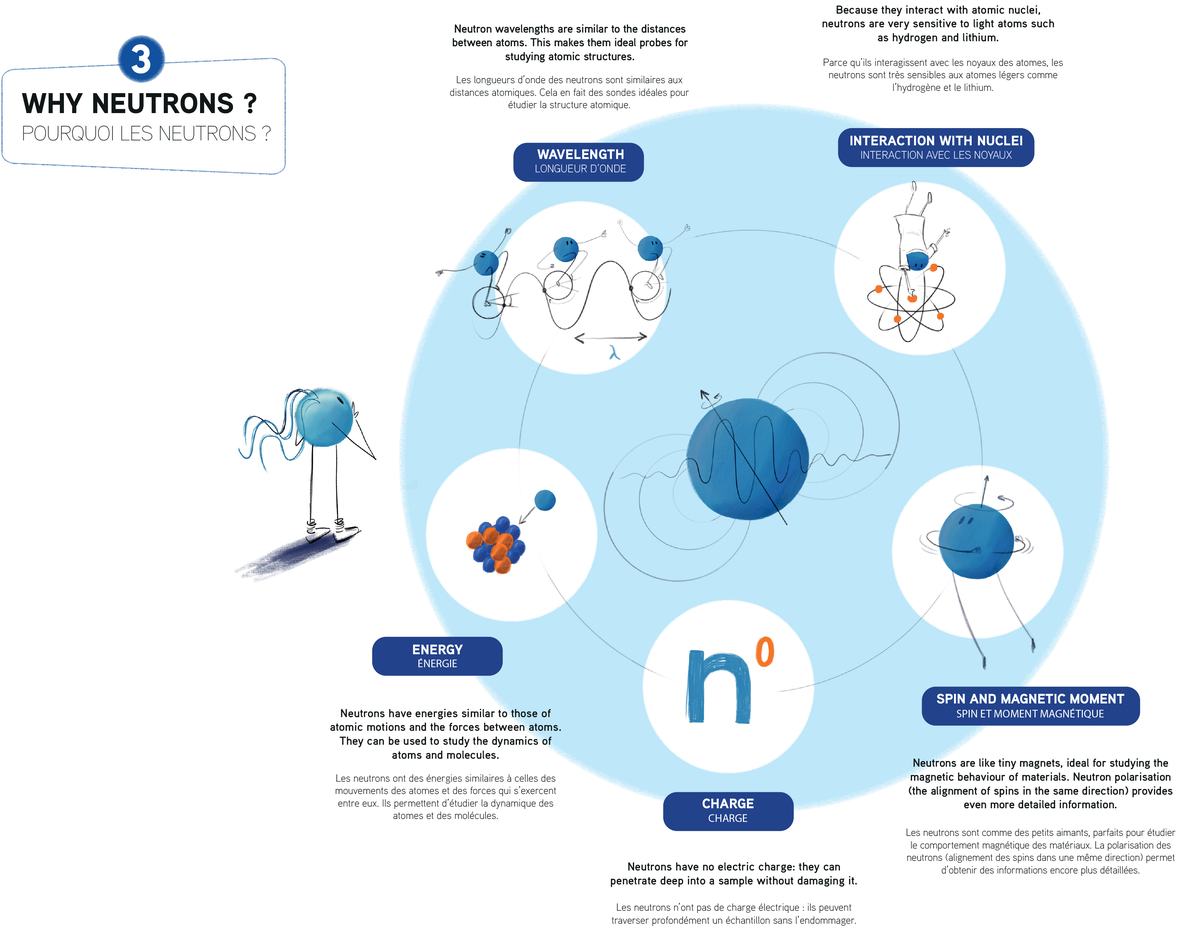
When beams of neutrons are used to probe small samples of materials they have the power to reveal what cannot be seen using other types of radiation. Neutrons appear to behave either as particles or as waves or as microscopic magnetic dipoles. It is these specific properties which enable them to yield information which is often impossible to obtain using other techniques.
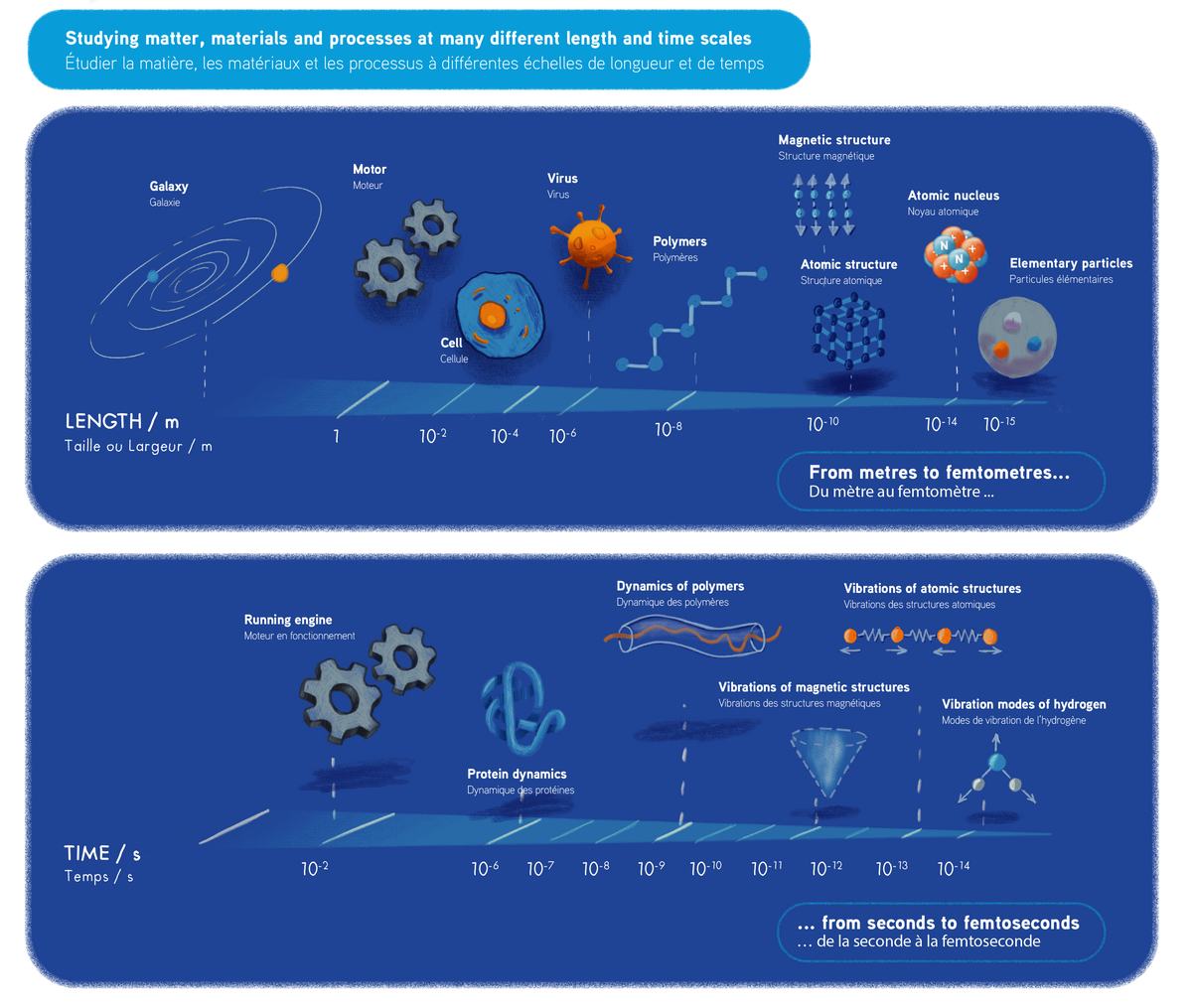
A wide range of length and time scales
Neutrons can be used in many different ways to study structures that range from life-sized to the atomic scale and interactions that occur at very different rates. For example, a thermal neutron as a wavelengths of the order of the angstrom, which is roughly the distance between atoms in a crystalline solid. Having a wavelength of about that distance means that thermal neutrons are sensitive to atomic length scales. To probe the longer length scales characteristic of proteins, polymers and other “soft” materials, neutrons with longer wavelengths are needed.
Neutron scattering
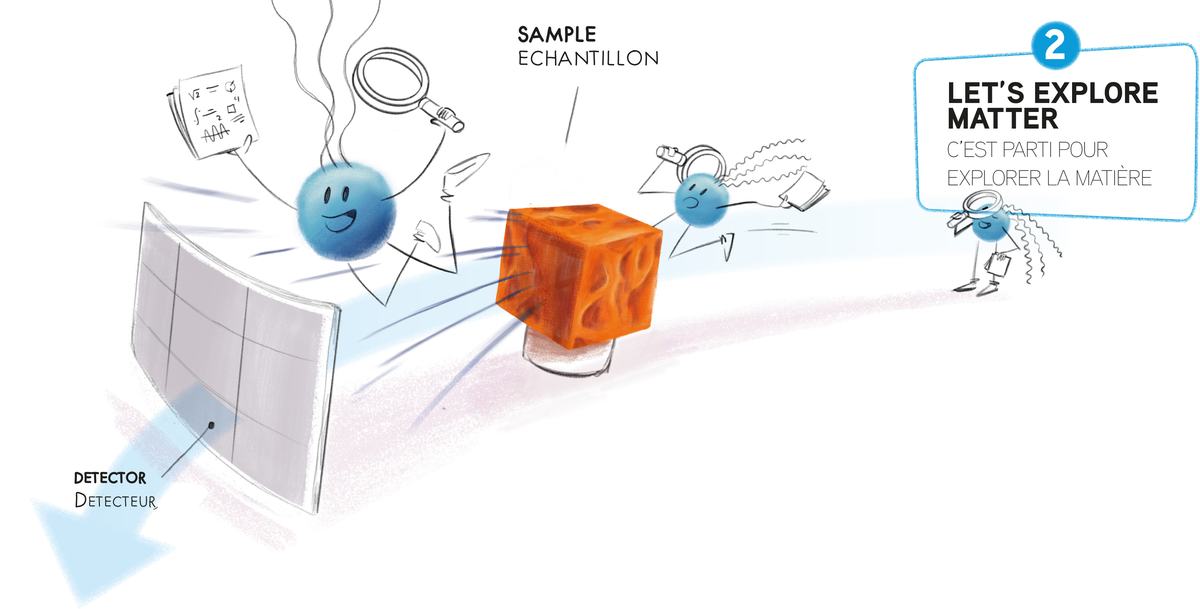
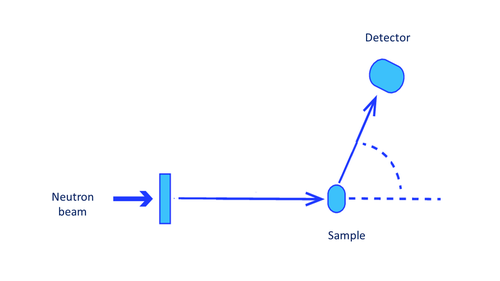
In neutron scattering experiments, scientists shine a beam of neutrons through the sample under study and investigate what comes out. This involves a long series of steps, each of them requiring sophisticated neutron technology.
The neutrons produced at the reactor core have to be slowed down (or moderated) and extracted into neutron guides, complex structures that bring them to the instruments. Scattered neutrons have to be recorded by neutron detectors whose working principles and configurations depend on the instrument, as does the neutron optics instrumentation for selection (according to energy or velocity), focusing and analysis.
The ILL is the world leader in neutron technologies, from neutron optics to detectors and sample environments, with technical know-how and capabilities that are unique in the world, and which benefit the neutron community and the neutron facilities at large.
Neutron scattering techniques
To obtain different types of information from neutron scattering, scientists use specialised instruments. The scattering off a sample can be elastic or inelastic. In elastic scattering, neutrons bounce off without their energy changing, but from the way they scatter it is possible to tell where the atoms are in the material. Elastic neutron scattering is very much used in neutron diffraction to study the structure of samples. In inelastic scattering neutrons may loose or gain energy when scattering off the sample, and this is measured to understand the dynamics of processes. This is at the basis of the functioning of neutron spectroscopy instruments.
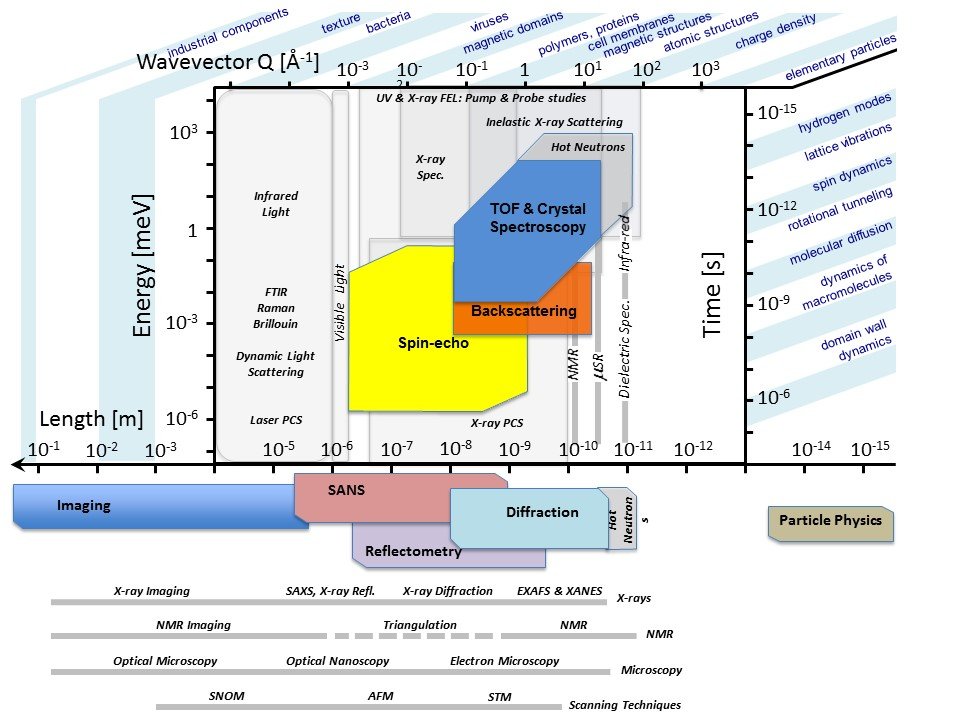
This figure shows the time and length (energy and wavevector) scales of the various neutron-based techniques (Courtesy: Ken Andersen). You can use it to identify the techniques which will best match your needs and then consult the list below to choose the appropriate instruments.
Neutron methods (cortesy K. Andersen)
Neutrons are useful in many fields of research
The way neutrons scatter off gases, liquids and solid matter gives us information about the structure of these materials (elastic neutron scattering). The neutron excitation of atoms gives information about the binding energy within matter (inelastic neutron scattering). Their ability to act as 'small elementary magnets' makes neutrons an ideal probe for the determination of structures and dynamics of exotic and novel magnetic materials. Heavy nuclei can be split with neutrons. This can shed light on a number of still unknown processes in atomic fission. Neutrons can also be captured by nuclei. The process releases secondary radiation which can be used to determine the inner structure of these nuclei.
The applications of neutrons scattering in condensed-matter physics, materials science and chemistry are immense. They range from the detailed study of the structure of new materials, in particular magnetic materials of relevance for the information technologies of the future, to numerous studies of relevance for the challenges related to the energy transition and to the environment - study of the recharging process in batteries, hydrogen storage in different materials, or of the characterisation more sustainable plastic materials.
In colloid research, neutrons give new information on such diverse subjects as the extraction of oil, cosmetics, pharmaceuticals, food industry and medicine.
Biological materials, naturally rich in hydrogen and other light elements, are ideal samples for analysis with neutrons: cell membranes, proteins, viruses, photosynthesis studies
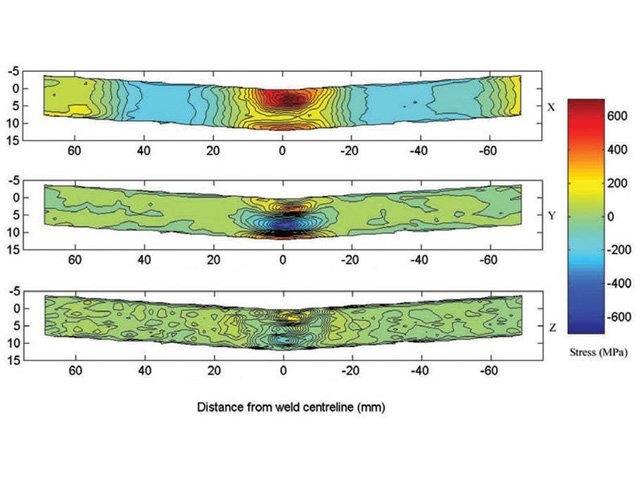
Since neutron diffraction is non-destructive, it is ideal for the engineering analysis of different phenomena in materials, in particular: visualisation of residual stress in materials (example: railway rails), hardening and corrosion phenomena in concrete, inhomogeneity and trace elements in materials.
As a nuclear reactor, the ILL neutron source is an ideal place for many studies and experiments on atomic fission and the structure of nuclei. And also for studying in detail the properties of the neutron itself, as well as of the neutrino (a product of the decay of the neutron). In particular, the development of sophisticated technology for the production of extremely slow neutrons (down to 5 m/s, while the velocity of the neutrons which leave the reactor is about 2200 m/s) enables groundbreaking experiments in particle physics.