

A new route towards smaller devices and ultrafast information processing
16 Jul 2026Polarised inelastic neutron scattering on IN20 directly revealed, for the first time, opposite-handed magnons in an altermagnet and showed that their chirality can be reversibly switched
-
 Quantum

Today’s electronics rely on electric currents, which generate heat as they move through ever-smaller circuits. This heat is becoming a major obstacle to making devices more compact and powerful. Researchers are therefore exploring another way to carry information: magnetic waves called magnons.
Some of these waves have a defined chirality, with atomic spins rotating clockwise or anticlockwise as the wave travels. These “chiral magnons” can transport spin information without an accompanying flow of electric charge, and thus less heating.
The challenge is to control these magnetic waves in materials that do not produce large stray magnetic fields, which could interfere with nearby components. This is why altermagnets, a newly recognised class of magnetic materials, are attracting attention: they could combine controllable ultrafast magnetic waves with better compatibility for densely packed devices.
Using polarised inelastic neutron scattering on IN20 at the ILL, researchers have for the first time seen these rotating magnetic waves directly inside an altermagnet. Moreover, they also showed that the direction of rotation can be switched by cooling the material in a small magnetic field.
This is the first unambiguous demonstration that chiral magnons in an altermagnet can not only exist separately, but also be controlled,an important step towards smaller devices and ultrafast spin-based information processing.
Looking beyond electric charge
As electronic devices become smaller and more powerful, heat is becoming one of their major limitations. Conventional electronics move information by moving electric charge, and part of that energy is lost as Joule heating.
This is why researchers have been exploring whether information could be manipulated in other ways. For example, information is stored in form of the direction of tiny magnets, called spins, a quantum property of atoms.
In magnetic materials, changes in the direction of these spins can travel as immaterialised waves, called magnons. Some magnons are chiral, meaning that the spins rotate with a well-defined clockwise or anticlockwise handedness as the wave propagates.
In chiral magnons, the direction in which the spins rotate is linked to the direction in which the wave travels. As chiral magnons propagate through a material, they transport spin angular momentum, creating what is known as a spin current, a transfer of spin information without an accompanying flow of electric charge. Such currents are central to spintronics, a field that aims to store, transmit and process information using spin rather than electric charge alone.
Thus, chiral magnons offer a way to transmit and process information over long distances with far less heating than conventional charge currents. But to use them in future devices, researchers must first be able to control their handedness reliably.
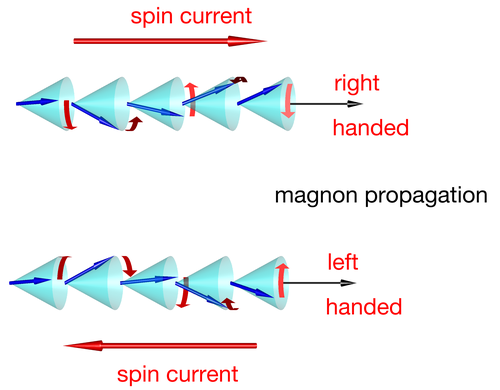
Figure 1. Right- and left-handed chiral magnons. The blue arrows represent atomic spins precessing as the magnon propagates through the material. In right- and left-handed modes, the spins rotate in opposite directions and therefore carry opposite spin angular momentum. The red arrows indicate the corresponding direction of the spin current.
Altermagnets: a promising novel type of magnetism
Until recently, chiral magnons were mainly associated with ferromagnets. In these materials, many spins align in the same direction, creating a net magnetisation whose direction can store an information bit, with two opposite orientations representing 0 and 1. This breaks time-reversal symmetry, meaning that reversing all the spins produces a genuinely different magnetic state. As a result, left- and right-handed magnons are no longer equivalent and their contributions do not simply cancel. However, the same net magnetisation produces stray magnetic fields that can disturb neighbouring bits and components, limiting how closely ferromagnetic elements can be packed.
Antiferromagnets avoid this problem because neighbouring spins point in opposite directions and perfectly cancel each other. As a result, they do not possess any stray magnetic field. Moreover, their exchange interactions between neighbouring spins are generally stronger, leading to much faster speed of the magnetic waves.
In many conventional antiferromagnets, however, time-reversal symmetry is effectively preserved. Meaning that reversing all the spins does not create a truly different magnetic state, because the original pattern can be recovered by shifting or inverting the crystal lattice. Left- and right-handed magnons therefore remain equivalent and balance each other, so no spin current is produced.
This is where altermagnets have generated excitement. Recently recognised as a distinct class of magnetic materials, they appear to combine some of the advantages of both ferromagnets and antiferromagnets. Like antiferromagnets, their neighbouring spins cancel, so they have no net magnetisation and avoid the large stray fields produced by ferromagnets. But their crystal symmetry is different and allows to break time-reversal symmetry: after reversing all the spins, the original magnetic pattern cannot be recovered by simply shifting or inverting the lattice, but only through a crystal rotation. This makes left- and right-handed magnons inequivalent, allowing them to separate in energy or momentum rather than remaining perfectly balanced and potentially generate a useful spin current.
Theory therefore predicted that altermagnets could combine ultrafast magnetic dynamics with minimal stray fields. Until now, however, the crucial feature a spin current, the magnon chirality, or direction of rotation, had not been directly observed experimentally.
First experimental observation of switchable magnon chirality in an altermagnet
Polarized neutron scattering made it possible to answer this question experimentally for the first time. An international research team studied MnTe, a prototype altermagnet, and directly observed separate magnons with opposite chirality.
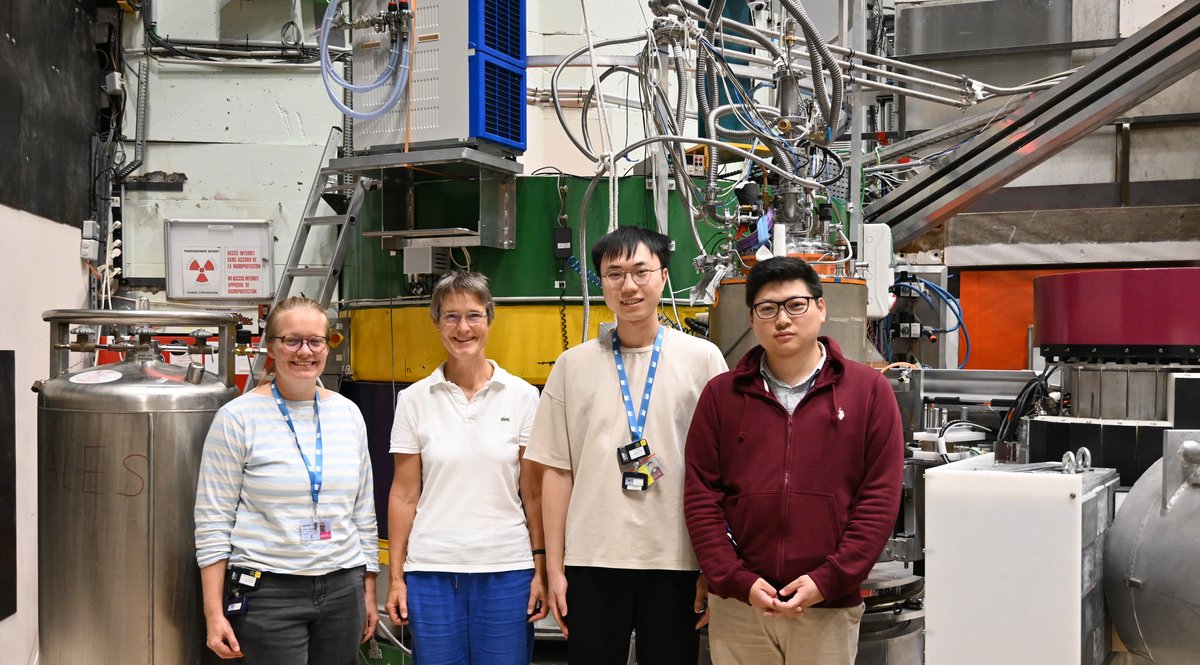
The team responsible for conducting the IN20 neutron-scattering experiments from left to right: Ursula Bengaard Hansen, Mechthild Enderle, Zheyuan Liu, Hodaka Kikuchi
Neutrons are especially well suited to this kind of measurement because they carry a spin of their own, making them sensitive to magnetism inside materials. In a polarized neutron experiment, researchers prepare the incoming neutrons with a chosen spin direction and measure how strongly they scatter from the sample. By comparing scattering intensities for opposite neutron spin directions, they can isolate the chiral part of the magnon signal, the part that reveals whether the magnons have a preferred rotation direction.
Full neutron polarisation analysis on IN20 at the ILL provided both the direct observation and the crucial demonstration of control. The measurements clearly resolved two separate magnon modes with opposite chirality. After cooling the material in small magnetic fields pointing in opposite directions, the researchers observed that the chiral signal of both modes reversed. This showed that the chirality of the magnon modes can be reversibly switched by magnetic field control.
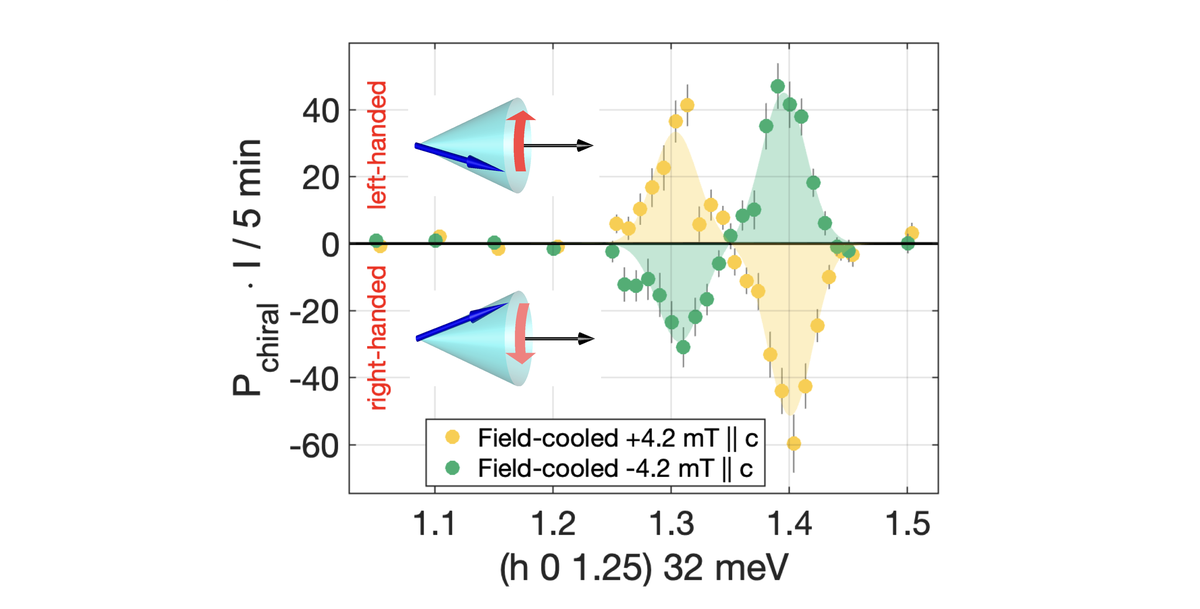
Figure 2. Reversible switching of magnon chirality. Polarised neutron measurements on IN20 show the chiral signal after cooling the sample in opposite magnetic fields: +4.2 mT (yellow) and −4.2 mT (green). Reversing the magnetic field applied during cooling reverses the sign of the signal for both magnon modes, demonstrating that their handedness can be switched between left- and right-handed states.
In other words, the neutron experiments on IN20 not only confirmed that separate chiral magnons exist in an altermagnet. They also showed that their chirality can be controlled, a key step towards future spintronic technologies based on altermagnets.
A new route for carrying information
These results confirm a key prediction of altermagnetism: altermagnets can host separate chiral magnon modes that can generate useful magnon spin currents without the large net magnetisation associated with ferromagnets.
Just as importantly, the study shows that this chirality can be manipulated. By reversing the magnetic field used during cooling, the researchers could reverse the chirality of the magnon modes. This means that altermagnets may offer not only magnons with a defined chirality, but also a way to control that chirality and that means reversing the direction of the spin current.
This matters because control is essential if magnons are to be used to carry or process information. In ferromagnets, such control comes with the drawback of stray magnetic fields. Altermagnets offer a different route: controllable ultrafast chiral magnons in materials with no net magnetisation.
The work establishes an important experimental foundation for future magnonic and spintronic technologies based on altermagnets.
Reference
Z. Liu, H. Kikuchi, Z. Wei, S. Asai, M. Enderle, U. B. Hansen, V. O. Garlea, M. D. Le, G. J. Nilsen, I. A. Zaliznyak and T. Masuda, “Observation of Switchable Chiral Magnons in an Altermagnet,” Physical Review Letters 136, 236705 (2026). DOI: 10.1103/m8lc-f8gk
ILL Instrument: IN20
ILL Contact Person: Mechthild Enderle
Institutions involved in the research: The University of Tokyo, Oak Ridge National Laboratory, ISIS Neutron and Muon Source, Brookhaven National Laboratory, High Energy Accelerator Research Organization