


The hidden role of water
16 Jul 2026How neutrons help decode ion transport membranes essential for energy transition devices.
-
 Energy
-
 Environment

Many devices that are central for the energy transition depend critically on materials able to efficiently transport ions. Improving the performance of this key component is thus critical to bridge the gap between promising sustainable energy technologies and their practical, large-scale applications.
Anion exchange membranes (AEM) transport hydroxide ions (OH⁻) between the cathode and anode while separating gases and maintaining the conditions required for efficient reactions. Optimising these systems requires a fundamental understanding of the relationship between membrane structure and ion transport under realistic operating conditions. However, a detailed microscopic description is lacking.
To address this challenge, researchers combined neutron scattering experiments with molecular simulations. They used four different neutron spectrometers at large scale facilities to probe complementary timescales. By connecting molecular-scale dynamics with macroscopic conductivity, this work provides a framework for designing improved membranes for fuel cells, electrolysers and other electrochemical energy technologies.

Bridging the gap: the need to go microscopic
Water electrolysers, splitting water into hydrogen and oxygen, are a key technology for green hydrogen applications; fuel cells convert chemical energy into electricity through clean process… these are just two examples of the variety of electrochemical devices that are central for the energy transition, all sharing a common point: they depend critically on materials able to efficiently transport ions. Improving the performance of this key component is thus critical to bridge the gap between promising sustainable energy technologies and their practical, large-scale applications.
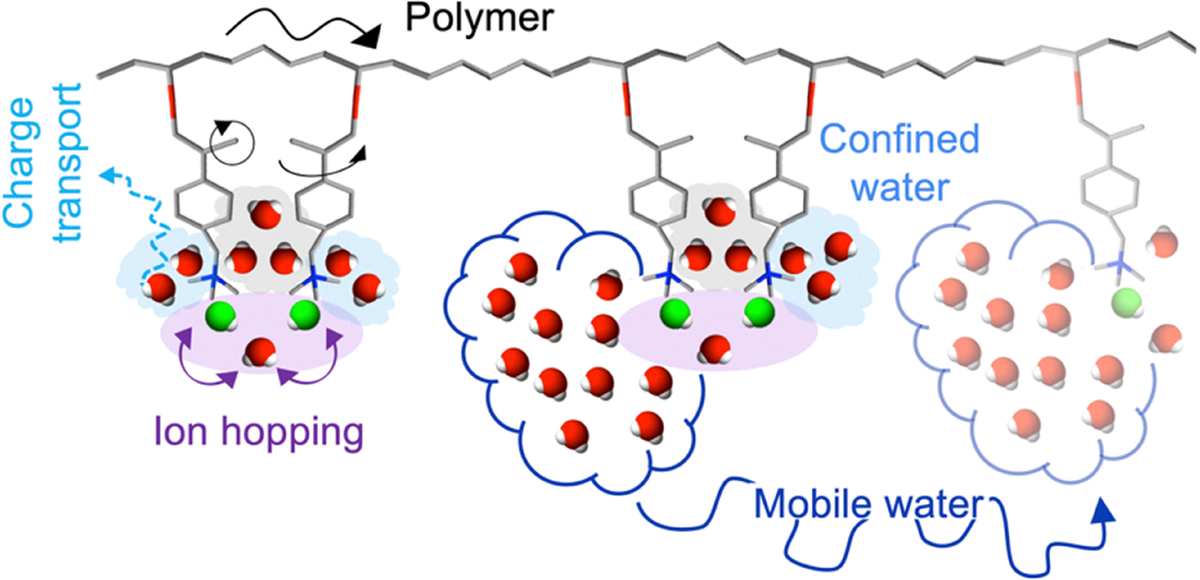
Anion exchange membrane (AEM) water electrolysers and fuel cells rely on membranes that transport hydroxide ions (OH⁻) between the cathode and anode while separating gases and maintaining the conditions required for efficient reactions. These membranes are made of a polymer backbone decorated with positively charged groups. When hydrated, they form networks of nanometre-sized water-filled channels through which ions can move.
While ion transport in dilute aqueous solutions is relatively well understood, transport inside confined environments remains a major scientific challenge. Within a membrane, ions do not simply diffuse. They interact continuously with surrounding water molecules and with the polymer framework that defines the transport pathways. Water interacts intimately with both the polymer backbone and the mobile ions. And ion size and charge density are known to critically influence the local structure and dynamics of water in polymeric environments.
Membrane performance is intrinsically governed by this complex interplay. Optimising these systems requires a fundamental understanding of the relationship between membrane structure and ion transport under realistic operating conditions. However, a detailed microscopic description of ion–water–polymer interactions is lacking.
Peering inside membrane with neutrons
To address this challenge, researchers combined neutron scattering experiments with molecular simulations. They used four different neutron spectrometers at large scale facilities to probe complementary timescales: SHARPER, the Léon Brillouin Laboratory spectrometer at ILL was used to investigate the picosecond timescales; LET and IRIS at ISIS (UK) provided information on molecular motions occurring over tens to hundreds of picoseconds; and IN16B at the ILL probed slower processes extending into the nanosecond range.
Neutron techniques are particularly powerful for studying hydrated membranes because they are highly sensitive to hydrogen, which is abundant in both water and the polymer. The multi-resolution quasi-elastic neutron scattering (QENS) approach allowed to separate different contributions to the membrane dynamics, including molecular rotations, ionic mobility and polymer relaxation. This provided a detailed picture of how the membrane components move and interact under different hydration conditions
The study compared the same membrane in two forms: with hydroxide ions (OH⁻) and with chloride ion (Cl⁻). Because the polymer itself remained unchanged, differences between the two systems could be attributed to the specific interactions between each anion and the surrounding water. To further isolate different contributions, membranes were studied using both normal (H₂O) and heavy (D₂O) water for hydration.
The very different sensitivities of neutrons to hydrogen and deuterium allowed the researchers to distinguish the dynamics of water from those of the polymer. The D2O-hydrated samples define the baseline associated with polymer dynamics under the various hydration conditions. Combined with molecular dynamics simulations and total scattering measurements, this approach revealed how the polymer, water and ions influence each other at the molecular level.
From water dynamics to better membranes
The results show that the efficiency of ion transport arises from the combined dynamics of three interconnected components: the polymer, the confined water and the transported ion. The polymer defines the environment, while the evolving water network controls how ions move within it. Water is shown to orchestrate ion mobility by forming ion-dependent hydrogen-bond networks that evolve with composition, temperature, and humidity, ultimately dictating membrane conductivity. These insights establish water not merely as a passive medium but as an active structural and transport agent.
The study also reveals dynamic coupling between polymer segmental motion and nanoconfined water species, as well as strikingly distinct hydration structures around OH− and Cl− ions. Hydroxide ions disrupt and dynamically restructure the surrounding water environment, enabling efficient proton transfer through flexible hydrogen-bond pathways, whereas chloride ions sustain a more ordered and static hydration structure that restricts transport. These contrasting behaviours persist across all hydration levels but become most pronounced under low-hydration conditions. Although the study focused on a specific type of membranes, similar behaviours were also observed in commercial membranes with different chemical structures.
By connecting molecular-scale dynamics with macroscopic conductivity, this work provides a framework for designing improved membranes for fuel cells, electrolysers and other electrochemical energy technologies. The common assumption that conductivity depends essentially on the hydration level and ion concentration is challenged. In fact, conductivity depends on how the polymer organises water and how that water interacts dynamically with the ions.
Reference: K. Smith, A.P. Periasamy, Q. Berrod, J.M. Zanotti, M. Appel, V. Garcia Sakai, A. Seel, T.F. Headen, B. Schwaighofer, D.J.L. Brett, T.S. Miller, C.D. Lorenz, J.R. Varcoe, S. Lyonnard, F. Foglia; The critical role of water structure in anion transport. Energy Environ. Sci. 2026; https://doi.org/10.1039/d6ee01258b
ILL instruments: IN16B, SHARPER
ILL Contact Persons: Markus Appel, J.M. Zanotti, Q. Berrod
Institutions involved in the research: University College London, ISIS Neutron and Muon Source, University of Surrey, Laboratoire Louis Brillouin (CEA - CNRS), Université Grenoble Alpes, Prosemino Lda.