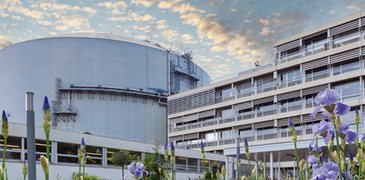
Reactor overview

ILL night large

Under its dome, the ILL operates the world’s most intense continuous neutron source: the High-Flux Reactor (HFR, known officially as Installation Nucléaire de Base n° 67), a nuclear research reactor designed to provide very intense neutron beams. The reactor operates 24 hours a day in cycles of approximately 60 days, delivering three cycles per year. Its core consists of a single fuel element of enriched uranium (almost 10 kg) cooled by heavy water (thermal power 58 megawatts).
Neutrons are produced by the fission of uranium nuclei. They can reach speeds of 20,000 km/second and must be slowed down (or moderated) for use in research. The ILL reactor comprises different sources that allow scientists to select different energy ranges.
The High-Flux Reactor has a modular structure that allows virtually all of its components to be replaced and upgraded. The replacement of the reactor vessel in 1995 has extended the technical life of the HFR until around 2060.

Contact

Email: reacteur@ill.eu

Recent news

Related pages
Page
Reactor cycles
2027 Cycle n°202 62 days 24/03 - 11/05/2027 43 MW* * including a 7-day contingency margin right at the start of the cycle. If restarting were to be delayed by 7 days, the reactor cycle would operate at 48.5 MW. Schedule details for future 2027 reactor cycles will be posted here 2026 Cycle n°199 48 d...
Page
Environment & Safety
A strong safety and security culture are fundamental principles for any nuclear facility. At the ILL, technical and organisational measures are implemented to reduce any risks to a level deemed acceptable. This constitutes the field of nuclear safety, which encompasses measures designed to:Ensure th...