


Move closer: understanding particle aggregation in solution
02 Nov 2026Exploiting the strengths of neutron scattering to understand how particles come together
-
 Health
Particles in solution can come close together to form larger structures, known as clusters. This clustering process is determined by both electrostatic attraction and repulsion. Understanding this delicate balance is essential in order to prevent clustering where it may impact the viscosity or functionality, for example in therapeutic formulations.
In a recent study performed on ILL’s small angle scattering instrument D22 and complemented by molecular dynamics
simulations, scientists were able to exploit fundamental properties of neutrons to investigate the behaviour of individual particles in solution. Their study revealed how the particles assembled into large molecular clusters with an inner core and an outer shell region. The particles were more condensed in the shell region and less so in the core owing to an interplay of attractive and repulsive forces, and, importantly, to the softness and deformability of the particles.
This study therefore provided valuable insights, on a tiny length scale, into the fundamental mechanisms behind molecular assemblies.

Why clustering matters
Particles in solution sometimes form so-called clusters - large assemblies held together by attractive forces. In solutions of therapeutic molecules such as antibodies, clustering can become a problem as it may alter the viscosity, the injectability and the bioavailability of pharmaceutical formulations.
It is known that the softness of the particles can determine the ways in which clusters form as well as their properties. Soft particles are able to “squeeze into one another” more easily (a phenomenon known as interpenetration), thereby forming very dense clusters. In addition, electrostatic forces - which are always present in real-life systems - between the particles are important to consider: while attractive forces bring particles close together, leading to even denser clusters, repulsive forces will drive particles apart and prevent clustering. The key to deciphering the balance between softness and electrostatics is understanding the behaviour of individual particles during the formation of clusters and how their shape, size or charge may change throughout the process.
Contrast matching: selective invisibility
Tracking individual particles within a solution of many can be a tricky mission. One technique particularly suited to do so is small-angle neutron scattering (SANS). In a SANS experiment, neutrons are directed at a sample - such as a solution of particles - and detected after being scattered by the sample. The resulting scattering pattern contains information about the shape and interactions of the particles.
A particular strength of neutrons is the massive difference in their sensitivity to hydrogen and its heavier “twin”, the isotope deuterium. This means that scientists can selectively “label” molecules with deuterium - which then allows them to closely follow the paths and behaviour of the labelled molecules, while hiding the signal of the unlabelled ones. This technique is known as contrast matching.
Neutrons on the hunt for individual particles
In a recent experiment carried out on ILL’s small-angle scattering instrument D22, a team of researchers elucidated the mechanisms behind clustering of so-called core-shell microgels. These are small molecular networks, the characteristics of which (such as size and electrical charge) can be easily adjusted during their synthesis. The description “core-shell” refers to the microgel structure: they can be visualised as slightly aged tennis balls, with the solid part of the ball representing the core and the fuzzy hair layer representing the shell. Once in solution, microgels can swell depending on the properties of the solvent used and are therefore of interest in a variety of research areas.
Using contrast matching, the scientists tracked down the behaviour of mostly negatively charged microgels in a solution containing a few positively charged ones - which were rendered invisible by deuteration. Their SANS experiments revealed that the microgels, which indeed assembled into larger clusters, underwent unexpectedly strong compression. This was especially true in the shell region, whereas almost no such compression was observed in the core.
As a reference, the team used a sample of negatively charged microgels, which behaved quite differently: here, the microgels were compacted in both their core and shell regions.
The compression in the oppositely charged microgels observed occurs for two reasons: first, the proximity of the microgels leads to the release of small ions, which increases the disorder of the system - a fundamental physical principle governing molecular interactions. Second, the microgels interpenetrate, which is possible due to their softness.
The results obtained by SANS were complemented by molecular dynamics simulations, which are particularly useful for providing information on very small length scales such as those of individual ions.
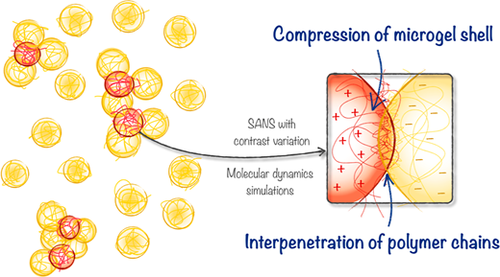
The data the scientists obtained thus provide precious insights into how both electrostatic repulsion and attraction can come together and create large molecular structures - notably, leaving their individual signatures in different regions of said structures. Importantly, their heterogeneously charged samples help provide insight into similarly heterogeneous and complex charged biomolecules such as proteins, making the research presented here applicable to biomedical samples.
By exploiting fundamental properties of neutrons, this experiment showed how softness, charge and deformability determines the three-dimensional arrangement of particles into larger structures.
This knowledge is highly valuable for the understanding of cluster formation in other systems, such as solutions of therapeutic molecules - and for finding ways to prevent clustering from interfering with molecule functionality.
Reference: Petrunin, Alexander V., Hannah F. Mathews, Tom Höfken, Philipp Leclercq, Ralf Schweins, Pablo Mota-Santiago, Stefanie Schneider, Andrij Pich, and Andrea Scotti. Compression and Interpenetration of Ionic Microgels in Electrostatically Self-Assembled Clusters. ACS nano (2026), DOI: 10.1021/acsnano.6c00724
ILL Instrument: D22
ILL Contact Persons: Ralf Schweins
Institutions involved in the research: Heinrich-Heine University, RWTH Aachen University, DWI - Leibniz Institute for Interactive Materials, Australian Nuclear Science and Technology Organisation, MAX IV Laboratory, Lund University