


When a frustrated magnet can’t decide how to order
29 Oct 2026Single-crystal neutron diffraction reveals competing forms of magnetic order in the kagome mineral clinoatacamite.
-
 Quantum

A simple triangle can be enough to throw magnetic order into trouble. When magnetic atoms are arranged on a network of corner-sharing triangles, they can find themselves in an impossible situation: neighbouring magnetic moments may prefer to point in opposite directions, but on a triangle they cannot all satisfy this preference at once. This phenomenon, known as magnetic frustration, can prevent a material from settling into a simple magnetic state and give rise to unusual quantum behaviours.
Clinoatacamite, Cu2Cl(OH)3, hosts a distorted kagome lattice, in which magnetic atoms form a network of corner-sharing triangles. It is closely related to herbertsmithite, one of the best-known candidates for a quantum spin liquid, an unusual state that has fascinated physicists for decades, in which spins remain strongly connected by quantum effects without settling into a conventional ordered pattern, even at extremely low temperatures. But unlike herbertsmithite, clinoatacamite develops long-range magnetic order below 18.1 K. Exactly what happens below this temperature has remained puzzling for decades, with different experiments appearing to give conflicting pictures.
Now, a combination of complementary measurements and single-crystal neutron diffraction, including measurements on D10 and D10+ at the ILL, has revealed a sequence of distinct magnetic states. The results show that distortion does not simply remove the magnetic frustration. Instead, different ways of organising the spins remain in competition and can even coexist over part of the temperature range.

Why triangles make magnetism complicated
The magnetic behaviour of a material originates from their atoms carrying tiny magnetic moments linked to a quantum property of their electrons called spin. One way to picture this is to represent each spin as a tiny arrow. In some materials, neighbouring spins can point in the same direction. In others, they prefer to point in opposite directions. The latter are known as antiferromagnets.
On a simple chain, this is straightforward: one spin can point one way, the next the other way, and the pattern can continue. On a triangle, however, satisfying two neighbours immediately creates a problem for the third. No arrangement can simultaneously satisfy all three interactions.
In a kagome lattice, where such triangles are linked together into an extended network, this problem is repeated throughout the material. Many different spin arrangements can therefore have very similar energies, making it difficult for the system to select a single state.
This is one reason kagome materials have become important in the search for quantum spin liquids, unusual states in which the spins remain strongly correlated but avoid conventional long-range magnetic order even at very low temperatures.
Herbertsmithite, ZnCu3(OH)6Cl2, is one of the most prominent candidates. Clinoatacamite belongs to the same family, but there is an important difference: its kagome network is distorted and additional magnetic copper ions lie between the kagome layers.
These differences have a profound effect on its magnetism. Unlike herbertsmithite, clinoatacamite does not remain magnetically disordered as it is cooled. Below 18.1 K, it develops long-range magnetic order. Exactly what this ordered state looks like, however, has remained unclear for decades.
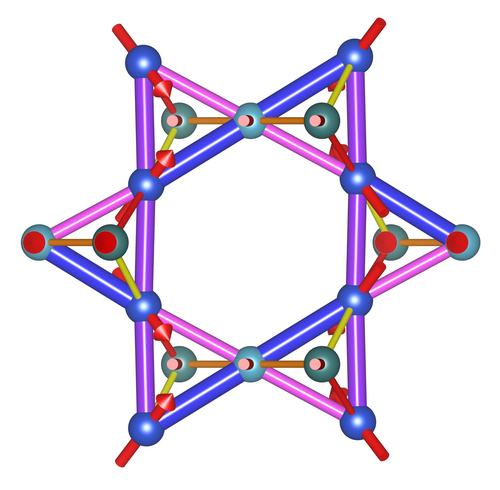
In a kagome lattice, where such triangles are linked together into an extended network, this problem is repeated throughout the material. Many different spin arrangements can therefore have very similar energies, making it difficult for the system to select a single state.
This is one reason kagome materials have become important in the search for quantum spin liquids, unusual states in which the spins remain strongly correlated but avoid conventional long-range magnetic order even at very low temperatures.
Herbertsmithite, ZnCu3(OH)6Cl2, is one of the most prominent candidates. Clinoatacamite belongs to the same family, but there is an important difference: its kagome network is distorted and additional magnetic copper ions lie between the kagome layers.
These differences have a profound effect on its magnetism. Unlike herbertsmithite, clinoatacamite does not remain magnetically disordered as it is cooled. Below 18.1 K, it develops long-range magnetic order. Exactly what this ordered state looks like, however, has remained unclear for decades.
A long-standing magnetic puzzle
Clinoatacamite has long been known to undergo a magnetic transition at 18.1 K. But earlier experiments did not agree on what happened below this temperature.
Measurements using muons, particles that act as very sensitive local probes of magnetism, indicated that long-range magnetic order sets in below 18.1 K. Yet neutron diffraction experiments on powdered samples detected the magnetic reflections associated with the known ordered state only below about 6 -7 K. Why should one microscopic probe detect long-range order at temperatures where another apparently did not?
The new study tackled this question using natural single crystals of clinoatacamite and several complementary techniques. Measurements of heat capacity, magnetic susceptibility and muon experiments confirmed that several magnetic changes occur as the material is cooled, but it was single-crystal neutron diffraction that revealed how the magnetic structure itself evolves.
Temperature-dependent measurements on D10+ at the ILL revealed magnetic reflections characteristic of one type of order between 18.1 and 6.4 K. Below approximately 6.4 K, a second set of magnetic reflections appears, corresponding to the low-temperature order seen in earlier powder experiments. Crucially, the two signatures coexist between roughly 6.4 and 4.6 K, before the higher-temperature one disappears.
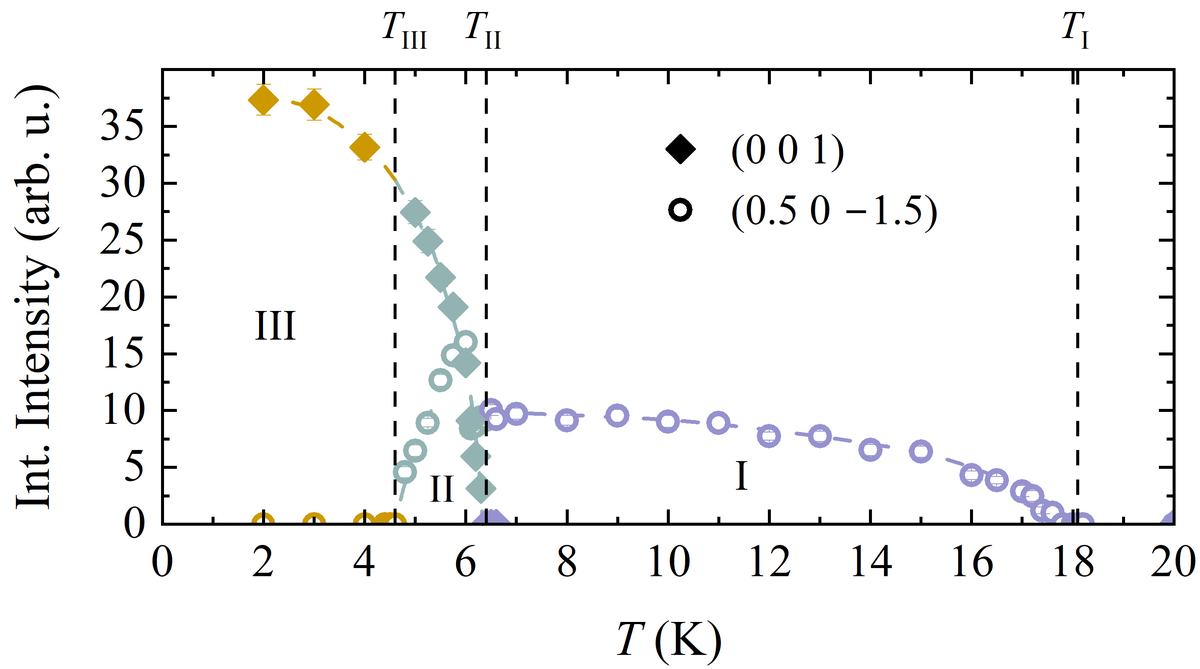
Figure 2. Three magnetic regimes in clinoatacamite. Temperature-dependent single-crystal neutron diffraction on D10+ follows two magnetic reflections that act as fingerprints of different forms of magnetic order. Their changing intensities reveal three regimes: one between 18.1 and 6.4 K, an intermediate region between 6.4 and 4.6 K where both magnetic signatures are present, and a low-temperature regime below 4.6 K. Dashed lines mark the boundaries between the three regions.
This resolves the long-standing disagreement between the earlier muon and neutron measurements: there really is long-range magnetic order below 18.1 K, but the form of that order changes with temperature.
Neutrons reveal frustration at another level
Resolving the three magnetic regimes answered the long-standing experimental puzzle, but it pointed to a deeper question: why does clinoatacamite pass through several different forms of magnetic order instead of settling into a single one?
An important clue comes from the lowest-temperature regime. Using D10 at the ILL, the researchers measured the magnetic diffraction pattern in detail at 1.7 K. Working with a single crystal allowed them to accurately measure several weak magnetic reflections that had been difficult to access in previous powder experiments.
The resulting structure revealed an important surprise. Even this ordered state cannot be described by one simple collective pattern of spins. Instead, it combines two distinct ways of organising the magnetism, known as magnetic ordering modes, which have different symmetries.
This provides a clue to the complex sequence of magnetic states observed as the material is cooled. In an ideal kagome antiferromagnet, frustration arises because many arrangements of individual spins can have similar energies. Distorting the lattice reduces this freedom and might therefore be expected to favour one particular form of order.
In clinoatacamite, however, the authors propose that the competition survives at another level. Different collective ways of organising the spins remain closely matched and can compete with or mix with one another. Physicists describe this situation, in which several possible ordered states are close to becoming stable, as multicritical. Their theoretical analysis suggests that the different symmetries of the two modes allow them to mix, potentially producing more complex, spatially varying magnetic textures.
The three magnetic regimes and the mixed character of the low-temperature state therefore point towards the same broader picture: distortion has not simply removed the frustration of the kagome lattice. Instead, it appears to have transformed it from competition between individual spins into competition between different ways for the whole magnetic system to order.
Reference
L. Stödter, C. Kastner, H. O. Jeschke, M. Reehuis, E. Chan, M.-H. Lemee-Cailleau, K. Beauvois, B. Ouladdiaf, F. Yokaichiya, F. Bert, T. J. Hicken, J. A. Krieger, H. Luetkens, J. L. Allen, R. Feyerherm, M. Tovar, D. Menzel, A. U. B. Wolter, B. Büchner, K. C. Rule, F. J. Litterst, U. K. Rößler, and S. Süllow, Competing Ordering Modes in the Distorted Quantum Kagome Material Clinoatacamite Cu2Cl(OH)3. Physical Review Letters (2026). DOI: 10.1103/xmh8-68vk
ILL Instrument: D10+
ILL Contact Persons: Marie Helene Lemee
Institutions involved in the research: Technische Universität Braunschweig, Jülich Centre for Neutron Science, Okayama University, Helmholtz-Zentrum Berlin, Université Paris-Saclay, Paul Scherrer Institute, University of Wollongong,
Leibniz Institute for Solid State and Materials Research, Technische Universität Dresden, Australian Nuclear Science and Technology Organisation