
More
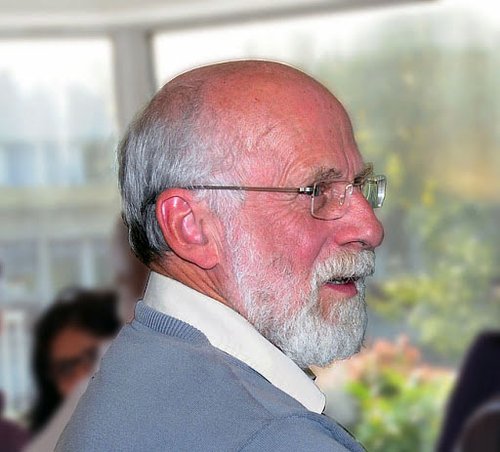
In 1988, the American physicist K.P. Coulter and collaborators [1] first showed that it was possible to polarise a polychromatic neutron beam by simple transmission/absorption through a polarised helium-3 filter.
At the same time, Francis Tasset set up a team and tested the Spin-Exchange Optical Pumping (SEOP) technique on D3 [2]. Disappointed by the results, Francis visited colleagues at ENS Paris and Univ. Mainz and decided to launch a project aiming at building the first Metastable-Exchange Optical Pumping (MEOP) filling station for the ILL. This station, called COW v, was assembled at Univ. Mainz and delivered to ILL in September 1996. Scheduled two months later on D3, the first experiment was a great success and the start of along series of progress [3]. At the time, the highest 3He polarisation was of 50% in the NSF cell and the production rate was of 0.4 bar.l/day.
Based on the experience gained with COW , the team led by Francis launched the construction of a second-generation MEOP station funded by UKRI in 2000. Two years later, this station, called TYREX, reached a 3He polarisation of 70% at an improved production rate. The team, led by E. Lelièvre-Berna then launched a 4-year EU upgrade programme during which they improved the optics, the cell production and the magnetostatic cavities required to maintain the 3He polarisation on the instruments. This effort democratised the use of NSF and allowed to reach 80% 3He polarisation. D. Jullien then designed, built and commissioned two MEOP stations called FLYNN for ISIS and ANSTO (2012) and the station TYREX-2 for ILL in 2023.
COW (1996) - TYREX(2002) - FLYNN (2012) - TYREX-2 (2023)
Two short movies show the historical experiments of 19
- the first spin filter was produced and then tested on the ILL neutron diffractometer D3
- 1st shedule experiment taking advantage of a 3He spin filter
References
1- Coulter K.P. McDonald A.B., Happer W., Chupp T.E., Wagshul M.E. (1988) Nucl. Instrum. Meth. Phys, Res., A270, 90-94. https://doi.org/10.1016/0168-9002(88)90013-7
2- F Tasset, TE Chupp, JP Pique, A Steinhof, A. Rhompson, E Wasserman, M. Ziade (1992) Physica B: Condensed Matter, 180-181, 896-898. DOI: 10.1016/0921-4526(92)90502-J
3- H. Humblot, W. Heil, E. Lelièvre-Berna & F. Tasset, Neutron News 8 (1997) 27. DOI: 10.1080/10448639708231997
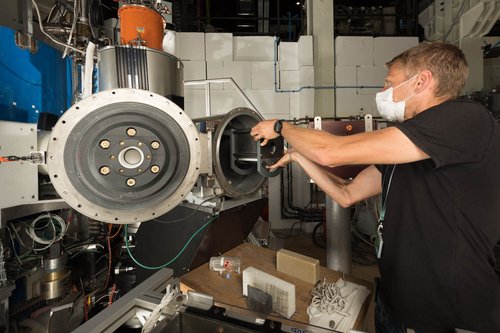
Benoit Mestrallet placing a freshly polarised 3He cell on D3, the Spin Polarised Hot Neutron Beam Facility. For the transport from Tyrex-2 to the instrument, the cell is placed in a special transport container with the suitable magnetic field to maintain the polarisation. Moving the cell from the container to its location on the instrument without losing the 3He polarisation requires trained operators.
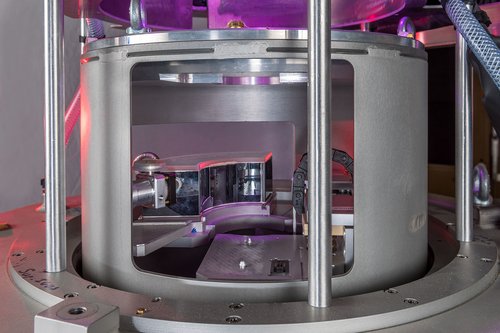
A close view of PASTIS3 installed on IN20, showing the 3He cell in position. PASTIS3 is the assembly which, on the TAS spectrometer, makes it possible to polarise and analyse the neutron beams.