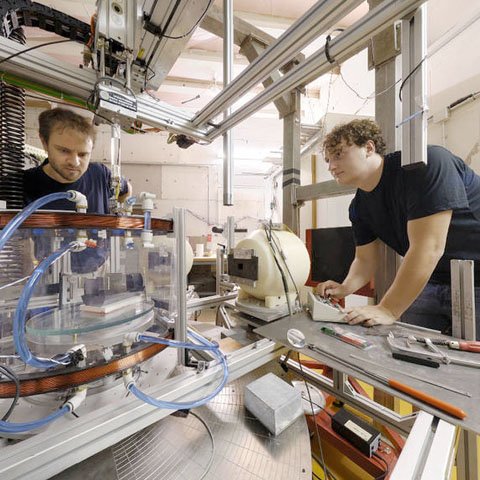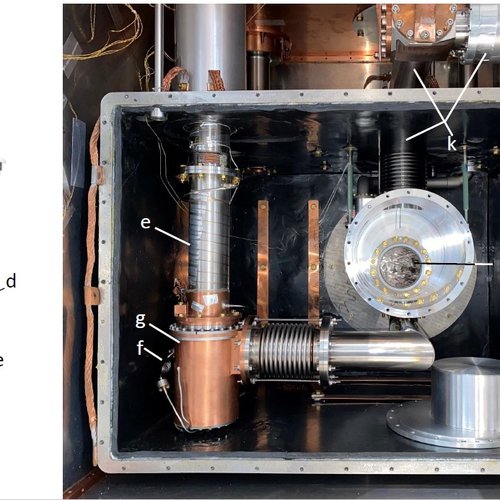
The ultracold neutron source SuperSUN is a density type, superthermal source using isotopically pure 4He at 0.6K as a convertor. The incoming cold neutron beam has a capture flux of about 1010 neutron/cm2^2/ s which is transformed into 3.8 × 10⁶ UCN measured at a reactor power of 48.6 MW at saturation. The instrument is used to address key questions of particle physics at the low-energy, high-precision frontier, complementary to experiments done at high-energy particle accelerators
Nuclear & Particle Physics
The Nuclear and Particle Physics (NPP) group operates several instruments/facilities scheduled in the user program: two instruments (PN1 - fission spectrometer "LOHENGRIN" and "FIPPS"- gamma-ray spectrometer) deal mainly with nuclear physics and applied nuclear physics aspects. Three other ones (PF1 - intense cold neutron beam facility, PF2 and SuperSUN - ultracold neutron facility) are covering mainly neutron particle physics aspects.
Additionally, the group has the responsibility of the thermal neutron interferometer (S18), operated as a CRG instrument, and of the RICOCHET collaboration instrument, installed at the ILL.
The film was displayed at the American Physical Society conference in March 2017.
NPP Instruments
The CRG instrument S18 is a perfect crystal neutron interferometer which can also be configured as a high resolution Bonse Hart camera. This instrument can be used for precise measurement of neutron scattering lengths and for basic neutron quantum optics studies and related phenomena. Applications: neutron interferometry, measurement of basic quantum physics laws; measurement of neutron-nuclei scattering lengths; quantum contextuality; decoherence; dephasing and depolarisation experiments; experiments with non-classical neutron states.
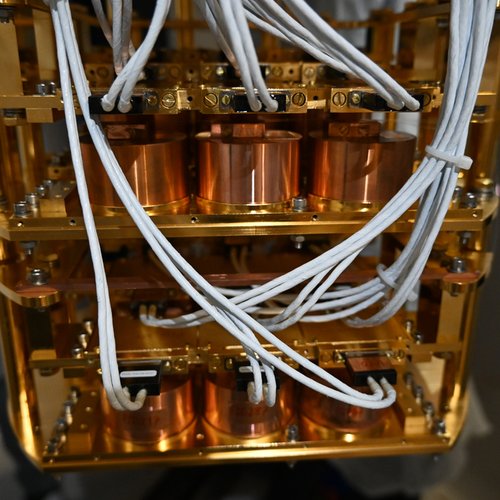
RICOCHET is an international collaboration aiming to explore the Coherent Elastic Neutrino-Nucleus Scattering (CeνNS), a long-predicted interaction that was observed experimentally only in 2017. A precise measurement of the nuclear recoil spectrum for reactor neutrinos, where the process is fully coherent, could reveal deviations from the Standard Model of particle physics, potentially unlocking the door to new physics. The RICOCHET experiment is installed at the ILL only 8.8 meters away from the core of the High Flux Reactor. This proximity provides an intense neutrino flux of approximately 10¹² neutrinos/cm²/s, ideal for studying CEνNS at low (sub-keV) recoil energies.
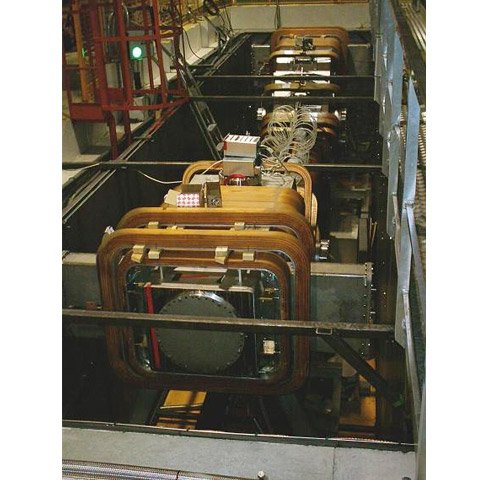
The main directions of research on PN1 were in the past centered around studies of the fission process but are now more and more concentrated on spectroscopy of very neutron rich nuclei. To this purpose two Germanium Clover detectors and ancillary detectors were purchased in the M0 phase of the Millenium project. The recoil mass separator for unslowed fission products LOHENGRIN uses fission products originating from a source of fissile isotopes placed in a beam tube (H9) near the core of the reactor. Specific fission products are selected by a combination of a magnetic and an electric sector field whose deflections are perpendicular to each other. The freely recoiling fission products are analyzed according to their energy over ionic charge (E/q) and mass over ionic charge (A/q) ratios.
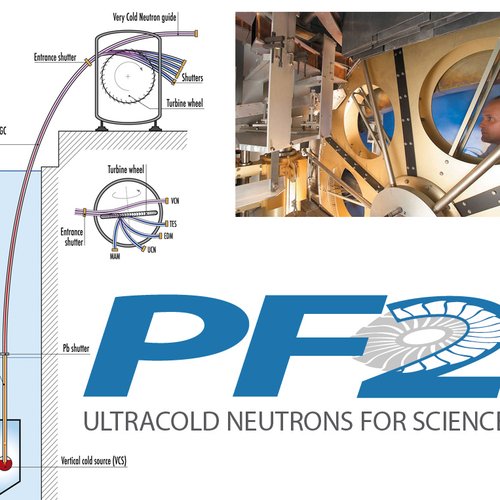
The ultracold neutron facility PF2 was built by TU Munich in collaboration with ILL. It provides a density of 50 cm^-3 of ultracold neutrons (UCN) with speeds less than 6 m/s. UCN are produced at the top end of a vertical guide where neutrons with speeds of 50 m/s are converted by the so-called Steyerl turbine into UCN. The UCN are then led by horizontal guides to several experiments in parallel. There is also an output for very cold neutrons (VCN) with a wavelength of 100Å. The fact that neutron are electrically neutral makes it possible to store UCN in traps. The majority of the measurements carried out at PF2 use this feature. Recent experiments concerned - amongst others - the measurement of the neutron lifetime, the measurement of the neutron electric dipole moment and the study of "anomalous losses" of stored neutrons.
Installed at the end position of the cold ballistic supermirror guide H113, PF1B provides the strongest polarised and unpolarised cold neutron beam in the world currently available for particle and nuclear physics (2x10^10 neutrons/(cm^2.s); the guide cross section is 6x20 cm^2).
It is the simplest but most flexible instrument at the ILL. Some of the experiments just use its neutron beam, other profit from its many devices needed to polarise, form, characterise, shield or remove the neutron beam. Recent experiments comprise measurements of neutron decay asymmetry coefficients and of properties of the neutron, studies of asymmetries in neutron capture reactions and neutron induced fission, nuclear spectroscopy of fission products, and measurements of fission cross-sections and yields of ternary particles in fission.
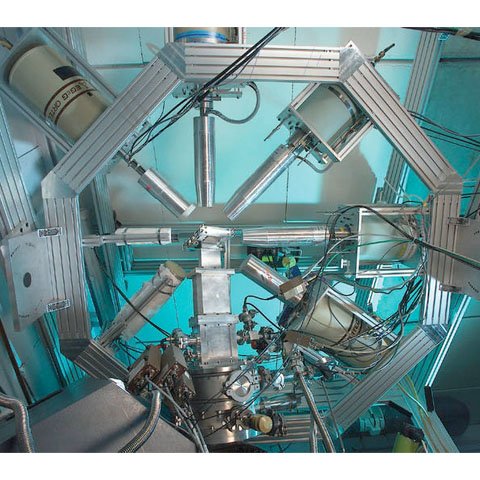
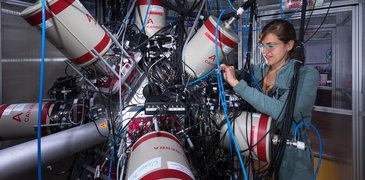
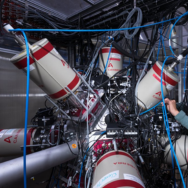
FIPPS is ILL's gamma-ray spectrometer for thermal-neutron-induced reactions. It is composed of a highly collimated halo-free pencil neutron beam impinging on a stable or radioactive target surrounded by a high resolution high-purity germanium detectors array. It is used for: studies of the fission process of heavy elements and of the structures of neutron rich matter; level densities as input for astrophysical calculations; search for doorway states for populations of long-lived isomers with medical applications by photo-excitation; precise knowledge of fission yields and decays of fission products; development of future nuclear reactors, fuel breeding schemes and nuclear waste transmutation.