

FASEM school at ILL: training on neutron and photon science for energy materials
05 May 2026The ILL recently hosted the third edition of the French Swedish Academy for Scattering Experiments and Modelling (FASEM), an advanced training school dedicated to early-career researchers working with neutron and photon techniques.
The French Swedish Academy for Scattering Experiments and Modelling (FASEM) is a biennial initiative designed to equip young scientists with both experimental and modelling skills across three key domains: environment and materials, life sciences, and energy applications. By bringing together participants from diverse scientific backgrounds, the programme fosters interdisciplinary approaches and promotes the effective use of large-scale research infrastructures. The initiative also contributes to strengthening long-term scientific exchanges between the French and Swedish research communities, particularly around major facilities such as ILL, ESRF, ESS and MAX IV. The FASEM format is strongly supported by the French Embassy and the Institut Français in Sweden.
The 2026 edition attracted strong international interest, with more than 150 applications received, reflecting the growing global reach of the programme. Thirty participants were selected to attend on site, while 50 more joined remotely. Applicants came from a wide range of countries, including emerging scientific communities, underlining the importance of accessible, high-level training opportunities in this field. This year marked the first time the school was held at ILL in Grenoble, under the local coordination of Peter Fouquet (instrument scientist and head of the ILL Graduate School) in close collaboration with Christine Darve (senior scientist at the European Spallation Source, ESS), who coordinates the FASEM schools.
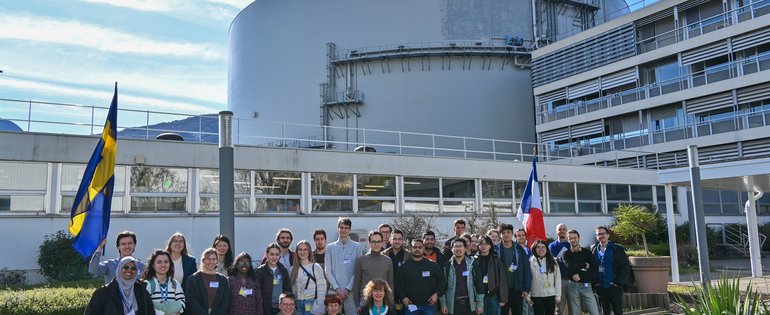
Christine Darve with the FASEM2026 participants.
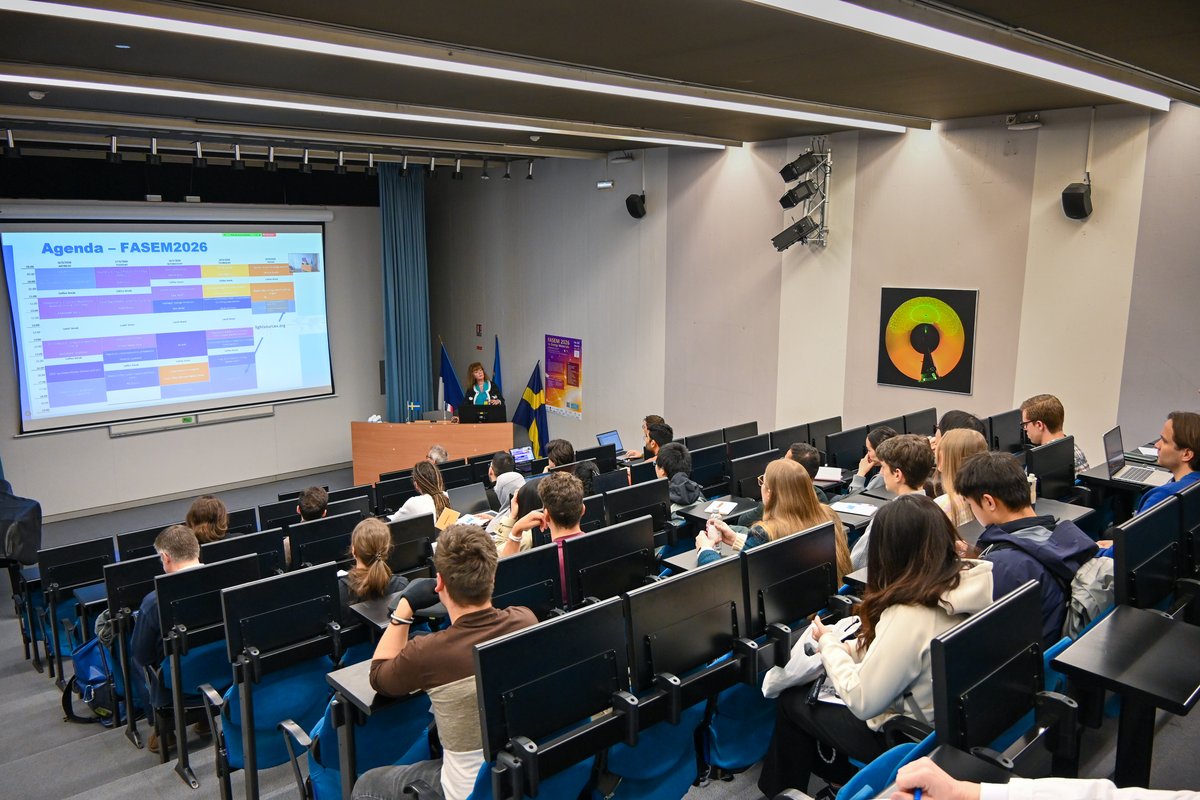
The scientific programme focused on energy-related materials while maintaining a broad overview of neutron and photon scattering techniques. Participants were introduced to methods such as imaging, diffraction, spectroscopy and small-angle scattering, alongside sessions on data processing and AI-assisted analysis. The programme also addressed the broader research landscape, including industry engagement, career development and the socio-economic impact of large-scale facilities. A key highlight of the week was the opportunity for participants to experience large-scale infrastructures first-hand. Guided visits to both the ILL and the ESRF (European Synchrotron Radiation Facility) allowed students to engage directly with instrument scientists and gain insight into experimental environments.
Beyond technical training, FASEM places strong emphasis on community building and networking. Through lectures, discussions and informal exchanges, participants developed connections that are expected to support future collaborations and scientific careers. “Through FASEM we support knowledge transfer, build networks, and help prepare the next generation of users of neutron and photon facilities,” says Christine Darve, adding: “It is also a unique opportunity to interact with and mentor young researchers.” Peter Fouquet highlights the importance of diversity within the programme: “Bringing together participants from different countries and backgrounds enriches the learning experience and helps them develop the skills needed for collaborative research and competitive project proposals.”
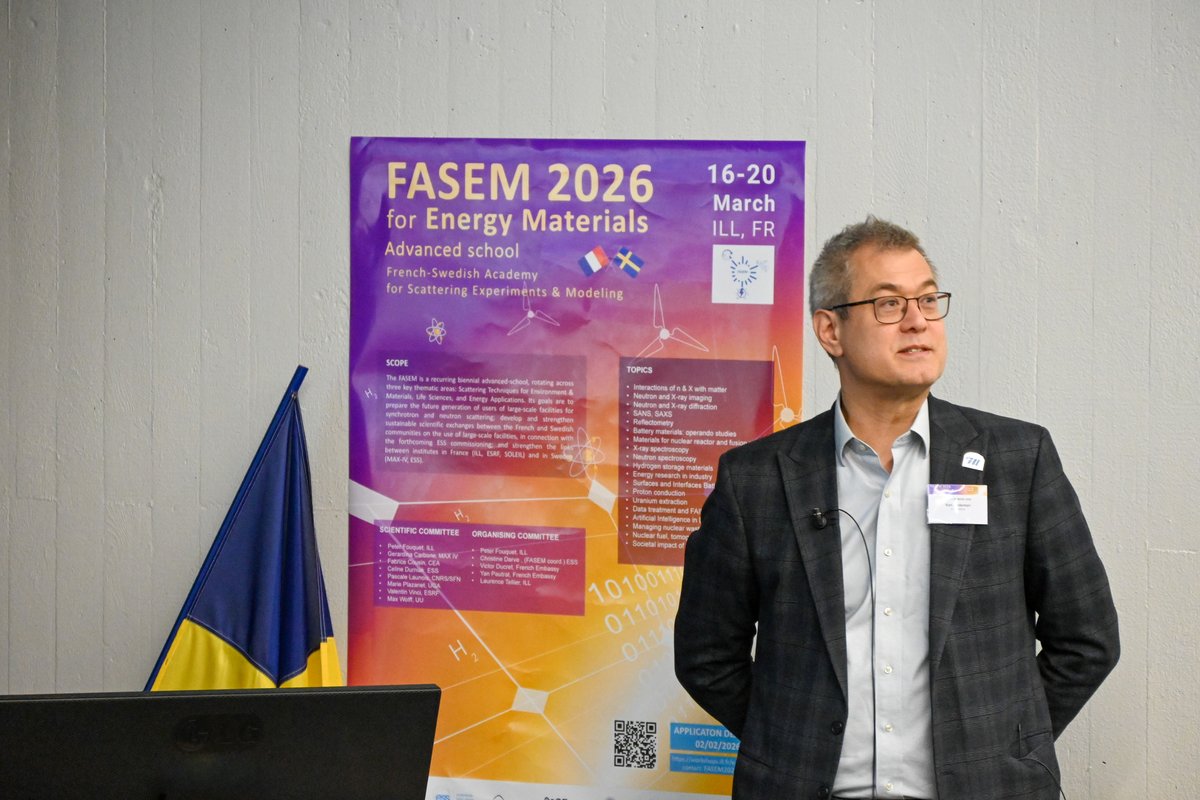
Ken Andersen, ILL director, at FASEM2026
Feedback from participants reflects both the scientific value and the collaborative atmosphere of the school. Many highlighted the benefit of gaining a broad overview of complementary techniques and a better understanding of how to design robust experimental strategies. “At this early stage of my PhD, the lectures not only prepared me for future experiments but also broadened my perspective on how to approach scientific challenges,” says Erika Magnusson from the Chalmers University of Technology (Sweden). Others emphasised the practical relevance of the training: “The course gave me the tools to better interpret scattering data and think about how to integrate these methods into my own research,” notes Marcus Liljenberg (KTH / PowerCell, Sweden). For Juliana Avtarovski (University of Wollongong, Australia), the experience was equally valuable from a networking perspective: “It was an incredible week meeting peers from around the world and discovering techniques that I will use in my future work.”
By combining high-level scientific training with international collaboration, FASEM complements existing initiatives such as the HERCULES school and contributes to strengthening the long-term expertise of the neutron and photon user community.