This website is being migrated. In case you don't find the information you are looking for, the old website can be found here. Thank you for reporting any anomalies to communication@ill.eu.

News

251010_ _Dir_Eur_AURA 01.jpg
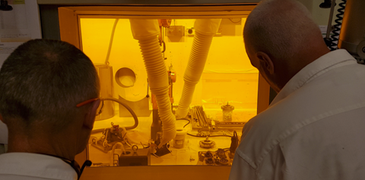
Oct. 21, 2025 €1.8 million invested to modernise two key instruments for European research
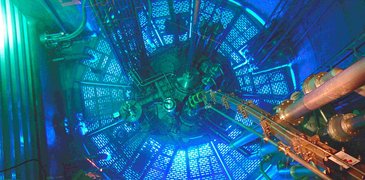
The ILL strengthens its research capabilities by modernising two key instruments (D11 and NeXT-MoTo) to address major challenges in health, energy transition and sustainable technologies. Supported by the Auvergne-Rhône-Alpes Region and the European Union, this project represents a €1.8 million investment under the CPER EPN 2030 (State-Region Plan Contract).
Vue ILL.jpg
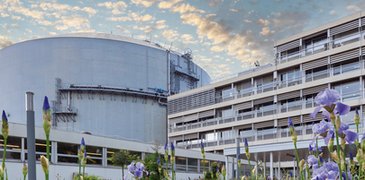
May 25, 2025 Green light to extend ILL operations until 2033
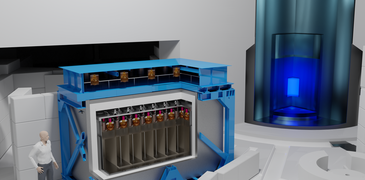
The ILL has just received a firm commitment from its Associate countries, France, the UK and Germany, to continue operation until 2033. “We have been working very hard to secure a unanimous commitment from all three Associate countries and are delighted with the decision,” says ILL Director, Ken Andersen, “The ILL is now in a position to plan scientific operation until the end of 2033.”
219x288mm_plastic_water__cover_4.png
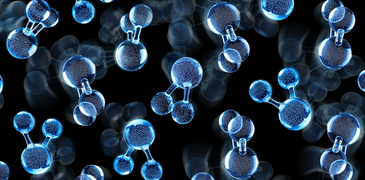
Feb. 12, 2025 Exotic observations at the ILL
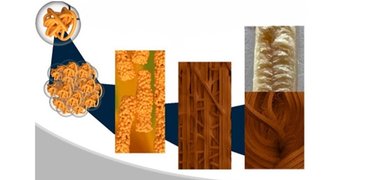
In everyday life, we typically encounter water in one of three familiar states – solid, liquid or gas. But there are in fact many more phases, some of which – predicted to exist at high temperature and pressure – are so strange they’re referred to as exotic. State-of-the-art neutron spectrometers and sample environment infrastructures at the Institut Laue-Langevin (ILL) have enabled the first experimental observation of one of these exotic phases – plastic ice VII.
molecular_moonlander_1.jpg
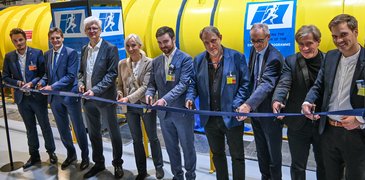
April 11, 2024 A molecular moonlander: insight into molecular motion on surfaces at the nanoscale
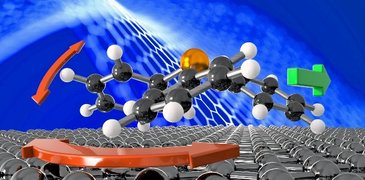
Using neutron spectroscopy data taken at ILL, researchers achieved a novel understanding of molecular movement at the nanoscale, providing new insights that may impact the design of future materials and technologies. The study has just been published in the Nature Portfolio open access journal Communications Chemistry – and is featured (as a banner) on the journal homepage.