


Going glassy
22 Oct 2026A novel type of material allows for unprecedented neutron-driven insights into its magnetic and structural properties.
-
 Quantum
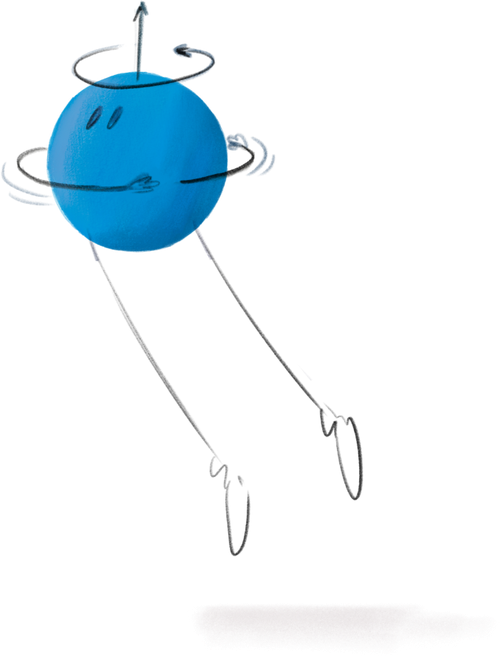
Glass is an omnipresent, yet surprisingly simple material. On a molecular scale, common glass is a disordered molecular structure consisting mainly of silicon dioxide. This simplicity limits the application potential of glass, making the development of novel types of glasses an important research area.
Recently, scientists have succeeded in attributing glassy properties - i.e., molecular disorder - to so-called metal organic frameworks (MOF). These structures, consisting of interconnected organic molecules and metal ions, are appreciated for their porous and usually ordered molecular structure which makes them great candidates in the area of, for example, catalysts. Introducing disorder into MOFs, thereby making them glass-like, opens novel application areas, in particular if these new materials are also magnetic. Until now, a detailed study of their magnetic structure was, however, impossible due to the presence of magnetic impurities.
A new synthesis route developed by an international research team allowed to obtain magnetic MOF glasses without such impurities. This enabled experiments aimed at characterising their magnetic structure using neutrons at the ILL - and exploiting the unique capabilities of neutrons - behaving like tiny magnets themselves - in the study of magnetic samples.

A new type of glass
Glasses are interesting materials: while hard and rigid, they lack the organised, repeating atomic structure of crystalline substances. They are found everywhere in our lives - from dishes to decoration to, importantly, windows which allow for natural illumination of living spaces. Typical glasses are rather simple substances, often with silicon dioxide (SiO2) as their principal component. This simplicity, while serving many purposes, limits their physicochemical properties and areas of application.
Metal organic framework (MOFs) - the development of which was rewarded with the Nobel Prize in Chemistry in 2025 - are hybrid substances made of interconnected organic molecules and metal ions. Their porous, ordered nature makes them particularly attractive as catalysts or storage material. Interestingly, recent research has shown that MOFs can also be disordered (amorphous) on the atomic scale, thus incorporating a key aspect of glasses. MOF glasses have been gaining increasing attention due to their large chemical versatility and increased application potential including sensors, batteries and catalysts.
Some MOFs have been predicted by theory to be so-called amorphous antiferromagnets. In addition to a lack of order on the atomic scale, this means that they can have magnetic moments, which align in an antiparallel fashion - making their overall magnetisation zero under normal conditions and thereby fulfilling the definition of antiferromagnetism. These properties further increase their chemical and application diversity.
Just like regular glasses, MOF glasses can be produced by rapidly cooling (quenching) a crystal-like material to low temperatures. The main issue with this process is that it can trigger chemical reactions which may introduce impurities into the final glass. This is particularly problematic when the glass contains elements such as iron, the atoms of which carry tiny magnetic moments. Importantly, these impurities also interfere with investigations of the MOF glasses - to an extent where, until recently, it was not possible to study them using neutrons and to obtain insights into their magnetic properties.
Cleaning up impurities
Scientists from Spain and the UK worked around this problem with great success by coming up with a new way of producing MOF glasses. Their synthesis route does not involve a molten precursor nor quenching - rather, they use chemical linkers (small organic molecules) to trigger a one-step reaction giving rise to a MOF glass. Since this novel process does not come along with any unwanted chemical reactions, the resulting glass does not contain any impurities.
This success allowed the team to perform, for the first time, high-quality neutron studies on MOF glasses. They performed these experiments on ILL’s diffractometer D20 to study the magnetic properties of an iron-containing MOF glass. Such studies are possible due to one particularly valuable property of neutrons: their own magnetic moment, which allows them to interact with and provide information on the magnetic structures of magnetic materials.
Order, disorder and neutrons
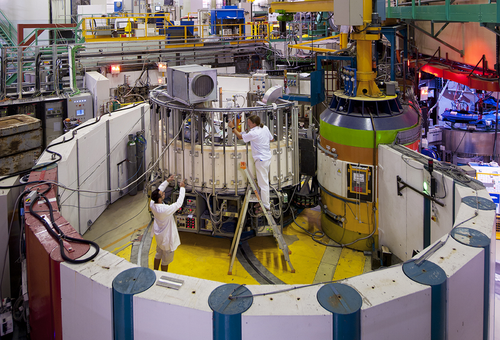
Thanks to these experiments, the team revealed magnetic correlations with a characteristic length scale in the MOF glass they studied. This length scale corresponds to the short distances between the iron atoms contained in the glass. Contrarily, no long-range order was observed in the material. These findings allowed them to classify the glass, in addition to being antiferromagnetic, as overall “amorphous” (i.e., without order), but with a local order preserved around each iron atom.
This study demonstrates how a physico-chemical approach can turn a long-standing challenge into a valuable opportunity - and obtain crucial information on a novel type of material. By exploiting the inherent physical properties of neutrons, these results pave the way towards even more insights into the fascinating world of MOF glasses, with the goal of further enhancing their application potential.
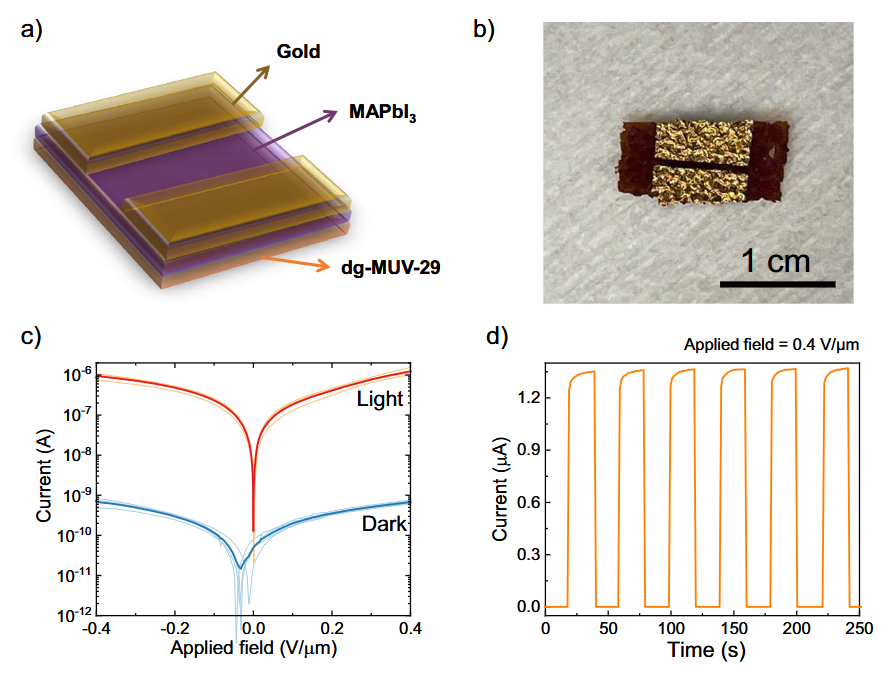
Simple proof-of-concept photo-detector in which a glassy MOF film is used as substrates, and results of the first tests. This study broaden the scope of potential applications and paves the way for future research areas.
Reference: León-Alcaide, L., Martínez-Goyeneche, L., Sessolo, M. et al. Direct synthesis of an iron metal-organic framework antiferromagnetic glass. Nat Commun 16, 8783 (2025). https://doi.org/10.1038/s41467-025-63837-w
ILL instrument: D20
ILL contact: José Alberto Rodriguez Velamazán, Oscar Fabelo