An intricate dance of order and instability
09 Oct 2026Neutron measurements reveal how calcium brings SrTiO3 closer to a nanoscale modulated state while strengthening its other lattice instabilities.
-
 Quantum

Strontium titanate (SrTiO₃) has unusual electrical properties that make it important both for fundamental research and for electronics. At low temperatures, it has a very large dielectric response, a property that allows materials to store electrical charge efficiently when used in electronic components.
This remarkable electrical response is closely connected to the fact that SrTiO₃ sits very close to becoming ferroelectric. In a ferroelectric material, small shifts of positive and negative charges create electric dipoles that line up, giving the material an overall electric polarization. As pure SrTiO₃ is cooled, it comes increasingly close to this ordered state, yet the ferroelectric transition never fully takes place. Understanding why has been the subject of extensive research since its discovery decades ago.
Recent studies have pointed to another possible piece of this puzzle: fluctuations of the electric polarization can couple to distortions of the crystal lattice, favouring a nanoscale pattern in which the two vary together across the material rather than remaining uniform.
In this study, researchers used inelastic neutron scattering on IN12 and ThALES at the ILL to see how this tendency changes when small amounts of calcium are added.
By following the vibrations of the crystal, they found that cooling makes the material increasingly prone to this ripple-like pattern. Adding calcium strengthens the effect even further. However, the pattern never becomes permanently static in the crystal.
At the same time, calcium stabilises ferroelectricity and strengthens another structural distortion already present in SrTiO₃. The results therefore show that these different tendencies develop together rather than competing. Understanding how they are connected could ultimately help researchers tune the behaviour of this and related materials through changing their coposition or other external parameters.
A material poised between several forms of order
Strontium titanate (SrTiO3) is a model material for studying how different forms of structural order emerge and interact. Its interest comes from the fact that the crystal lies close to several lattice instabilities: subtle rearrangements of the atoms that can lead to new states of the material.
Two of these are well established. The first is a structure in which the TiO6 octahedra that make up the crystal rotate in alternating directions. This is known as an antiferrodistortive transition.
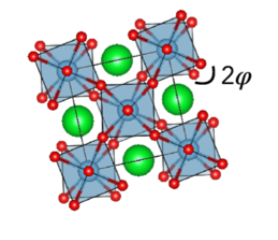
Two of these are well established. The first is a structure in which the TiO6 octahedra that make up the crystal rotate in alternating directions. This is known as an antiferrodistortive transition.
The second is a tendency towards ferroelectricity. In a ferroelectric material, positive and negative charges shift slightly relative to one another, creating electric dipoles that align collectively and produce a spontaneous electric polarization. In pure SrTiO3, these dipolar fluctuations become increasingly strong as the material is cooled, but they never settle into long-range ferroelectric order. This unusual regime, known as quantum paraelectricity, was identified nearly five decades ago, yet understanding why ferroelectric order is avoided in SrTiO3 remains an active question.
This is not only of fundamental interest. At low temperatures, SrTiO3 has a very large dielectric response, allowing it to store electrical charge very efficiently. Understanding the origin of this behaviour could therefore also help in tailoring materials for electronic applications.
Replacing some strontium atoms with calcium changes both tendencies. Adding even a very small amount of calcium changes this balance: above about 0.18% Ca, ferroelectric order appears, while the antiferrodistortive distortion is also strengthened.
More recently, experiments have suggested that SrTiO3 is also close to a nanoscale modulated state, in which the electric polarisation is coupled to distortions of the crystal lattice. In such a state, the electric polarisation and the accompanying distortion of the crystal would not be the same everywhere. Instead, they would vary in a repeating pattern through the material, rather like very fine ripples on water, over distances of around 15 nanometres - tiny on an everyday scale, but extending across many atomic spacings within the crystal.
This led to the central question of the study: how does this nanoscale modulation interact with the other instabilities already present in SrTiO3? In particular, does the emergence of ferroelectricity weaken this modulated tendency, as expected from theory, or do the different forms of order develop together?
Neutrons reveal how the instabilities grow together
The experiments showed that the different instabilities develop together. As more calcium is added, ferroelectricity and the antiferrodistortive distortion become stronger and so does the tendency towards nanoscale modulation.
To uncover this connection, the researchers studied vibrations of the crystal lattice using inelastic neutron scattering on IN12 and ThALES at the ILL. Atoms in a solid are constantly moving around their positions though forces that act somewhat like springs, and these collective vibrations propagate through the material as waves known as phonons. If a particular collective motion becomes easier as the material is cooled, the corresponding phonon softens, meaning that less energy is needed for the atoms to move in that specific pattern. This tells researchers that the crystal is becoming increasingly susceptible to that type of structural rearrangement.
They tracked how the crystal’s vibrations changed as the material was cooled and as more calcium was added. Upon cooling, one particular phonon became much softer, and the softening was strongest at a specific wavelength, a sign that the crystal is developing an increasing tendency towards a nanoscale modulated state.
With calcium substitution, the phonon softening became even stronger and the characteristic length of the modulation decreased from about 15 nanometres in pure SrTiO3 to around 10 nanometres in the calcium doped samples. Yet the modulation never settled into a permanent ordered structure. The material therefore moves closer to a nanoscale modulated state without fully entering it.
At the same time, calcium strengthens both ferroelectricity and the antiferrodistortive distortion. The fact that the modulated tendency becomes stronger alongside them shows that the three instabilities are closely intertwined and develop together rather than compete.
More broadly, bringing these three instabilities into a single picture provides a framework for understanding some of the unusual properties of SrTiO3. Knowing how they depend on one another also opens possibilities for tuning the material’s functionality, for example through doping or other external parameters. Similar couplings between lattice strain and other forms of order may also be important in other quantum materials.
Reference
Fauqué, B., Chaney, D.A., Bourges, P., Raymond, S., Bourdarot, F., Hiess, A., Steffens, P., Baptiste, B., Paolasini, L., Bosak, A. and Behnia, K., Incipient Modulated Phase in Sr1-xCaxTiO3. Physical Review Letters (2026). DOI: 10.1103/mpx9-b5x3
ILL Contact Persons: Arno Hiess
Institutions involved in the research: L’Université Paris Sciences et Lettres, ESRF, Laboratoire Léon Brillouin, Université Grenoble Alpes, ESS, IMPMC-Sorbonne Université, National Institute of Advanced Industrial Science and Technology