
Characteristics
| Compressor |
|---|
| Powerful hydraulic actuator under closed-loop control |
| Velocity: 30 cm/sec, final position within 3 µm precision |
| Polarisation Preserving Piston and Chamber: Titanium alloy, 15 cm diameter and 60 cm stroke |
| Total displacement: 10600 cm3, compression ratio: > 15000 |
| Lasers |
|---|
| Infrared fibre laser (from ALS) |
| Optimised for helium gas 23S1-23P transition (1083 nm, 2 GHz bandwidth) |
| Power: 100 W (10 x 10 W) |
| Magnetic field |
|---|
| 9 coils of 2 m diameter |
| Field amplitude: 10 Gauss |
| Homogeneity region: diameter 1.2 m., length 2.5 m |
| Relative field gradient: < 3. 10-4 cm-1 |
| Overall performance |
|---|
| 85% polarisation in static mode |
| 80% on neutron beam |
| Production rate: 2.5 bar.litre/hour |
| Final pressure: up to 4 bar |
The 3He neutron absorption cross-section is extremely spin dependent. The polarised gas acts as a neutron spin-filter (NSF) both for creating the polarisation of the incident beam and for analysing the polarisation after the sample.
3He has a very large 1/v absorption cross-section and only absorbs neutrons in the opposite spin state to that of the 3He nucleus. The cross-section for scattering is very small and essentially isotropic. These two features make polarised 3He NSFs a very efficient and also a very “clean” technology for neutron beam polarisation. The filters are optically neutral in contrast to other polarisation methods, which invariably modify the angular and/or wavelength distribution and can also produce spurious effects, such as off-specular or small-angle scattering (supermirrors) or multiple or higher-order Bragg scattering (polarising crystals). The beam polarisation obtained with an NSF is perfectly homogeneous over the beam profile and there is no γ-background created by the absorption of the neutrons in the NSF.
The level of gas polarisation is the critical parameter for the performance of the NSF. The Tyrex-2 central filling station typically provides 3He gas at a polarisation of about 80% on the neutron instrument. After being polarised on Tyrex-2, the 3He gas will inevitably start to depolarise with a characteristic depolarisation time T1. The main relaxation contributions typically arise from the material of the NSF cells and magnetic field gradients. Relaxation times are currently of the order of 100-300 hours, which means that the NSF gas is typically replaced on the instrument once every 1-2 days. The polarisation decays in a regular and predictable way, allowing accurate data correction.
Now available in sufficiently large quantities for several instruments to be supplied every day via the Tyrex-2 central facility, 3He NSFs are becoming an attractive solution for neutron beam polarisation over large solid angles and for the whole range of neutron wavelengths.
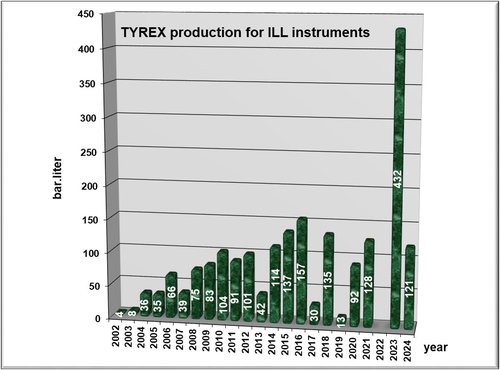
The Tyrex-2 filling station for nuclear polarisation of 3He gas was constructed at the ILL during the period 2019-2023 to replace the previous Tyrex station, which provided polarised 3He for ILL instruments from 2002 to 2021. The Tyrex-2 machine uses metastability exchange optical pumping for polarising the 3He gas at about 1 mbar pressure in ten optical pumping cells. The gas is then compressed up to several bars via a hydraulic titanium-alloy piston compressor. The machine can provide about 2.5 bar.l/h of 78-82% polarised gas.
Reference: Andersen K.H., Chung R., Guillard V., Humblot H., Jullien D., Lelièvre-Berna E., Petoukhov A., Tasset F., Physica B 356, 103-108 (2005). DOI: 10.1016/j.physb.2004.10.057