Switch instrument:
Virtual tour
D9
Hot neutron four-circle diffractometer
D9 - Hot neutron four-circle diffractometer
It is used for precise and accurate measurements of Bragg intensities up to very high momentum transfer. The resolution allows routine recording of extended data sets for the detailed study of atomic disorder and atomic thermal motions. The short wavelength allows the study of compounds containing absorbing elements like Gd or Sm.
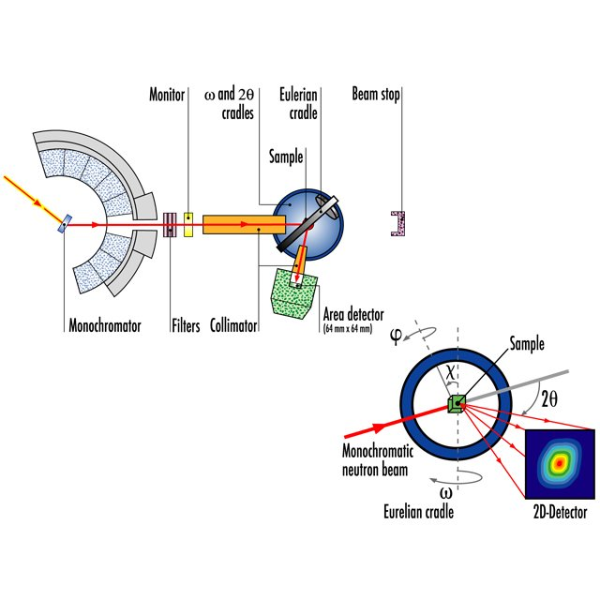
Instrument layout. Because of the short neutron wavelength very small atomic displacements can be identified, accurate to typically 0.001 Å. D9 is equiped with a two-dimensional multidetector for a more accurate and secure data collection.
Applications
General themes:
- Structural phase transitions
- Atomic anharmonicity
- Structural disorder
- Hydrogen bonding
- Packing of organic molecules
- Magnetic structures, especially Gd
- Electron density studies
- Twinning and superlattice problems
- Ordering in alloys
Fundamentals of diffraction:
- Extinction effects
- Test of dynamical theory
- Thermal diffuse scattering
- Resonance scattering
Special use:
- atomic resolution neutron holography