
PF2 - Ultracold neutron facility
Instrument layout
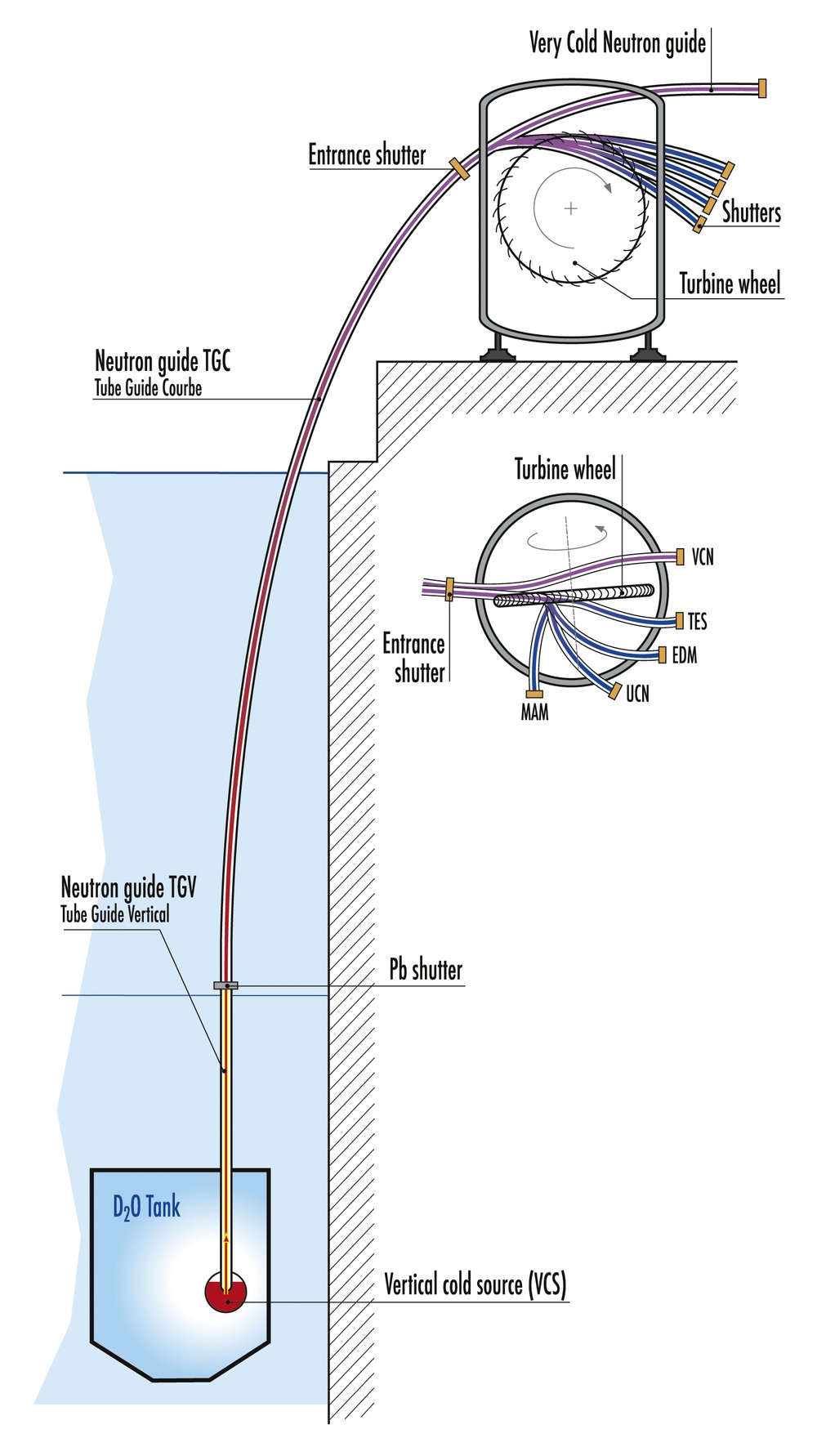
The high intensity of UCN/VCN at the experimental site stems from a combination of several design features that result in the strongest flux of UCN/VCN worldwide: A beam of very cold neutrons is extracted from ILL's vertical cold source by an optimized neutron guide system that dips into the liquid deuterium. UCN are produced "externally" by a Doppler shift device, the so called Steyerl neutron turbine.
In this way the high reflection and absorption losses associated with the windows that would be necessary in the case of direct UCN extraction are greatly reduced; furthermore, part of the beam can be used for experiments where VCN are required.
The neutrons are transported to five experimental platforms, where scientic users can connect their own experiment:
- The platform PF2/VCN is dedicated to experiments using very cold neutrons.
- The platforms PF2/MAM, PF2/UCN, and PF2/EDM can be used for experiments with ultracold neutrons. They are running in time-shared mode, making advantage of the fact that during the time of storage of UCN in one experiment, another experiment can be fed.
- The platform PF2/TEST is operating at a lower flux. It is used for test experiments.
The instrument zone
PF2 is an ultracold neutron (UCN) source consisting of a straight then curved vertical neutron guide which selects very cold neutrons (VCN) with a speed of only 60 m/s. Then, these neutrons enter a "neutron turbine" and hit blades rotating with a receding speed of about 25 m/s. This transforms neutrons into UCNs with a velocity range from 0 to 15 m/s.
The VCNs and UCNs produced by PF2 are distributed to a series of experiments.
The neutron turbine
The neutron turbine is a mechanical device which slows down the neutron, i.e. which Doppler shifts incoming Very Cold Neutrons (VCN) into Ultra Cold Neutrons (UCN).
Performance of the neutron turbine
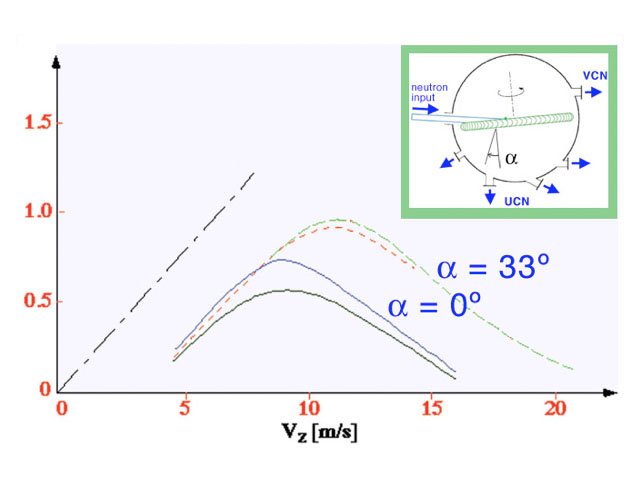
The figure shows time-of-flight data for the UCN turbine plotted as a function of axial velocity v using the setup shown above. The weak dependence of the UCN output on position and on angle α is typical for the turbine. The spectral cutoff depends clearly on α. The dashed-dotted curve refers to the Maxwell spectrum at the turbine blade ends (up to a lateral velocity of 6.2 m s-1).
PF2 - Ultracold neutron facility
Ultracold neutrons (UCN) with wavelengths around 1000 Å have several unique features: one of them is that they are totally reflected from the surface of most materials under any angle of incidence. This offers the possibility of storing neutrons in so called neutron bottles (or traps) for the observation of several fundamental characteristics of the neutron itself.
The facility PF2 operates a steady-state high-flux ultracold and very cold neutron source, which is unique in the world. In contrast to many instruments at the ILL, scientific users bring their whole experimental apparatus to PF2 to connect it to one of our beam ports.
Our source can serve four experiments with UCN (PF2/MAM, PF2/UCN, PF2/EDM, PF2/TEST), and one experiment using VCN (PF2/VCN) simultaneously.
Applications
- the search for a neutron electric dipole moment;
- neutron beta decay studies in a magnetic traps as well as in liquid and solid wall traps;
- gravitationally bound quantum states;
- ultracold neutrons (UCN) spectroscopy and diffractometry and optics;
- very cold neutrons (VCN) interferometry;
- UCN quasielastic heating studies;
- the development of a neutron microscope and UCN monochromators, etc;
- investigation of materials suited in UCN experiments
PF2 Video
The film was displayed at the American Physical Society conference in March 2017.