
FIPPS - FIssion Product Prompt gamma–ray Spectrometer

FIPPS – FIssion Product Prompt gamma–ray Spectrometer

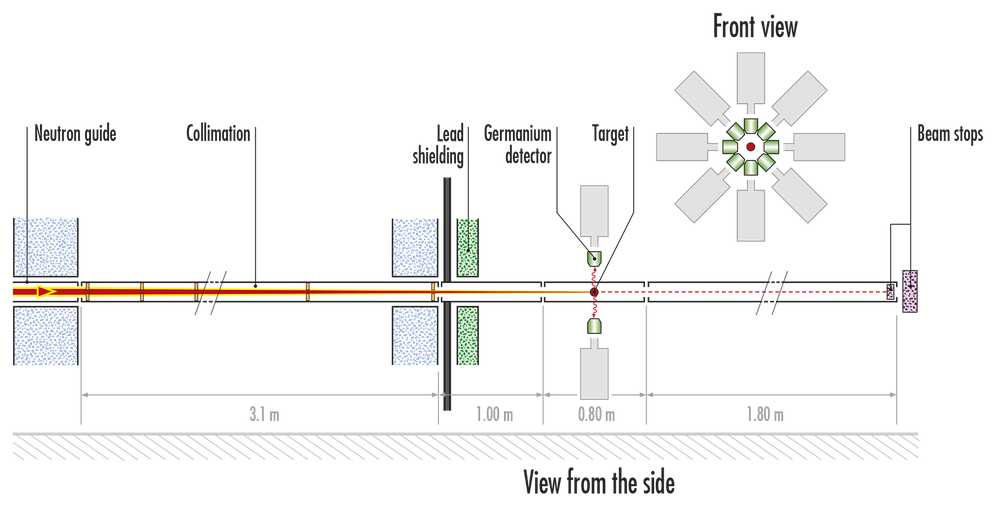
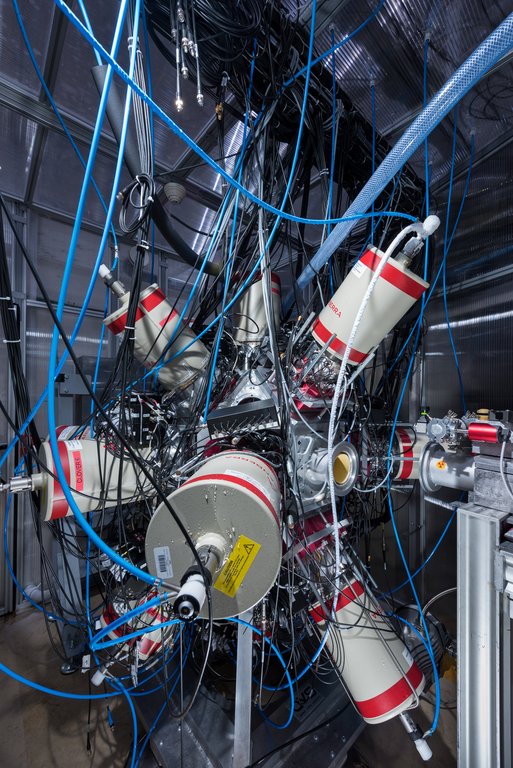
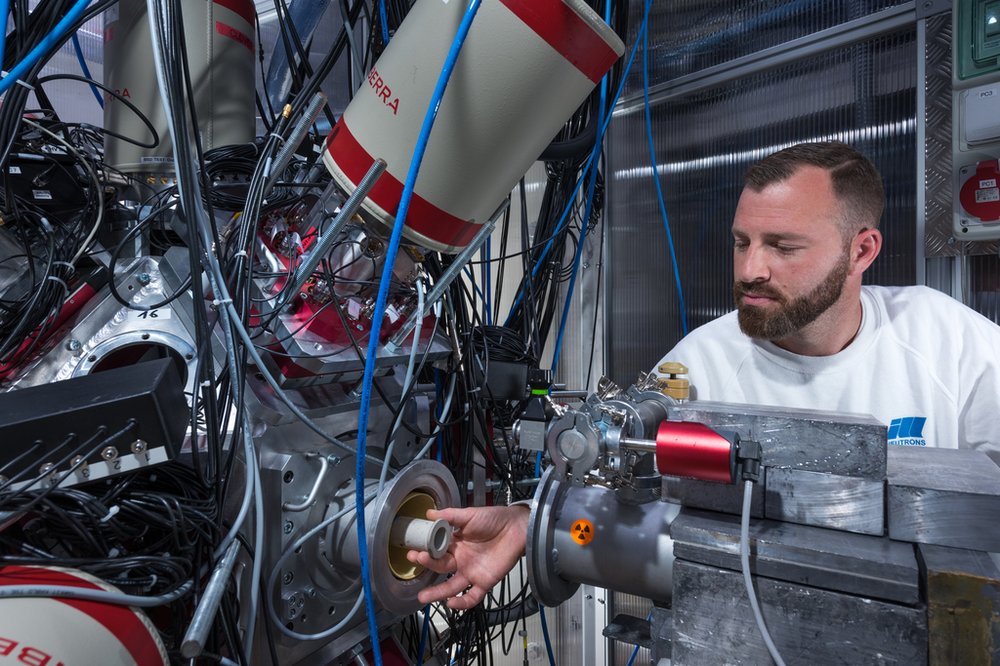
FIPPS is ILL's gamma-ray spectrometer for thermal neutron induced reactions. It is composed of a highly collimated halo-free pencil neutron beam impinging on a stable or radioactive target surrounded by a high resolution High Purity Germanium detectors array. This setup consists in the phase I of the instrument, operational since January 2017. In a second phase, the High Purity Germanium detectors array will be coupled to a fission fragment spectrometer based on a gas filled magnetic (GFM) device.
FIPPS is located in the guide hall ILL7, at the end of the H22 thermal neutron guide.

FIPPS is supported by the Auvergne Rhône-Alpes (AURA) region
Applications
The FIPPS project addresses two fundamental domains of nuclear physics:
- Fission of heavy elements:
despite enormous efforts towards a dynamic microscopic calculation it is not yet possible to reproduce the experiments. The main deficiency resides in the incomplete description of the dynamics of the fission process, i.e. the path from initial excitation energy to the partition of final excitation energy and spin distribution. Multiparametric studies on correlations between fragment distributions and their excitation and spin distributions are essential for a fundamental understanding of the fission process. - Structure of neutron rich matter:
an important fraction of nuclear structure studies nowadays is devoted to the question how well nuclear microscopic models work when nuclear parameters are changed. The increase of neutrons changes for example the characteristics of the nuclear surface and modifies therefore the spin-orbit interaction of the pairing forces. Neutron capture induced fission is an elegant way to produce a large variety of neutron rich fission fragments. It is possible to populate nuclei with more than 12 neutrons in excess of the stable isotope.
Furthermore new nuclear structure and fission yield information also has implications for other disciplines.
Examples are level densities as input for astrophysical r-process calculations in non-equilibrium conditions, search for doorway states for population of long-lived isomers with medical applications by photo-excitation, precise knowledge of fission yields and decays of fission products for ab-initio calculation of reactor neutrino spectra for sterile neutrino searches (STEREO), and, last but not least, the development of future nuclear reactors, fuel breeding schemes and nuclear waste transmutation.
FIPPS + IFIN array
Since 2018 the 8 FIPPS clovers have been equipped with anti-Compton shields and with additional 8 modules from the IFIN collaboration
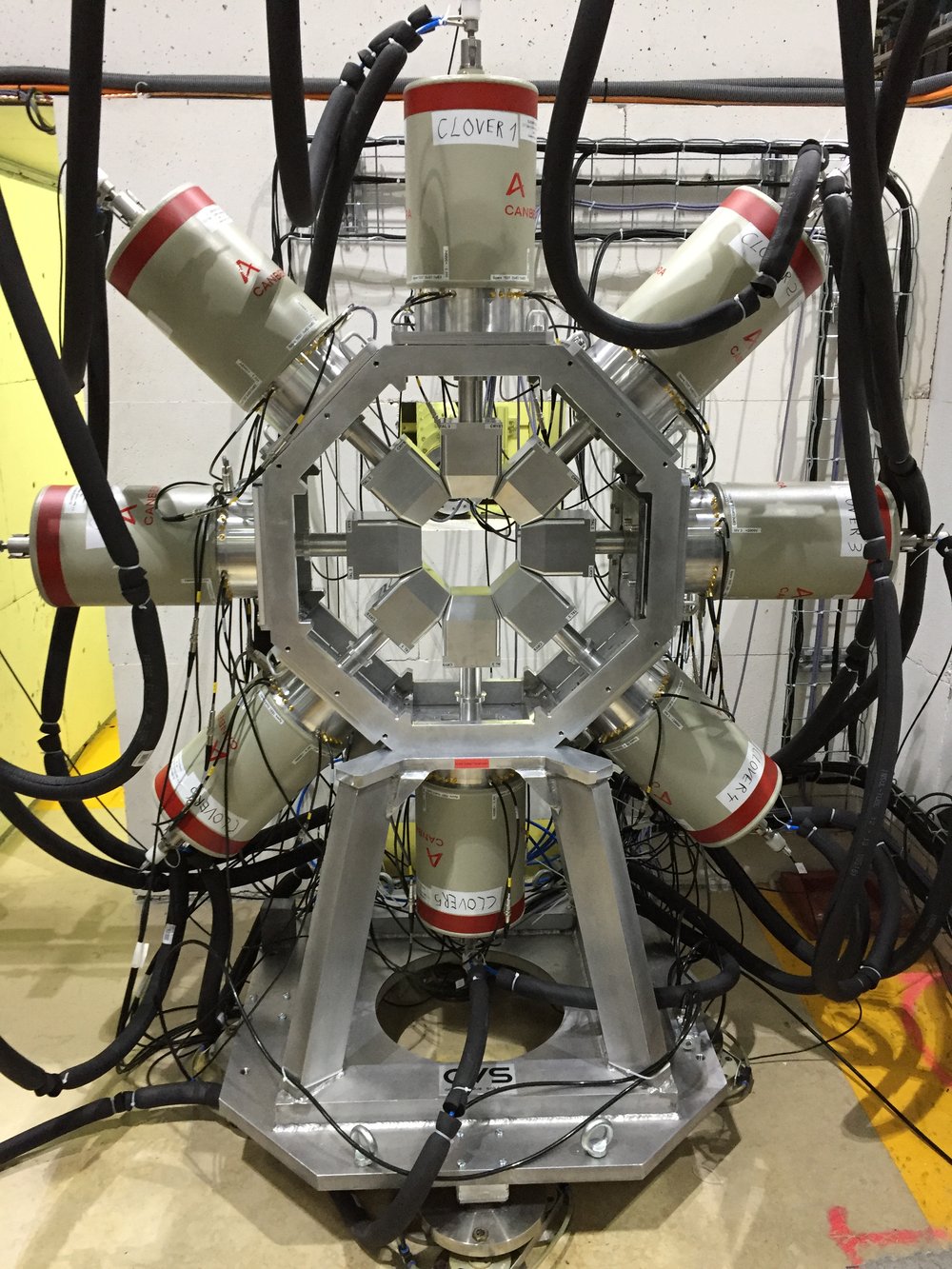
FIPPS HPGe array central ring
One of the configurations of the FIPPS HPGe array consists of a central ring holding 8 clovers, each composed of four n-type HPGe crystals (diameter 50mm, length 80mm, front tapered), mounted around the target position
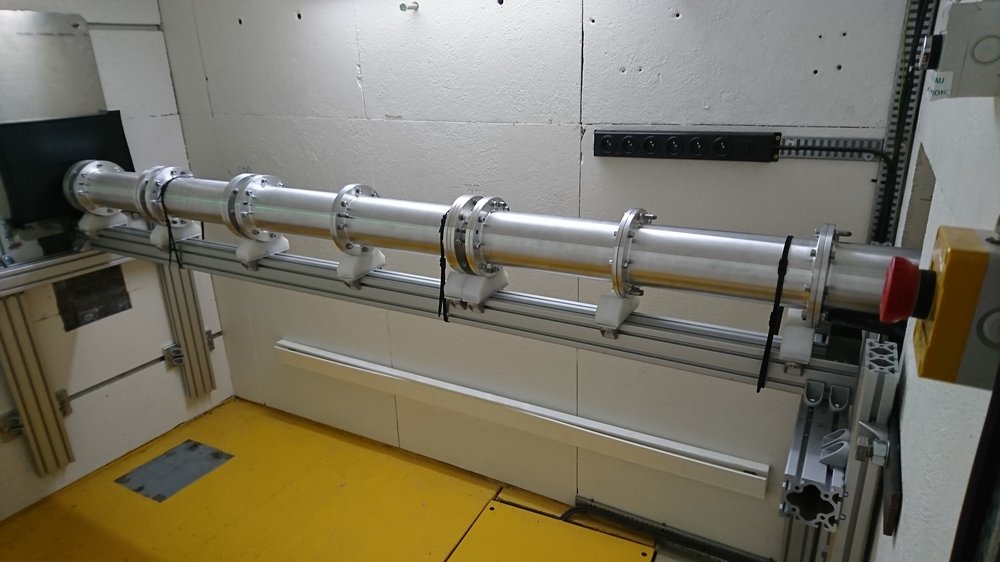
Neutron beam
The neutron beam from the H22 guide is collimated to a halo-free pencil beam of 1.5cm diameter. The neutron beam intensity at the target position is of 108 n.cm-2.s-1.
The Li target holder
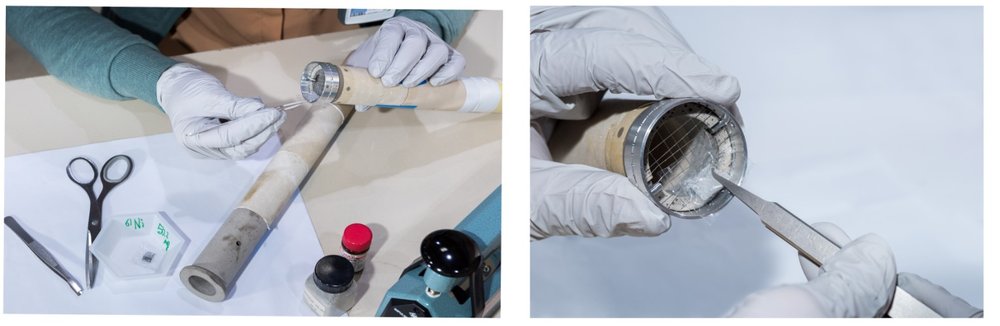
The FIPPS vacuum chamber is a C-fiber cylinder. The target holder is made out of Li plastic, in order to suppress the neutron-induced background.
The FIPPS electronics
All FIPPS signals are treated with digital electronics (CAEN cards). The data are taken in listmode, in order to allow for a flexible event builder.
The FIPPS targets
Targets for (n, gamma) experiments are sealed in teflon bags and placed in the Li plastic target holder.