
How it works
From IN5 to IN5B
IN5B is a fully redesigned instrument with many improvements which can be summarized in a single number: 60 time more intensity.
This IN5 renaissance went through complexe mechanical operations such as the installation of a large new detector chamber as shown in the movie.
This chamber now accomodates a large detector bench and the first test spectrum recorded is shown in figure 2.
Working on the instrument
This video was recorded on Oct, 2006 during an experiment intitled "Light-induced biological-function related dynamics in bacteriorhodopsin (purple membrane)".
The unusual environment setup comprises a powerful pulsed laser which illuminates the sample to trigger the light-induced transition specific to this system. This is phase-locked with a controllable delay to the incident neutron pulses at the sample.
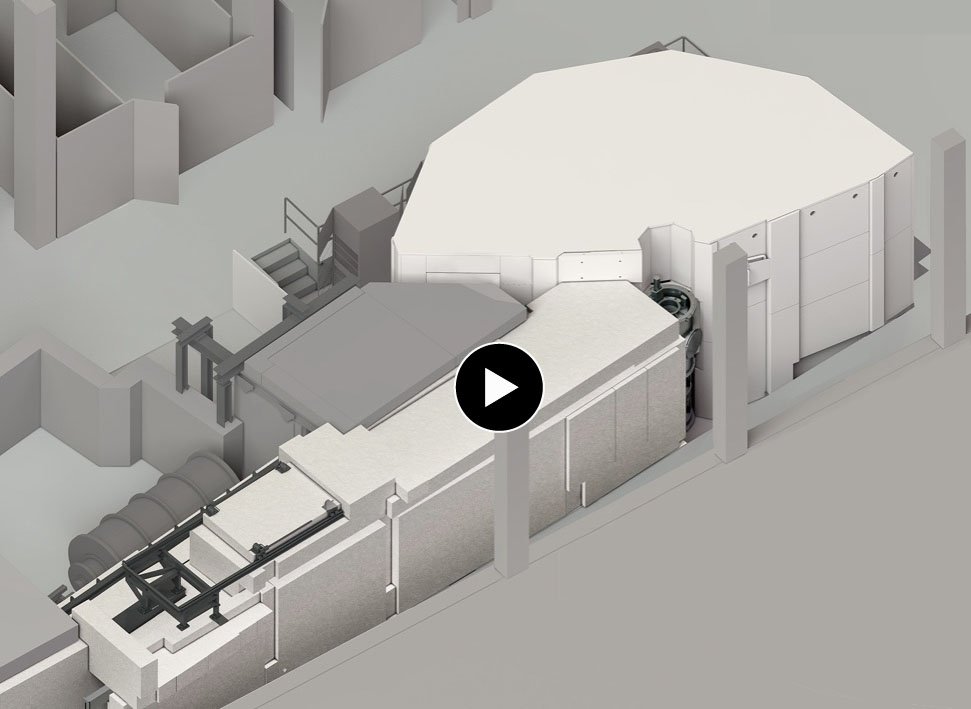
How does the IN5B time-of-flight spectrometer work?
IN5 is a typical direct geometry neutron Time-of-flight (ToF) spectrometer. This high precision instrument is used to study low-energy transfer processes as a function of momentum transfer (e.g. quasi-elastic scattering in solids, liquids, molecular crystals and inelastic scattering, etc).
The animation below (HTML5 or Flash ) shows how measurements are performed :
- the continuous polychromatic neutron flux from the neutron guide H16 is turned into a pulsed monochromatic beam by a set of 6 choppers.
- the monochromatic neutron bursts are inelastically scattered by the sample, either a liquid, a powder or a single crystal.
- the scattered neutrons are collected by a huge detectors array covering 30 m2.
- the time-of-flight analysis of incoming neutrons from each monochromatic burst results in a three dimensional spectrum x, y (detector position), t (time).
This gives access to the so-called dynamic structure factor, S(Q,ω), describing the structure and dynamics of the sample at atomic level.