IN13 - CRG - thermal neutron backscattering spectrometer
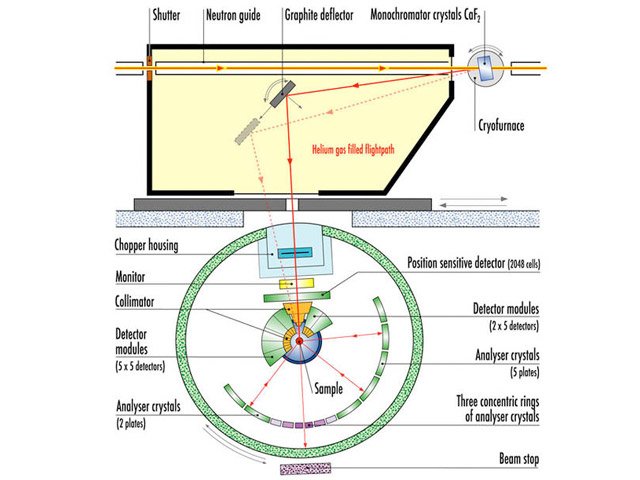
Thermal neutron backscattering spectrometer

IN13+ has been repositioned on its own dedicated branch of the new H24 guide with improved monochromator optics.
Thanks to its high energy resolution and high momentum transfer the backscattering spectrometer IN13 is particularly useful for the microscopic study of single particle motions (jump reorientation, rotational and translational diffusion, tunnelling) observed by incoherent neutron scattering.
Applications
IN13 is mainly devoted to life sciences, in particular to the study of the dynamical features of macromolecular compounds in the μeV energy region, but scientific applications can be also found in areas of materials science, solid-state physics, geophysics and chemistry.
Biology
- Membranes and protein dynamics ; Protein/membrane interactions ; Extreme environmental conditions in biosciences and biotechnology ; In-vivo studies
Polymers and saccharides
- Saccharides and trehalose dynamics ; Main chain and side chain motions in polymers ; Conducting acid-doped polymers ; Rotator phases
Confined media and inclusion compounds
Quasicrystals
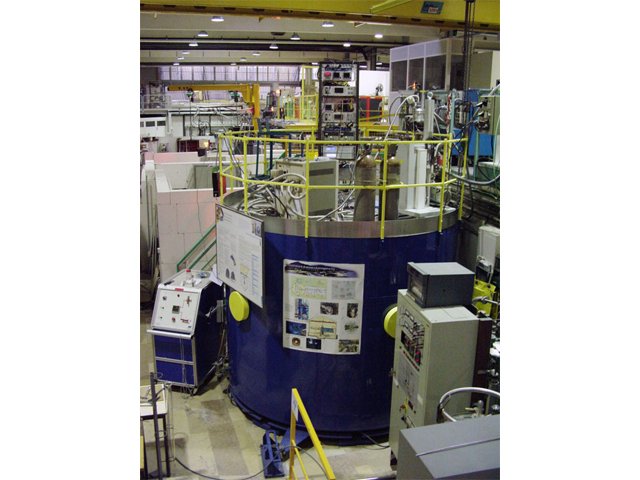
A general view of the instrument
When seen from the outside, IN13 is a close box. The shielding is in the shape of a cylinder with access to the sample position from the top platform.
Inside IN13
This photo shows the inside of IN13 as seen from above, i.e. from the hole through which samples and sample-environment devices are installed on the instrument.
- incident neutron beam
- sample position
- small angle analyser made of CaF2(422) cystals
- large angle analysers made of CaF2(422) cystals
- a set of 32 3He neutron detectors