Characteristics
| Main characteristics of FlatCone | |
|---|---|
| active pixel width | 1.3 deg. |
| no. of pixels | 31 |
| angular coverage | 75 deg. |
| SA distance | 765 & 1000 mm |
| analyzer crystals | Si 111 |
| cold neutrons | kf= 1.4 Å-1ΔE = 0 - 10 meV |
| thermal neutrons | kf = 3 Å-1ΔE = 0 - 40 meV |
| scan modes | ΔE = const.Q = const. |
| luminosity/channel | ≈ 1/3 of TAS |
| transverse resolution | ΔQ ≈ 1/2 TAS |
| background (FlatCone & IN20 Si111, July 2006)P= 58.3 MW, H13 & OS closedEN = 15 meV, empty OrangeEN = 15 meV, CuGeO3 in Orange | 3 cts/channel/6000 sec14 cts/channel/100sec50 cts/channel/100 sec |
| host instruments | IN8, IN14, IN20 |
| Pending | |
| polarization analysis insert | 3He filter |
| vacuum sample chamber | |
Characteristics
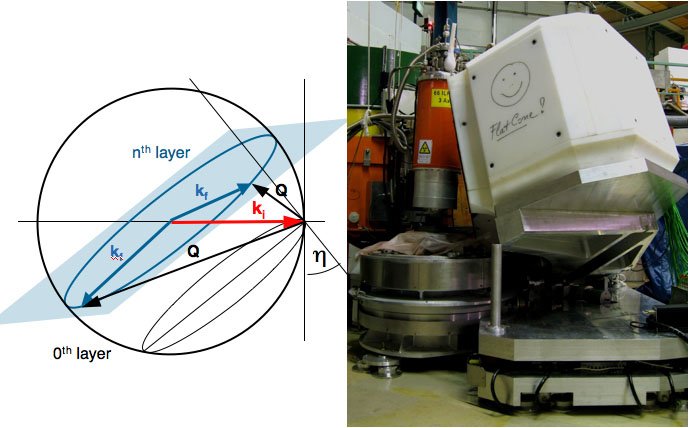
FlatCone can be used either in the horizontal mode to collect data from the equatorial reciprocal plane or in the tilted mode (see figure below) to collect data from reciprocal planes above the equatorial plane using the flatcone geometry.
Thanks to the absence of second order reflections the silicon analyzers provide a signal free of higher harmonic contamination when working with thermal neutrons (kf = 3Å-1). With cold neutrons the choice of kf = 1.4 Å-1 permits to access a window of energy transfers of up to 1 meV while working with a Be-filter in the incident beam. The work at higher energy transfers with an unfiltered beam on IN14 needs some experience and caution.
A valuable tool when using FlatCone is the application vTAS which offers a FlatCone option.
In the simulation mode one can modify all instrument parameters and then play with the measurement parameters by interactively moving either the Q,ki,kf triangle (reciprocal space) or the instrument parts (direct space).