
D4 - Disordered Materials Diffractometer
D4 - Disordered Materials Diffractometer
D4, a two-axis diffractometer, uses short-wavelength neutrons from the hot source to measure diffraction patterns over a large Q-range. Combining very high counting-rate stability with very low background counts, D4 can determine the local atomic structure of disordered materials (liquids, amorphous solids, nano-structured materials, disordered crystals) with excellent accuracy.
Applications
- Short and intermediate range order in liquid, amorphous and nano-structured materials.
- Isotopic substitution methods for resolving partial structure factors.
- Magnetic structure studies on very absorbent systems, such as those containing Gd, Eu, etc.
- Pair-Distribution Function (PDF) analysis of powder diffraction patterns.
Instrument layout
A large array of microstrip detectors provides not only a high counting rate but also a very good counting-rate stability. Combined with a very low+stable background counting rate, D4c (the present version of the D4 instrument) is thus well-adapted for high-accuracy measurements on small samples, and for sensitive difference measurements as in the case of small scattering-length contrast.
D4 shares the beam tube H8 with the IN1 triple-axis and Lagrange (Be-filter) spectrometers, and is therefore available for only about 50 % of the time.
A general view of the instrument
This top view of the instrument was taken in 2007 during measurements on aerodynamically-levitated samples melted via laser-heating.me.
A view of the fan-like neutron-detector
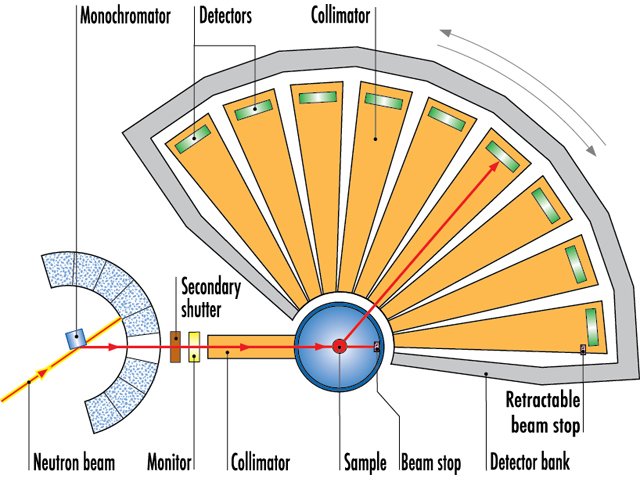
The detector assembly is a array of nine 1D position sensitive detectors with an angular resolution of 0.125º. The available 2θ-range is 1.5º to 140º. Because there are 7º in between two detectors, 2-positions scans are required to produce a complete diffraction pattern up to 135º. For a complete diffraction pattern up to 140º at least 3 positions are required.
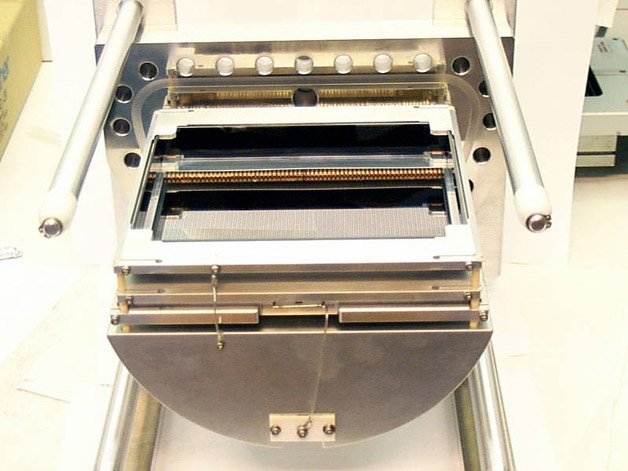
Detail of one of the microstrip detectors
This photo was taken while the detector was being assembled. The black glass plate bearing the microstrips is in a 3He chamber inside the shielding.