Characteristics
| Guide hall n°1, thermal guide H22 |
|---|
| Monochromator | |
|---|---|
| take-off angle 44.22° | |
| crystal | pyrolytic graphite (002) |
| wavelength | 2.52 Å |
| flux at sample/n cm-2s-1 | 7.9 x 10⁶ |
| crystal | Germanium (311) |
| wavelength | 1.28 Å |
| flux at sample/n cm-2s-1 | 0.4 x 10⁶ |
| max beam size | 5 x 2 cm2 |
| Detector | |
|---|---|
| 3He multidetector containing 1280 cells | |
| angular range 2θ | 128° |
| radius of curvature | 1.500 m |
| detector efficiency | 86 % at λ = 2.52 Å |
| max diameter / mm available around the sample | 600 |
| Dedicated Sample environment | |
|---|---|
| cryostat | 1.5-300 K |
| furnace | 300-1200 K |
| Eulerian cradle | RT texture experiments |
| Sample change | RT experiments |
Instrument Description
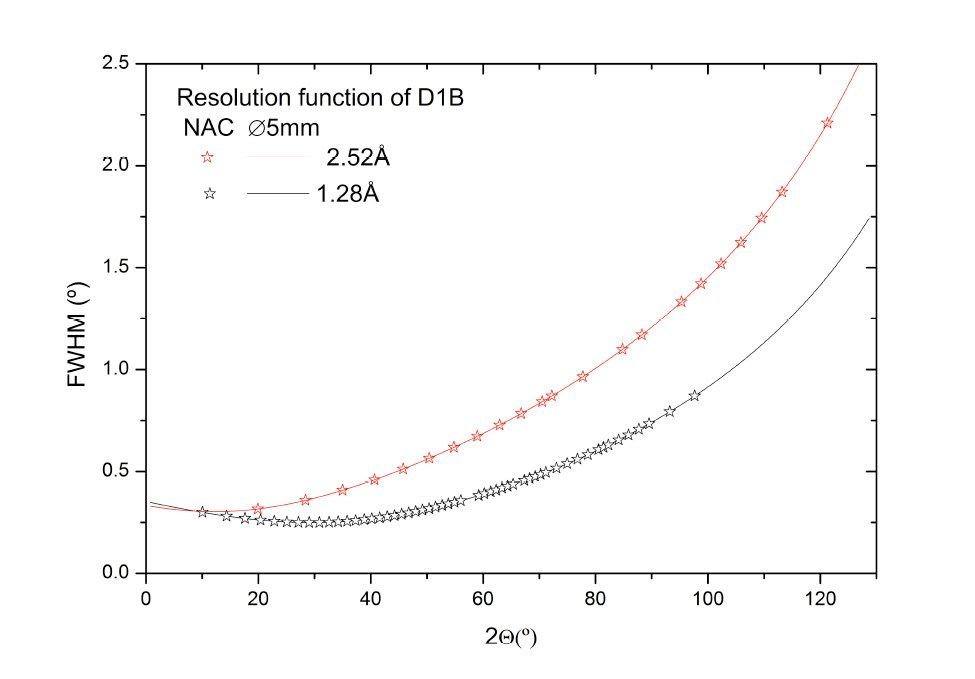
D1B is a two-axis spectrometer dedicated to powder diffraction experiments requesting a high neutron flux. A great number of experiments performed on D1B concern the determination of magnetic structures. At small angles where magnetic peaks are expected, a high spatial resolution can be achieved, the FWHM reaches 0.25° at 1.28Å and 0.3° at 2.52Å (for a sample of 5 mm in diameter).
Seven pyrolytic graphite monochromator crystals focusing onto the sample position provide a flux of 7.9·106 n cm-2s-1. A second wavelength with = 1.28 Å is available by using a germanium monochromator. D1B is equipped with 3He/CF4 position sensitive detector composed of a system of multi electrodes with 1280 wires covering a 2θ range of 128°.
Its specially designed cryostat is known for its low background crucial for some experiments with small intensity changes. A dedicated vanadium furnace achieving up to 1200K is also available. Other environments from ILL pool can be also installed; diffraction peaks arising from those environments are stopped by a Radial Oscillating collimators (ROC).
Because of its high flux at = 2.52 Å together with the large multi-detector, surface studies such as adsorbed phases as well as real-time diffraction experiments are possible. Collecting a diffraction pattern with sufficient statistics in minutes (1-5 min) even seconds allows in situ studies of reaction kinetics. A fast detection of phase transitions can also be obtained by scanning the temperature. A complete thermal variation of the diffraction patterns (1.5 - 300 K) can be achieved in few hours (3-5h).
The texture of polycrystalline samples can also be investigated using the Eulerian cradle available on D1B. Scanning 2 or 3 positions allows the complete determination of the pole figures in typically one day of beam time.
D1B is controlled by a Linux workstation on which data reduction and treatment programs are also available. The raw data are on-line corrected for efficiencies of the detector cells. In addition another Linux workstation for remote control of the instrument and several PCs running under Microsoft Windows with a direct internet connection are also installed in the cabin of D1B. More sophisticated programs with graphical user interface for data visualization (2-dim and 3-dim. plot displays, LAMP Large Array Manipulation Program) and analysis (Rietveld and integrated intensities) are at user´s disposal.
Resolution curve of D1B
Resolution curve of D1B