
Switch instrument:
D7
Diffuse Scattering Spectrometer
How it works
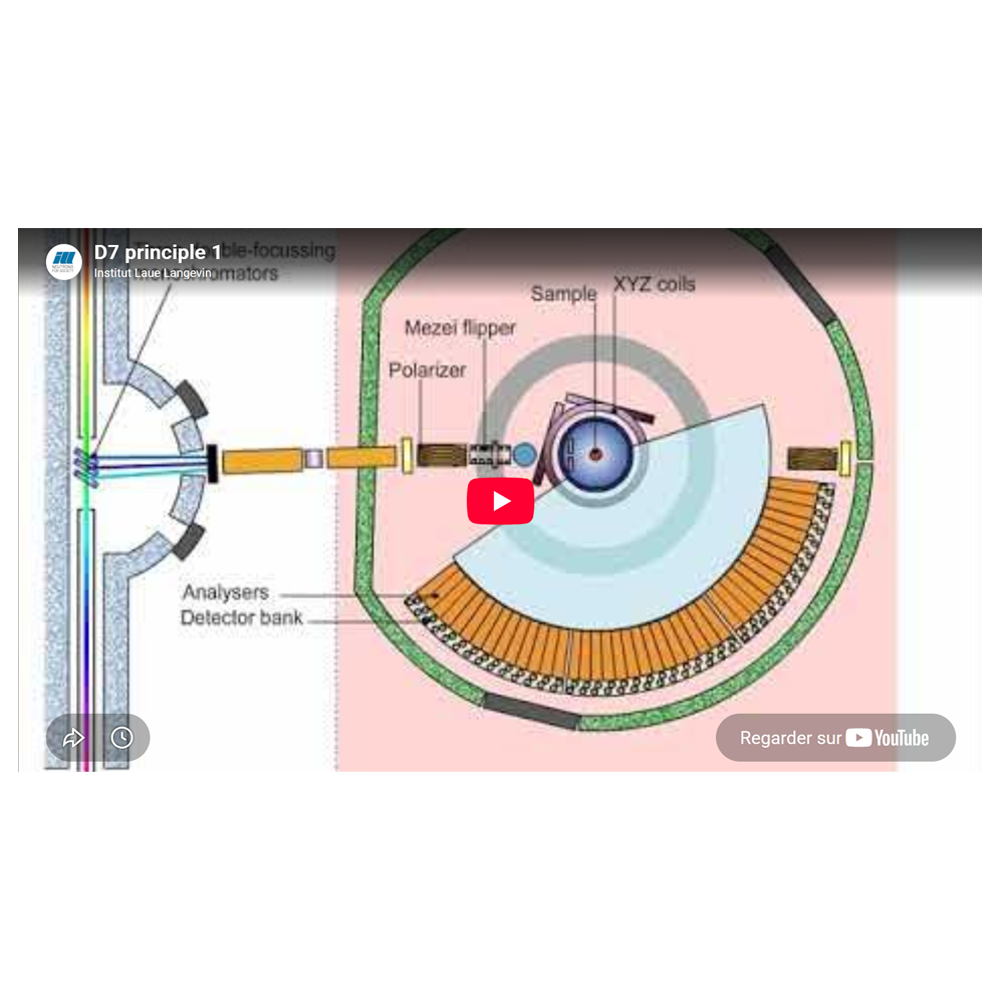
- Beam from cold guide H15 arrives at vertically focussing graphite monochromators.
- The monochromatic beam passes through a Be filter and arrives at the supermirror bender polariser.
- The neutrons are polarised in the z-direction.
- The neutrons pass through a Mezei spin-flipper, which is "off" when measuring non-spin-flip cross-sections, and "on" when measuring spin-flip cross-sections.
- The neutrons are rotated into the x, y or z direction using 3 orthogonal Helmotz coils situated at the sample position.
- After scattering from the sample the neutrons are analysed for final spin state, and detected using the 3 multi-analyser/detector banks, with 22 supermirror bender analysers and 44 3He detector tubes in each bank
Experiments on D7 are performed to investigate diffuse scattering from disordered systems – magnetic & non-magnetic. The diffracted intensities measured at D7 makes it possible to model such disordered systems.
How neutron spins behave
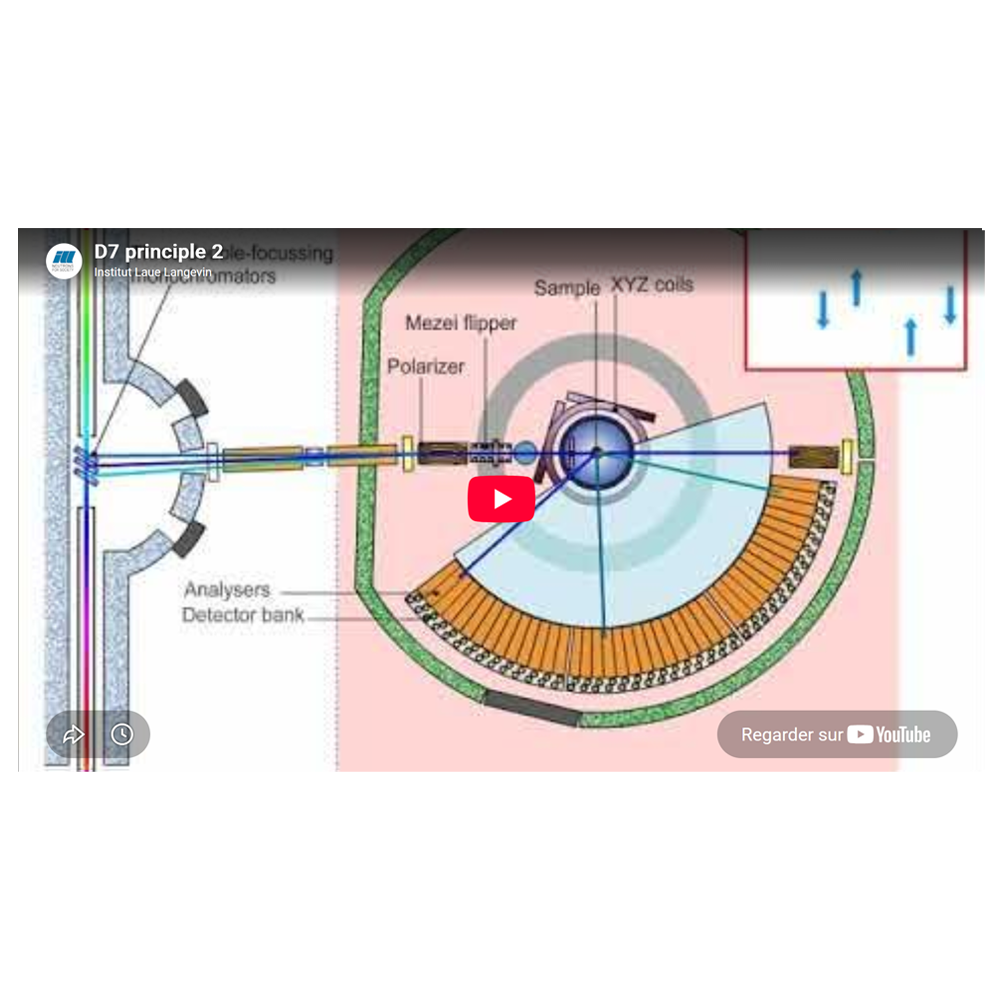
Here D7 is shown in its spin-flip (SF) configuration.
- Unpolarised neutrons are reflected by the graphite monochromator.
- The incident neutron beam is polarised by the supermirror bender polariser.
- For measurement of SF cross-sections, the neutrons are spin flipped by the flipper.
Flipper is turned off when measuring non spin-flip (NSF) cross-sections. - The neutrons are reflected and also partially spin-flipped by the sample.
- The spin-up neutrons are transmitted and spin-down neutrons are absorbed the supermirror bender analyser before being detected.
Video
D7 Principle
How it works
Video
How neutron spins behave
How it works