
How it works
Instrument layout
A new monochromator assembly was commissioned in 2016, making use of experience in the engineering of multi-crystal arrays with remotely controlled two-dimensional (horizontal and vertical) variable focusing accumulated over the last decades.
The new device includes four crystal faces that can be alternatively set in Bragg reflection: mosaic pyrolytic graphite and copper crystals with reflecting planes PG002 and Cu200, as well as elastically bent perfect silicon crystals with reflecting planes Si111 and Si311 both eliminating the second order diffraction harmonics.
A new single-detector secondary spectrometer called ThermES (as abbreviated from Thermal Excitation Spectra) was commissioned in 2020.
Thermes has a compact design and optimized neutron shielding conceived to minimise all parasitic background not coming from the sample or passing away from the principal optical path. While the most of background in an IN8 experiment is typically stemming from the sample and its nearest environment (cryostat etc.), the signal-to-noise ratio could be anyway improved due to thoroughly arranged neutron shielding environment. An additional gain in high-resolution work is brought in by the new enriched boron coated slit collimators and thorough design of their neutron shielding that permitted eliminate major sources of background leaking into the zone around the analyser crystals.
The analysers in use are presented by the double-focussing devices built from mosaic crystals of pyrolytic graphite (reflection plane PG002) and copper (reflection plane Cu200) and also elastically bent perfect silicon crystals (reflection plane Si111).
The classical single-detector configuration of Thermes is enriched with a diaphragm positioned next to the Helium-3 counter. This diaphragm permits variation of the sensitive area of the neutron counter and helps to optimise the signal-to-noise ratio in the experiments with diverse sample sizes.
The new spectrometer proposes a larger dynamical range with respect to the previous setup, especially towards high values of momentum transfer or high scattering angles, now possible up to at least 120 degrees in both scattering directions.
Due to its modular structure the Thermes secondary spectrometer can be replaced, similarly to the previous setup, with the FlatCone multi-analyser spectrometer in case if mapping of the scattering intensity in different crystal planes is required.
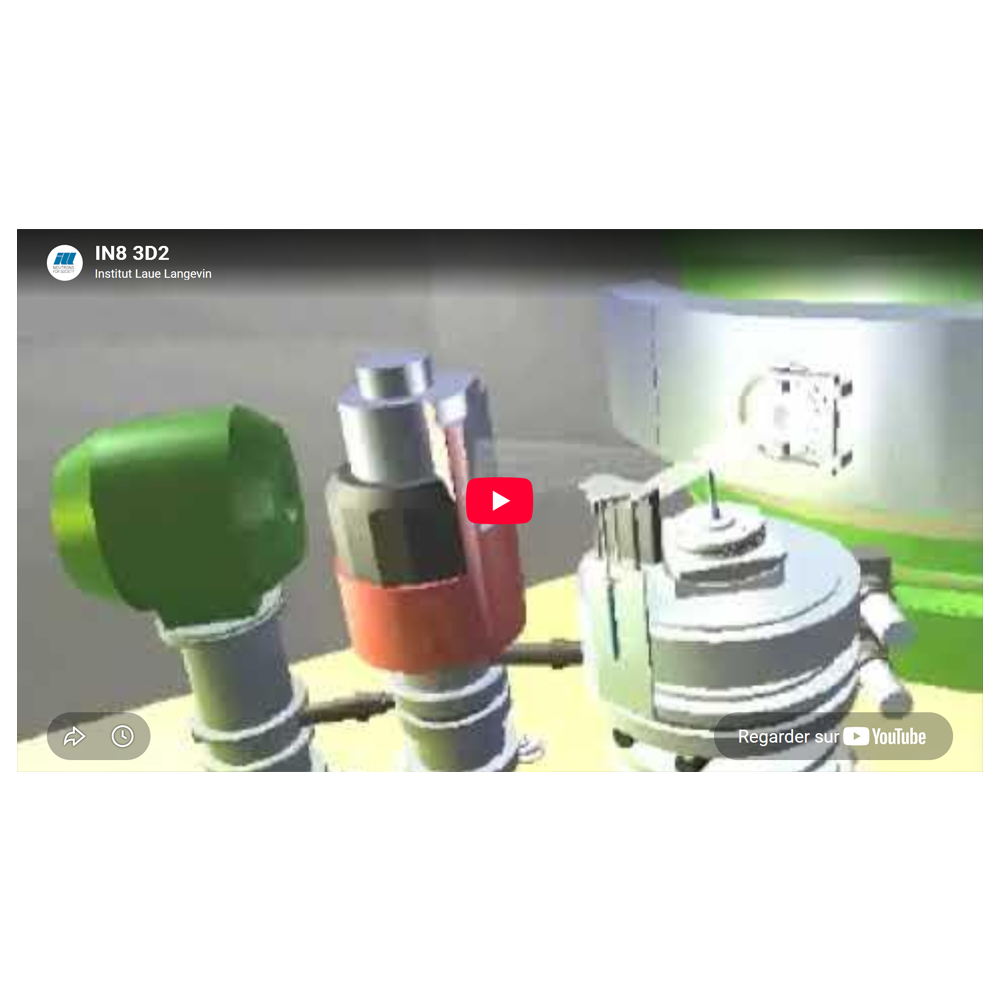
- The animation shows the typical measuring strategy of a three axis spectrometer like IN8.
- The monochromator selects a beam of neutrons in a narrow energy band.
- The analyser is positioned to select a scattering direction (related to the momentum transfer, Q)
- The energy of the neutrons which pass through the analyzer is determined by varying the angle of Bragg reflection from the analyzer
- Each configuration of the spectrometer corresponds to a well-defined point in the (Q,ω) space.