
Upgrades and examples
Collimation renewal project (2001-2004)
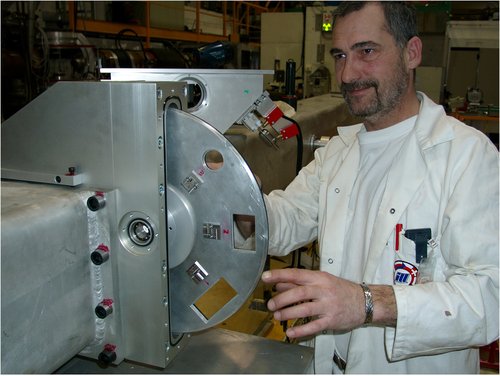
With 3 new collimation distances (1.5m, 28m and 34m), 6 new diaphragm changers, new mechanics including a complete re-alignment and the modifications at the selector area, the instrument has considerably gained in:
- performance
- resolution
- flexibility
- reliability
For instance, a flux gain of ≈ 10 is obtained for certain experimental conditions.
New detector and tank project (2005-2008)
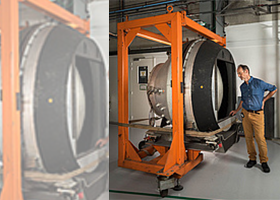
The future scientific requirements are calling for an innovative evolution of the instrument with a “best possible” specification, in order to strengthen ILL’s leading position in small angle scattering and maintain D11 as one of the world-wide most powerful and versatile SANS instruments. Consequently, the project of developing a faster and larger SANS detector has started in 2005, in the framework of the ILL’s Millennium Programme.
The present 3He detector will be replaced by the 3He - MWPC 128x128-7.5 (the former CERCA 3He detector of D22). This detector has a considerably larger counting area thus a much better dynamic range, a better efficiency and a better spatial resolution. After some modifications of the detector electronics, the maximum possible countrate can be increased to about 300 kHz, i.e. a factor of 6 higher than the present D11 detector. The detector shall be installed in a new tank with an extended length and larger diameter. In conjunction with the enhanced counting area, the tank elongation will considerably increase the totally available Q-range of the instrument and allow for measurements at significantly lower Q-values than possible at present. Furthermore, it is planned to implement in the future a multi-hole imaging USANS option, thus challenging new frontiers in space and time resolution.
Guide replacement (2006-2008)
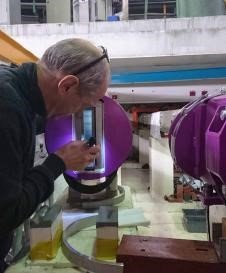
Following the review and analysis of the D11 guide system by McStas simulations in late 2005/ early 2006, an innovative guide design change had been decided in spring 2006. Significant flux gains can be predicted for a large range of collimation distances with a new widened glass guide with an opening 6.5m trumpet (30mm->45mm width) at the collimation entrance and a focusing trumpet at the collimation exit, near to the sample position
(see Lieutenant K., Lindner P., Gähler R. (2007) J. Appl. Cryst. 40, 1056 - 1063).
In June 2006 the guide replacement project has been approved and coupled with the "new detector & tank" projcet to result in the extended Millennium project “D11 Revised”.