More
Studies of magnetic structures and phase transitions, especially to incommensurate structures, are dominant amongst the experiments carried out on D10.
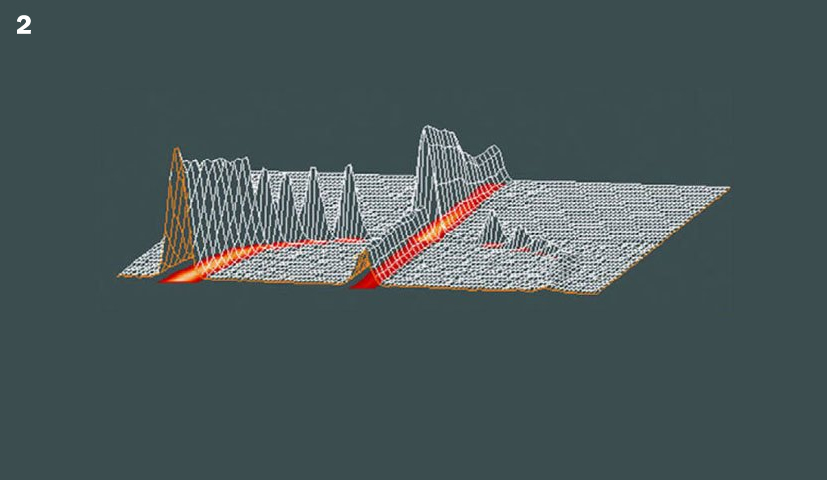
Magnetostatic measurements on CuB2O4 had revealed two transitions at TN = 21K and T* = 10K. The exact structures of the two magnetic phases were determined on D10 by following selected Bragg reflections with temperature (Fig. 1) and exploring reciprocal space within each phase.
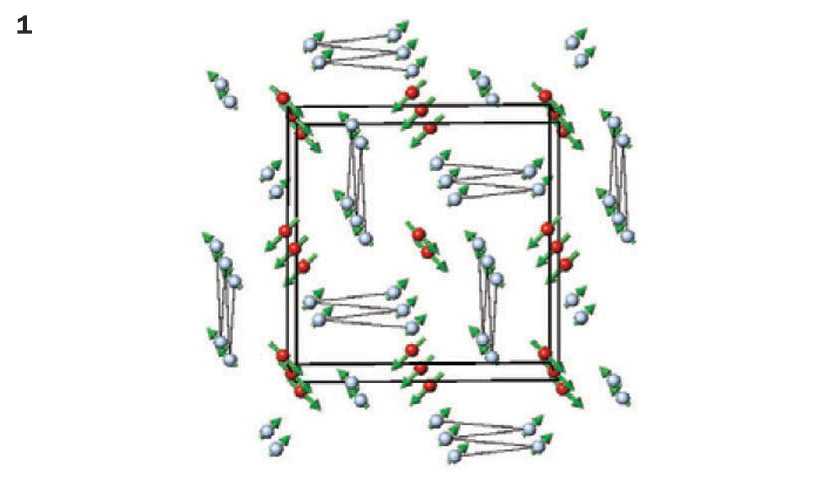
The first transition is to a commensurate non-collinear antiferromagnetic structure, with a small spontaneous ferromagnetic component (Fig. 2);
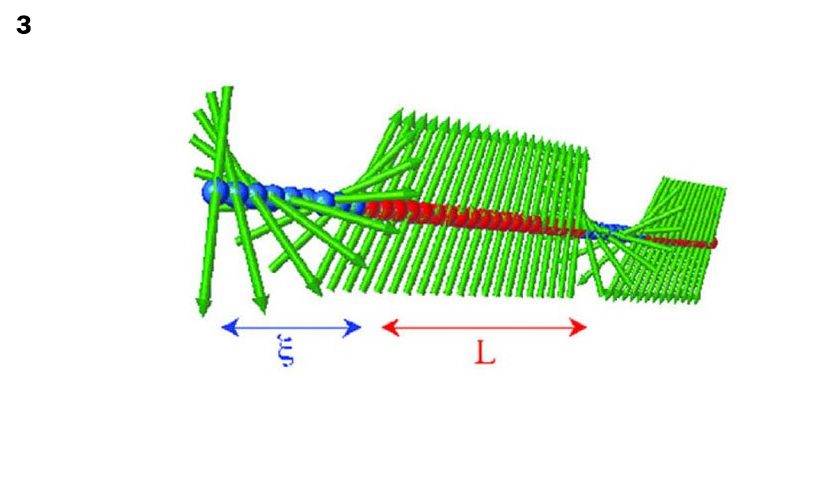
The second is to a helical structure where the phase of the spins along the tetragonal c axis stays constant over a length L then changes abruptly over a short period ξ (Fig. 3).
Close to T* the magnetic structure can be pictured as a periodic structure of domains which are separated by domain walls or equivalently solitons.
The soliton lattice is further confirmed by the appearance of higher-order harmonics and considerable diffuse scattering near the Bragg reflections.
Reference: Roessli et al., Phys. Rev. Lett. 86, 2001, 1885-1888.
The use of crystallographic data to map reaction pathways is well established for interactions of nitrogen and oxygen nucleophiles with carbonyl, both in bond formation and cleavage. Could a similar analysis by structural correlation be applied to the reduction of ketonic carbonyl by hydride addition?
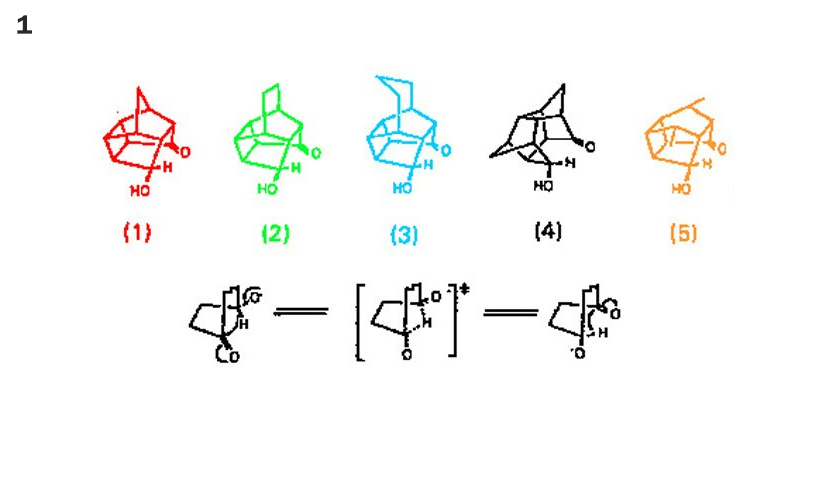
A number of polycylic hydroxyketones, containing sterically constrained 4-hydroxycyclohexanone or 4-hydroxycycloheptanone substructures which rearrange by a 1,4 hydride shift on treatment with base (Fig. 1), were prepared.
Rates of rearrangement of the derived alkoxides had been determined, as had the X-ray crystal structures of derivatives of some of the hydroxyketones. Crucial to the analysis of the correlations were the positions of the potentially hydridic hydrogens at the alcohol methine, and should ideally be determined by neutron diffraction. This experiment was the first such determination of the structure of a reactive hydroxyketone.
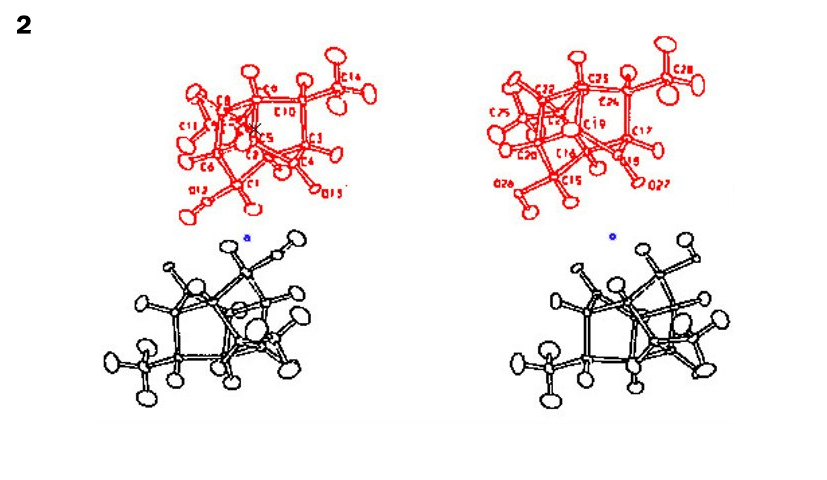
This analysis gave clear evidence of steric compression of the potential hydride donor and accepting carbonyl (Fig. 2).
Somewhat surprisingly there was no evidence of any adjustment in molecular geometry to show coupling between the functional groups, a result attributed to the weaker hydridic character of this alcohol compared to its salts.
Reference: R.H. Fenn et al., Acta Cryst. C45 (1989) 423-428.