This website is being migrated. In case you don't find the information you are looking for, the old website can be found here. Thank you for reporting any anomalies to communication@ill.eu.

Chemistry and Materials

Structure characterisation - Water dynamics – Planetology - Catalysis - Energy production – Clean energy - New materials - Novel engineering processes - Methods

The influence of structure is everywhere; the properties of water and ice, the hardness of metals, the strength of magnets, the biology of DNA or the effect of antibodies on viruses – all depend on structure. Crystallography is studied at the ILL in a broad sense, using both single crystal and powder diffraction. Some structural studies may require small-angle-scattering as well.
Neutron diffraction is ideal for determining the structure of materials containing light atoms such as hydrogen, carbon, nitrogen and oxygen.  We need to understand the structure of materials before we can understand their properties and how they react.

To master the methodologies leading to new improved materials we need detailed knowledge of the structure of solids at the atomic or molecular level. Owing to their unique properties, neutrons can play a crucial role in this, by resolving, for example, the arrangements of magnetic moments in complex magnetic systems, by locating light atoms in intricate structures, or by assessing the residual stress distribution in bulky mechanical parts. The development and engineering of components with improved functionality is the key to technological progress, which in turn provides sustainable economic growth. To achieve this goal, scientists and engineers are developing smarter materials and components.

Highlights brochure on how neutrons help understanding the structure of new materials:

Highlights

Neither_solid_nor_liquid_illustration.png
July 10, 2025 Neither solid nor liquid : Neutrons help reveal an exotic state of matter
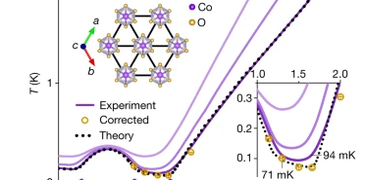
A team of researchers recently used the thermal-neutron two-axis diffractometer D23 at the ILL to investigate Na2 BaCo(PO4 )2 (NBCP), a material that surprisingly behaves as a ‘spin supersolid’ -a state combining properties of both a solid and a liquid. Neutrons, acting like tiny magnets themselves, were the ideal probes to reveal the hidden magnetic order and dynamics within this material. This discovery, which is also relevant for energy-efficient cooling, provides the first real-life evidence of a supersolid state in a quantum magnet.
D2B_L Gendrin3_Web.jpg
July 7, 2025 Neutrons explore exotic insulator's quantum secrets
A recent study published in Nature Communications reveals an unexpected transition between two different insulator states. Neutron diffractometry experiments at the ILL, conducted on the D2B high-resolution, two-axis diffractometer, open up the path towards advanced technologies by providing vital insights into the complex electronic behavior of such materials.
2025 06_CommUkleev_2_image.jpg
July 4, 2025 Spinning into the future : polarised neutrons help unravel the mysteries of skyrmions
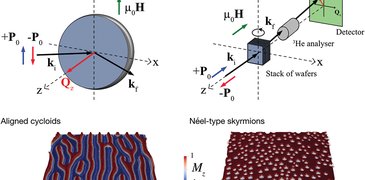
A recent study, published in Science and Technology of Advanced Materials, and conducted at the Institut Laue-Langevin (ILL), utilised polarised neutron scattering on the D33 instrument to explore skyrmions. This research provided crucial microscopic insights into these magnetic structures. The D33 instrument's unique ability to combine high magnetic fields and  polarised neutrons was essential for understanding skyrmion phase transitions. The findings  can enhance the development of skyrmion-based spintronic devices, which promise lower energy consumption and higher data storage efficiency. The study's methodologies can be applied to other magnetic materials, aiding in the discovery of new phenomena and the development of advanced magnetic materials.
219x288mm_plastic_water__cover_4.png
Feb. 12, 2025 Exotic observations at the ILL
In everyday life, we typically encounter water in one of three familiar states – solid, liquid or gas. But there are in fact many more phases, some of which – predicted to exist at high temperature and pressure – are so strange they’re referred to as exotic. State-of-the-art neutron spectrometers and sample environment infrastructures at the Institut Laue-Langevin (ILL) have enabled the first experimental observation of one of these exotic phases – plastic ice VII.
20240701 AntimicrobialPeptides LPorcar AdobeStock_98515861.jpeg
Aug. 7, 2024 Neutrons reveal surprises about the action of natural antibiotics
Antimicrobial peptides (AMPs) are natural antibiotics which are very effective against resistant bacteria. Despite their interesting properties, AMPs remain difficult to use. A study just published marks a remarkable step forward in understanding how AMPs work. Taking full advantage of neutron and X-ray scattering, researchers obtained results that are both important and surprising.
240701 twopopulations coverimage.jpg
July 2, 2024 Protein biopharmaceuticals: understanding the processes to take applications further
A recently published study uses neutron and X-ray scattering to deepen our understanding of freeze-drying protein stabilisation processes, widely used in biopharmaceutical applications. The results obtained for a protein relevant for pharmaceutical applications are in stark contrast with those previously obtained for lysozyme, widely used as a model protein. This highlights the importance of protein selection in such studies.
240522   Supercritical fluid dynamics_4x3.png
May 22, 2024 Unlocking the secrets of supercritical fluids
A study now published in Nature Communications brings remarkable insights into the enigmatic behaviour of supercritical fluids, a hybrid state of matter occupying a unique space between liquids and gases, and arising in domains ranging from the pharmaceutical industry to planetary science. The obtained results are at the limit of current experimental possibilities and could only be obtained in a high-flux neutron source such as the ILL.
molecular_moonlander_1.jpg
April 11, 2024 A molecular moonlander: insight into molecular motion on surfaces at the nanoscale
Using neutron spectroscopy data taken at ILL, researchers achieved a novel understanding of molecular movement at the nanoscale, providing new insights that may impact the design of future materials and technologies. The study has just been published in the Nature Portfolio open access journal Communications Chemistry – and is featured (as a banner) on the journal homepage.
molecular_moonlander_1.jpg
April 11, 2024 A molecular moonlander: insight into molecular motion on surfaces at the nanoscale
Using neutron spectroscopy data taken at ILL, researchers achieved a novel understanding of molecular movement at the nanoscale, providing new insights that may impact the design of future materials and technologies. The study has just been published in the Nature Portfolio open access journal Communications Chemistry – and is featured (as a banner) on the journal homepage.
230608_Ring_of_diffuse_scattering.jpg
Sept. 6, 2023 Upward spiral for next-generation computing
Experimental evidence of rare magnetic behaviour in LiYbO2 will help to open the door to a new family of materials with potential applications in spintronics, quantum computing and more. Though continuous down-scaling in microelectronics has enabled the industry to achieve phenomenal success, the trend is now approaching fundamental limits. Promising alternative technologies for next generation d…

Video playlist