This website is being migrated. In case you don't find the information you are looking for, the old website can be found here. Thank you for reporting any anomalies to communication@ill.eu.

Spectroscopy

Neutron spectroscopy probes the dynamics of magnetic moments, molecules and lattices over length scales ranging from a few angstroms to tens of nanometers, and over timescales from tens of femtoseconds up to the microsecond.

Within neutron spectroscopy, there are 4 main techniques which use different methods to determine the energy of the incident and scattered neutrons and are adapted to different kinds of scientific studies. An overview of instrument parameters is provided in the instruments page.

Spectroscopy instruments

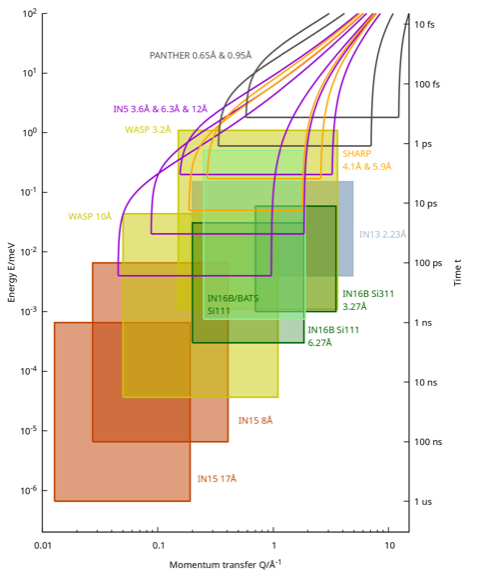
Various dynamic ranges of the Spin-echo, Back-scattering and Time-of-flight instruments at the ILL. Figure made by M. Appel.

Time-of-flight (TOF) spectrometers use the time-of-flight of neutrons through the spectrometer to determine the energies of the incident and scattered neutrons.

There are 3 dedicated time-of-flight (TOF) spectrometers. These instruments are optimised for different kinds of scientific studies, which depends mainly on their energy resolution and momentum transfer range.

IN5 Cold neutron multi-chopper TOF spectrometer
SHARPER Cold neutron time-focussing TOF spectrometer
PANTHER Thermal neutron TOF spectrometer

There is a range of triple-axis (TAS) spectrometers which use crystal monochromators and analysers to determine the incident and scattered neutron energies. TAS spectrometers are mainly used to study single crystal samples, focusing on specific regions of interest in reciprocal space. The TAS instruments are optmised for different kinds of scientific studies, which depends for example on the energy and flux of the incident neutron beam, polarised neutron capability and the availability of specific sample environments.

IN1 TAS/LAGRANGE Hot 3-axis spectrometer

IN8 High-flux thermal 3-axis spectrometer

IN12 Cold 3-axis spectrometer (CRG)

IN20 Polarized thermal 3-axis spectrometer

IN22 Polarized thermal 3-axis spectrometer (CRG)

ThALES Three Axis instrument for Low Energy Spectrometry

Neutron backscattering provides higher energy resolution than TOF or TAS by using crystal analysers that operate in a backscattering geometry. There are 2 dedicated spectrometers

IN16b Versatile high flux backscattering spectrometer

IN13  Thermal neutron backscattering spectrometer

IN16b is a very versatile instrument which includes a time-of-flight option to significantly increase the dynamic range.

Spin Echo Spectroscopy (NSE) achieves very high energy resolution using the change in polarization between the incident and scattered neutron beams to measure small energy changes due to the dynamics in the sample. The energy resolution is better than that of neutron backscattering and is expressed in Fourier times since the technique measures directly the intermediate scattering function I(Q,t).

There are 2 dedicated spectrometers, WASP and IN15, which differ essentially in terms of the detector coverage and therefore the count rate. IN15 holds the record for measuring the longest Fourier time – about 1 microsecond. 

Instrument parameters

An overview of instrument parameters is provided here to help you choose the most suitable instrument. By clicking on the instrument, you can go directly to the dedicated instrument pages where more information can be found, including scientific highlights and contact details for the instrument scientists.

Recent science highlights