
Deuteration Laboratory (D-Lab)
The ability to replace hydrogen with its heavier (and more strongly scattering) deuterium (2H or D) isotope in a way that is usually highly isomorphous offers unique possibilities for neutron scattering studies of the structure and dynamics of biological systems in basically all relevant sample habits. Such a capability requires a range of in vivo and in vitro techniques that are very difficult to maintain and develop in laboratories serving the needs of many user groups, given that the methods involved are not easy to deploy on a one-off basis. They need continuity of expertise, economies of scale, and continuous methodology development that is driven by a combination of pressures from emerging new capabilities at the neutron facilities themselves as well as from the scientific priorities of the user communities that operate them.
A platform for natural deuterated lipid extraction (L-Lab) has recently been set up: find out more.
Access
The Deuteration Laboratory (D-lab) is run as a user platform and is part of the Biology, Deuteration, Chemistry and Soft matter group (BDCS). It allows users in the area of life sciences and structural biology to seek tailor-made deuterated biomolecules in support of neutron scattering (D22, D11), protein crystallography (LADI-III, D19), Dynamics (IN13, IN16) and reflectometry (D17, FIGARO).
Access to the platform is by a rapid electronic peer-review system. Applicants should contact dlab-proposals@ill.eu and/or lipids@ill.fr before submitting proposals to discuss technical feasibility. The D-lab proposal form should be used for deuterated material other than lipids and sterols, i.e. proteins, RNA/DNA and deuterated biomass in general. If deuterated lipids or sterols are requested, the new joint D/L-lab proposal form should be used. Once completed and following discusion with the D/L-Lab teams, proposals will be sent, as an electronic attachment, to the ILL User Office (User Office). Note that acceptance of a proposal to use the deuteration and/or lipid lab facility does not imply automatic allocation of neutron beamtime although the beamtime committee will be informed of the outcome of the deuteration proposal.

Large Crystal Growth
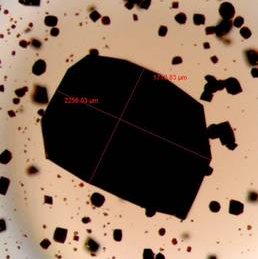
For neutrons, the full exploitation of protein crystallography is still strongly restrained by crystal size. Given the fluxes available at the most powerful neutron sources, this will always be a challenging aspect in delivering the huge potential that neutrons have for biological crystallography. The crucial developments for macromolecular deuteration that have occurred in the past and in dedicated facilities have resulted in a reduction of the crystal volumes needed by a factor of ~10. Macromolecular deuteration and the constant upgrades of dedicated instruments have had a very strong impact in the field of NMX (neutron macromolecular crystallography). Instruments such as LADI-III, D19 at ILL (Grenoble, France), and BIODIFF at FRM-II (Garching, Germany), are amongst the best diffractometers of their type in the world.
By the very nature of crystallisation, there is no empirical reason why conditions could not be identified that allow crystal growth to be extended. It should be a matter of putting sufficient emphasis on rational approaches for the systematic exploration of growth conditions in relation to the specific phase diagrams, but it remains a real challenge. The D-Lab team can be contacted for advice on large crystal growth of protein samples for crystallography applications.
The ILL D-lab members
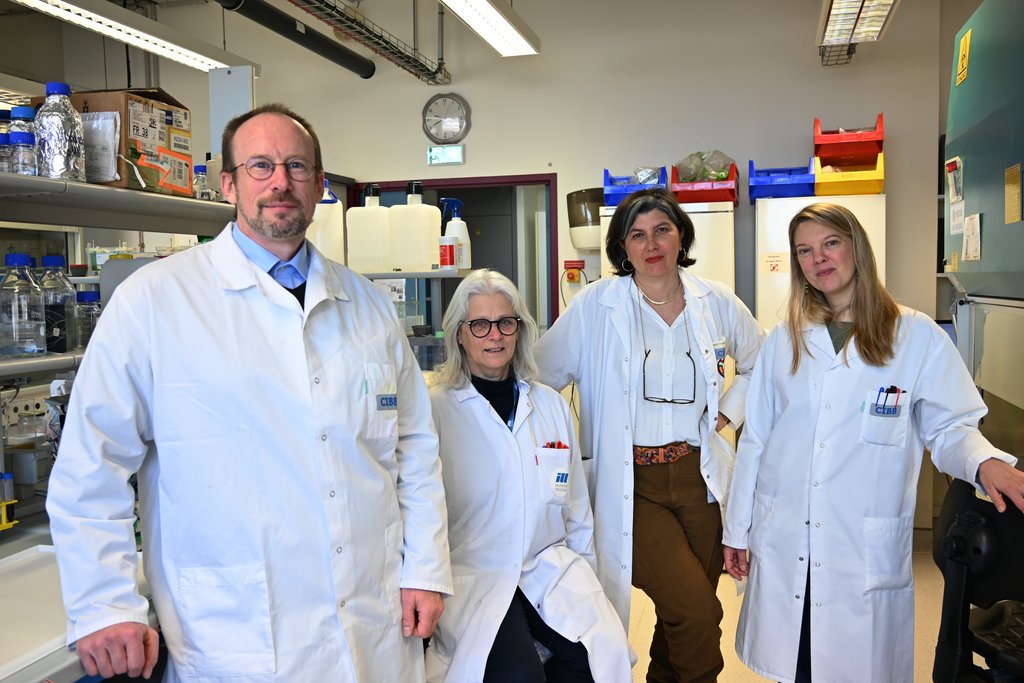
From left to right: Frank Gabel, Valérie Laux, Martine Moulin and Juliette Devos
Contacts:
Martine Moulin (+33) (0)4 76 20 71 68
Frank Gabel (+33) (0)4 76 20 75 74
Valérie Laux (+33) (0)4 76 20 75 00
Juliette Devos (+33) (0)4 76 20 94 32