This website is being migrated. In case you don't find the information you are looking for, the old website can be found here. Thank you for reporting any anomalies to communication@ill.eu.

Nuclear and Particle Physics

Cosmological evolution – Theory of particles and forces – Stellar astrophysics – Quantum Mechanics - Nuclear fission – Metrology

Our views about the building blocks of Nature – fundamental particles and forces – have evolved dramatically over the past decades. We now have models that attempt to unify the forces and particles, and describe how they came into existence in the very early Universe. To test these models, particle physicists have designed experiments over a wide range of energies. 

In the sub-eV range, the cold or ultra-cold neutrons produced at the ILL can tell us a great deal about the 'symmetry' characteristics of particles and their interactions – perhaps helping to explain, for example, how the Universe came to contain mainly matter and not antimatter, even though created in equal amounts. 

Neutrons at the ILL are also used to investigate the structure and behaviour of nuclei by  generating excited nuclear states. Although atomic nuclei have a finite number of constituents – neutrons and protons – they display extremely diverse modes of excitations associated with both single-particle and collective behaviour, and can be regarded as miniature laboratories for studying complex, strongly interacting systems. The ILL is also able to create exotic nuclei with high numbers of neutrons to explore the pathways by which elements are made in the stars.

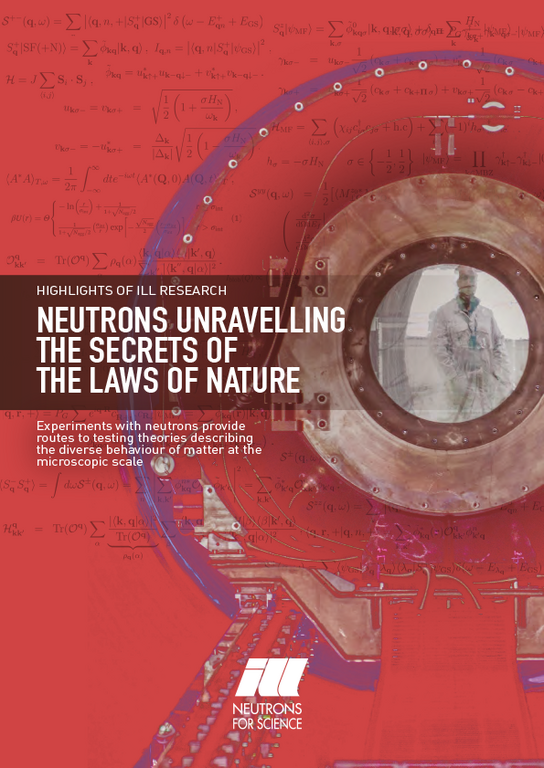
Highlights brochure on how neutrons unveil the secrets of matter:

Highlights

AdobeStock_1155410126.jpeg
28 juillet 2025 JEFF4: une nouvelle référence en matière de données nucléaires pour la recherche et ses applications.
La bibliothèque JEFF (Joint Evaluated Fission and Fusion) est une base de données qui rassemble les connaissances expérimentales et théoriques sur les données nucléaires, les mettant ainsi à la disposition de la communauté des utilisateurs de données nucléaires. La publication de sa version JEFF-4.0 est une avancée majeure pour cette communauté, un succès auquel l'ILL a largement contribué.
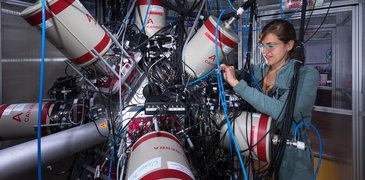
FIPPS_2019 10 21 256788_DSC2375.jpg
3 juillet 2025 Idées exotiques, objectifs unifiés
Même plus d'un siècle après la découverte du noyau atomique, aucun modèle universel n'est encore capable de prédire avec fiabilité ses propriétés en fonction des variations du nombre de protons et de neutrons. Les noyaux exotiques, ces systèmes complexes et très instables dotés de propriétés uniques, repoussent les limites de la théorie nucléaire actuelle. Une nouvelle pièce de ce puzzle a récemment été ajoutée par la combinaison de résultats expérimentaux issus de deux grandes installations internationales et de calculs théoriques avancés.
231130 MirrorNeutrons 13_vignette.jpg
30 novembre 2023 Les neutrons oscillent-ils dans un monde caché ?
Aujourd'hui, les physiciens peuvent décrire notre monde avec une précision toujours croissante : le modèle standard de la physique des particules décrit avec succès toutes les observations concernant trois des quatre interactions fondamentales (l'interaction électromagnétique, l'interaction faible et l'interaction forte). La gravitation, la quatrième interaction connue, est entièrement expliquée …