🇬🇧
•

Recherche
Une culture solide en matière de sûreté et de sécurité constitue un principe fondamental pour toute installation nucléaire. À l’ILL, des mesures techniques et organisationnelles sont mises en œuvre afin de réduire les risques à un niveau jugé acceptable. C’est ce qu’on appelle le domaine de la sûreté nucléaire, qui englobe les mesures visant à :
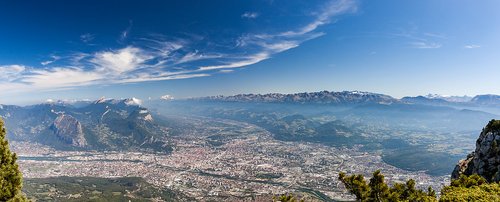
L'ILL exploite un laboratoire de surveillance de la radioactivité dans l'environnement, qui est agréé par l'Autorité de sûreté nucléaire et de radioprotection (ASNR) et qui fait partie du réseau national de mesure géré par l'ANR. Les résultats des mesures effectuées sont rendus publics par leur intermédiaire sur ce site.
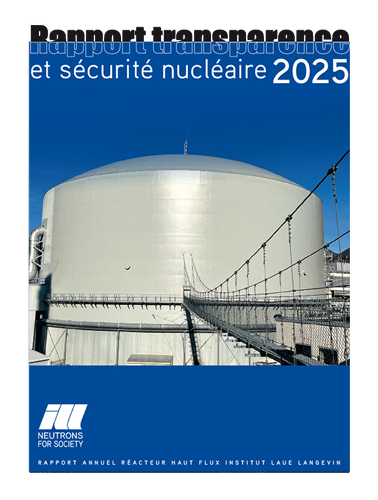
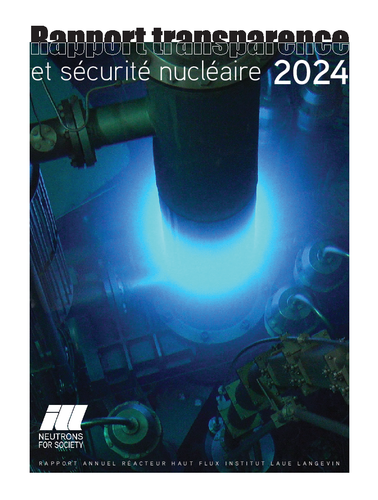
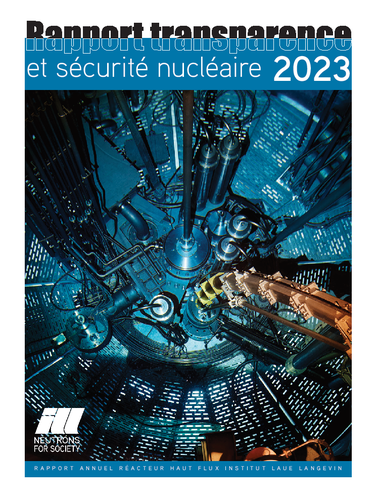
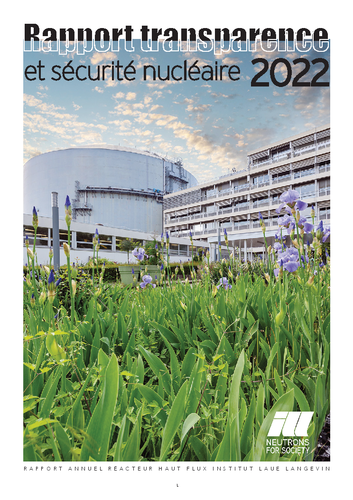
Les déchets radioactifs produits par l'Institut font l'objet d'une déclaration annuelle aux autorités (TSN). Ce rapport présente un aperçu de l'activité de l'ILL au cours de l'année écoulée. Les rapports annuels sont disponibles ci-dessous en français.
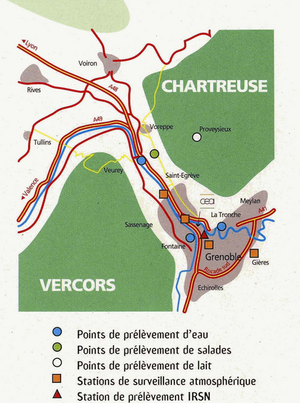
Il s’agit de contrôler la radioactivité dans tous les compartiments de l’environnement. Cette surveillance radiologique implique quelque 1500 prélèvements d’échantillons par an, qui donnent lieu à 5000 analyses !
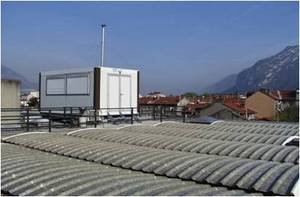
Le laboratoire dispose également d'équipements mobiles destinés à être utilisés en cas d'accident, à savoir deux véhicules d'intervention équipés d'appareils de surveillance des radiations.
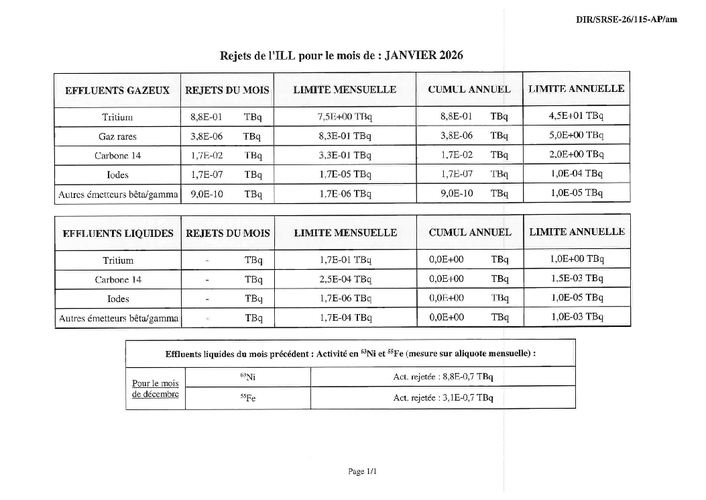
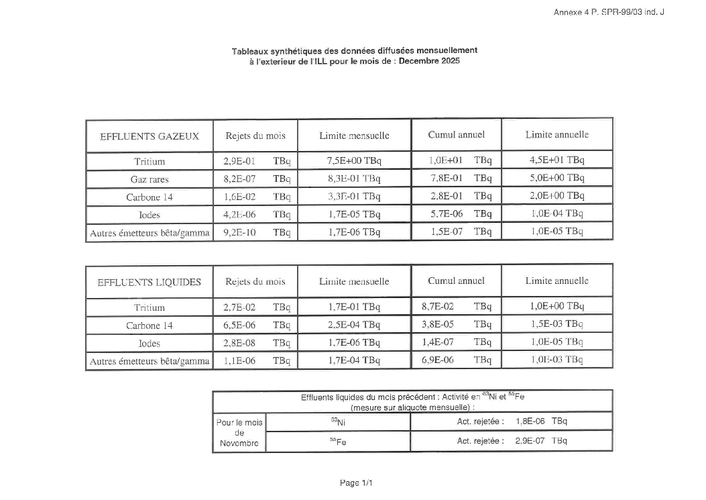
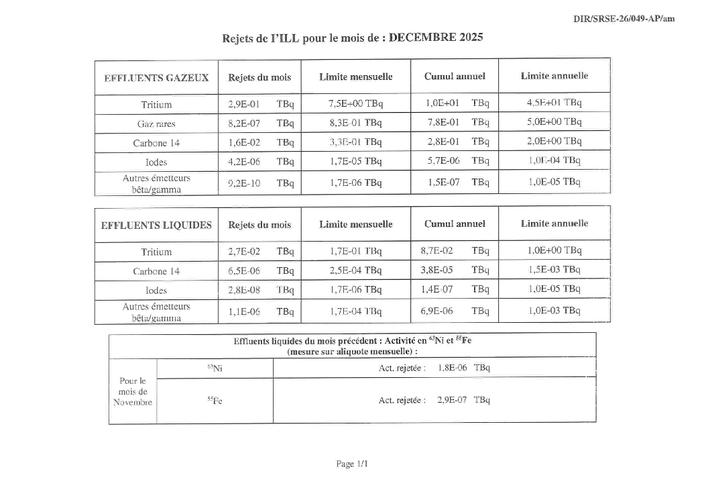
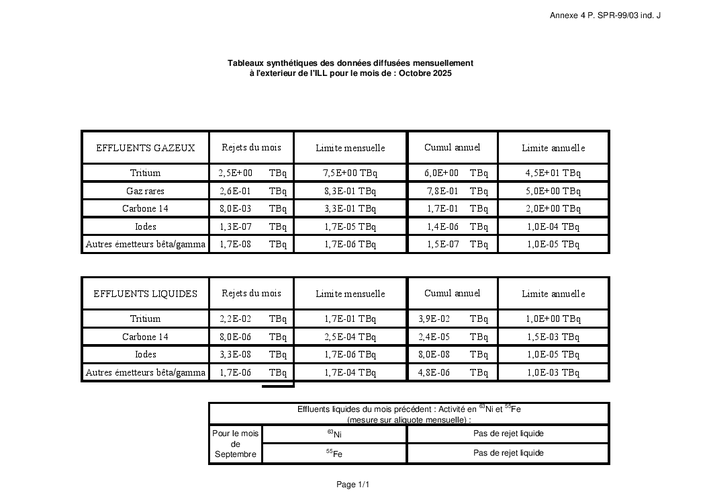
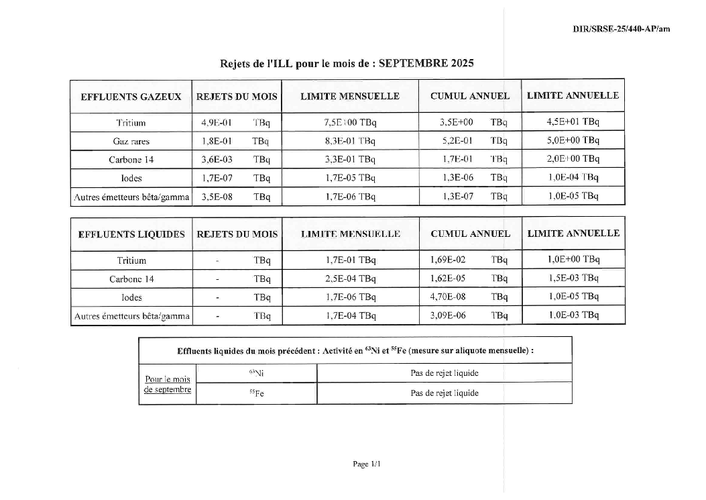
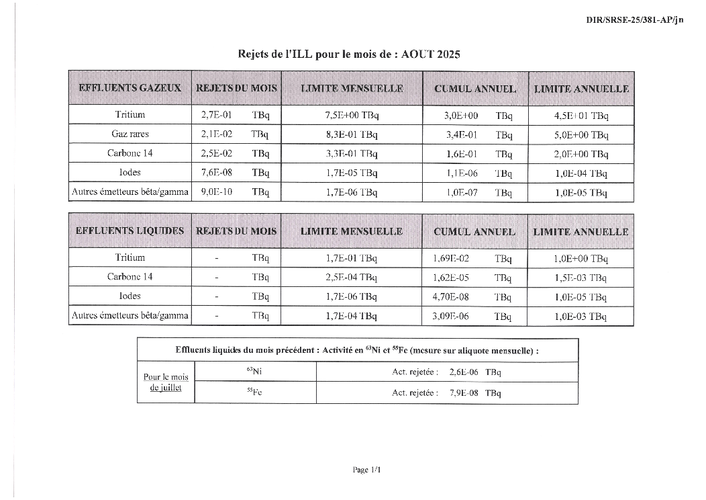
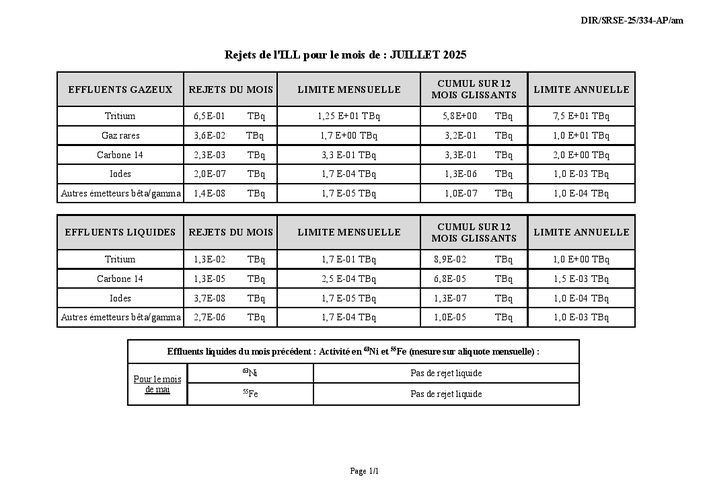
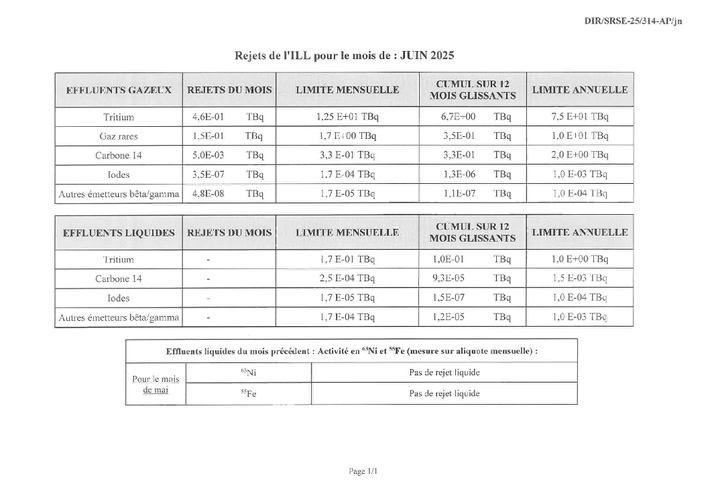
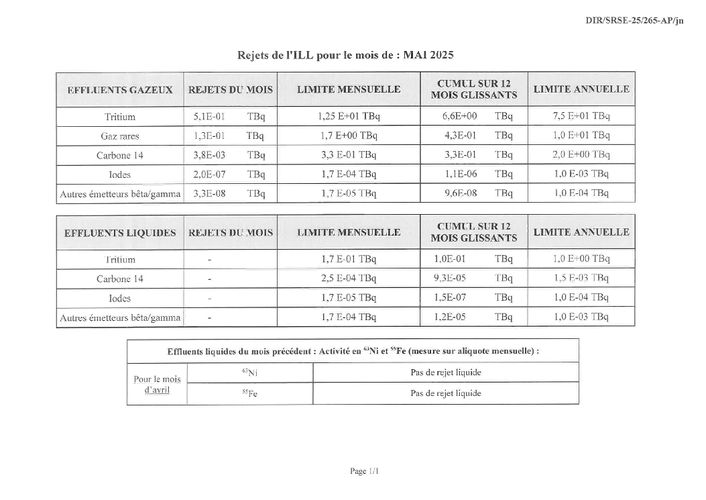
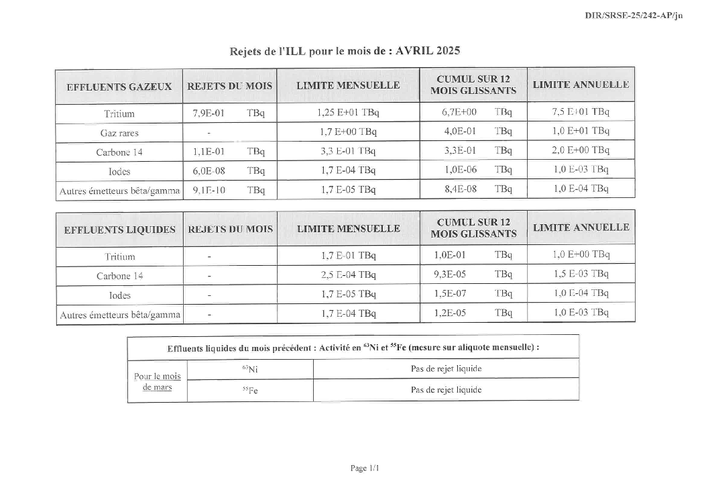
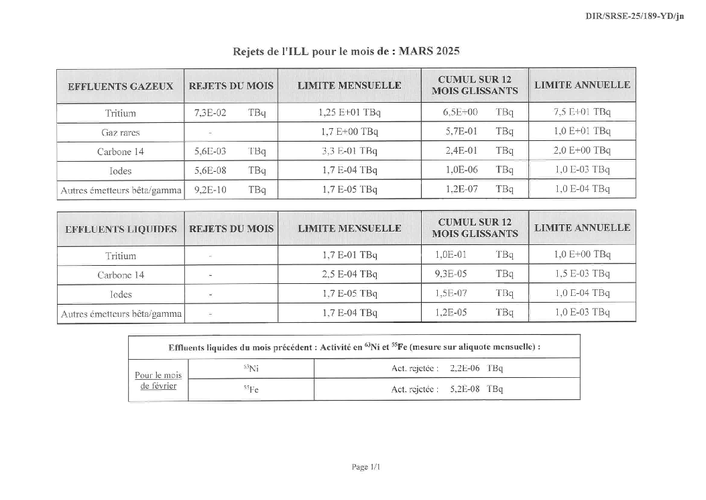
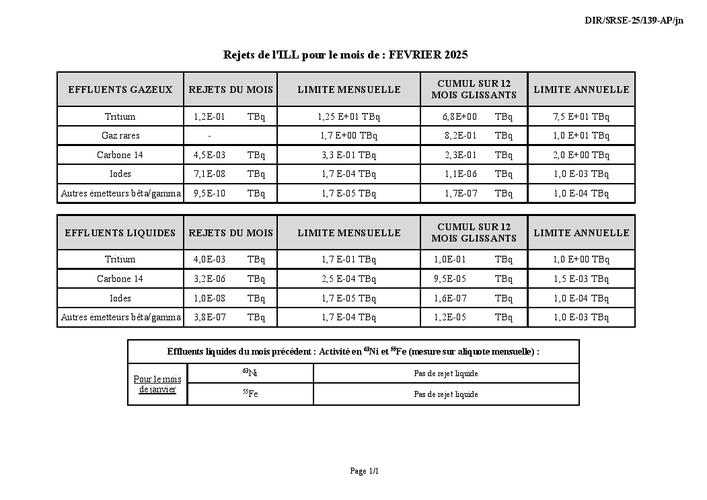
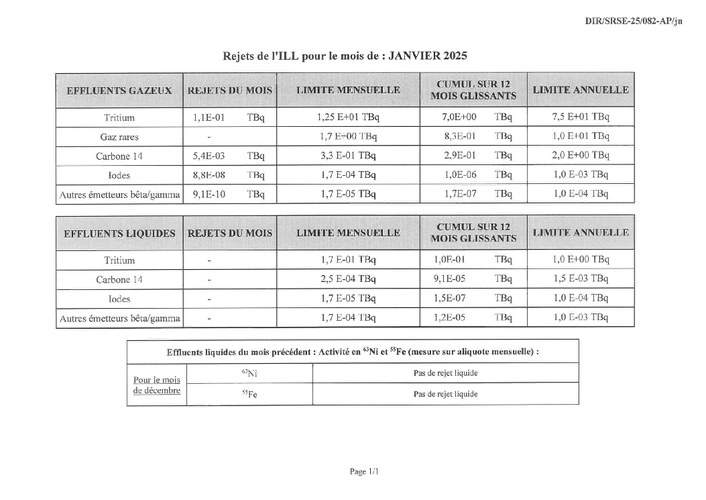
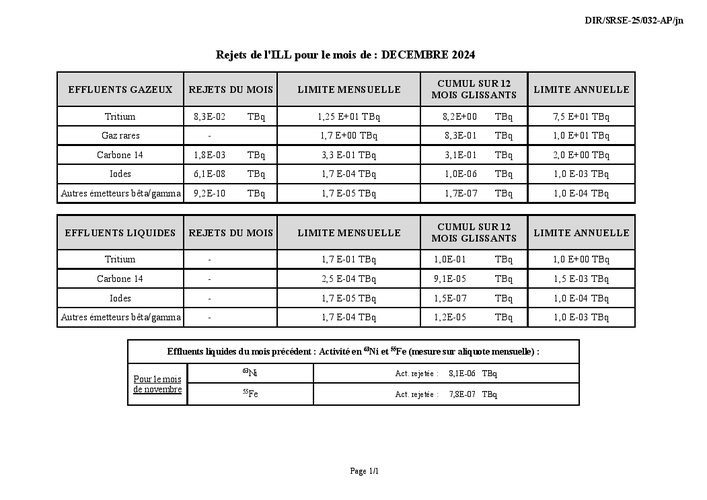
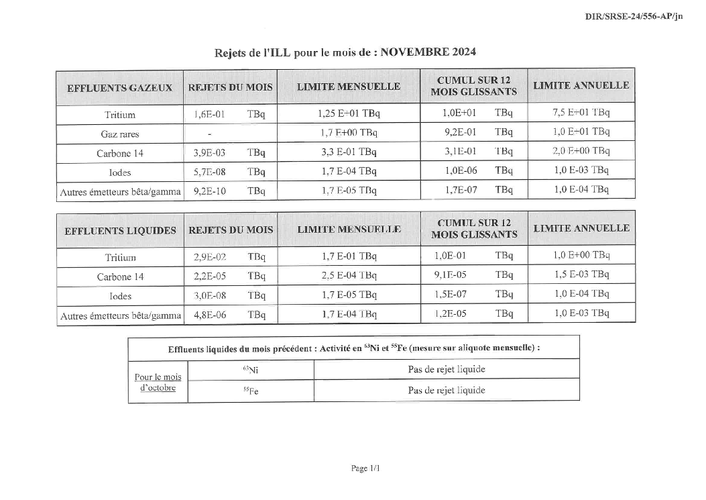
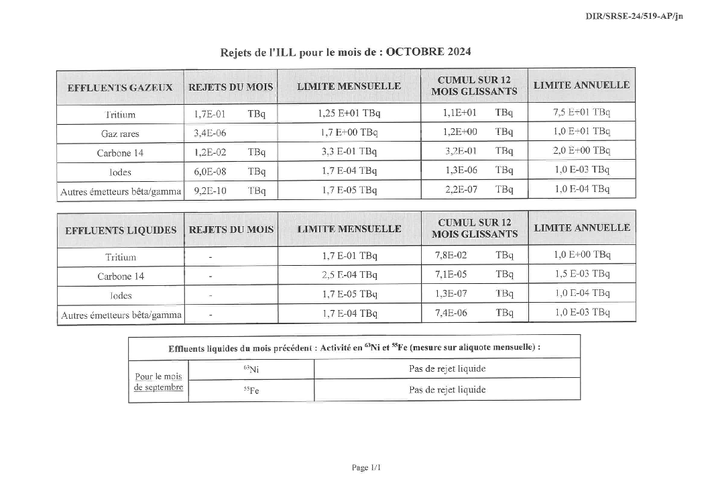
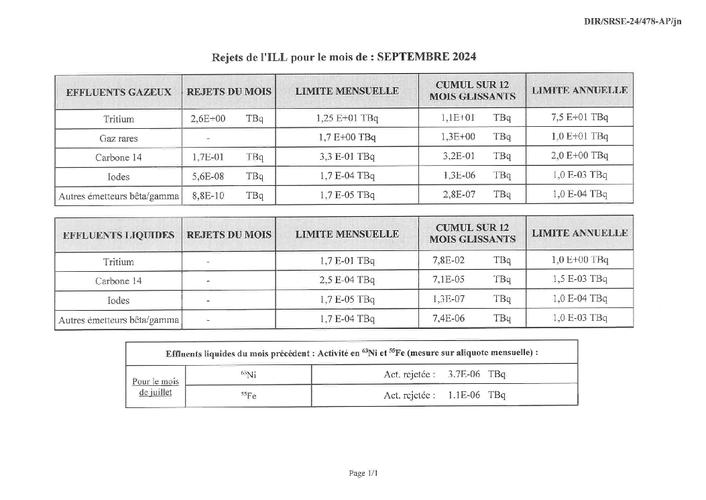
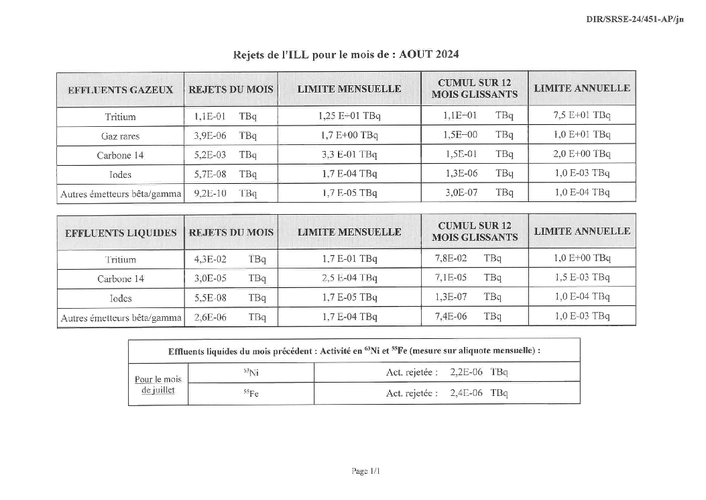
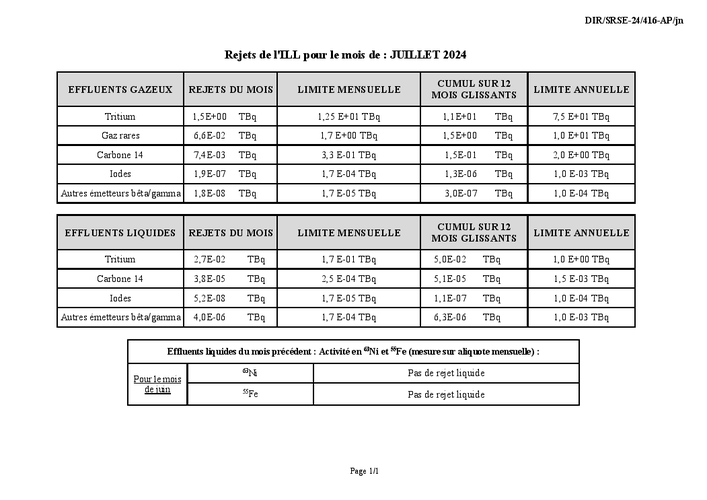
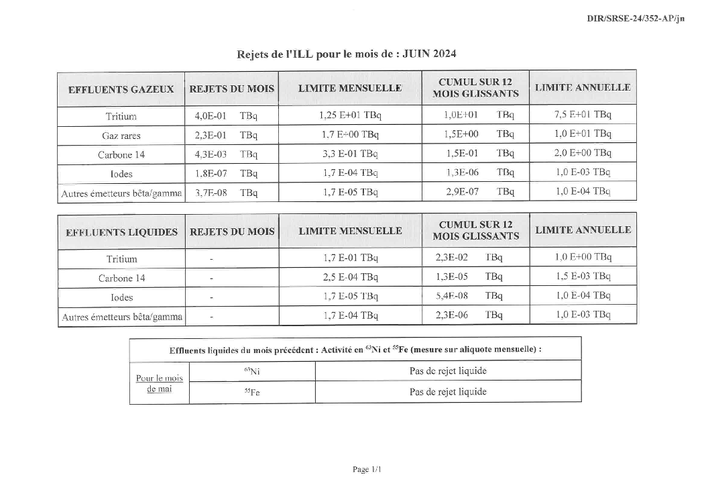
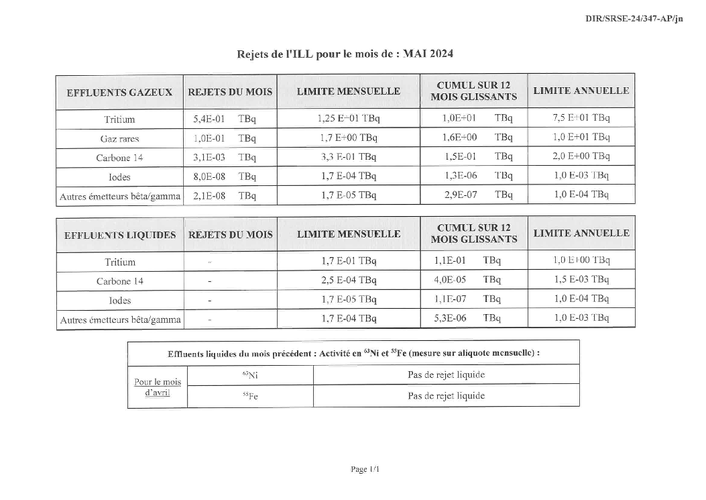
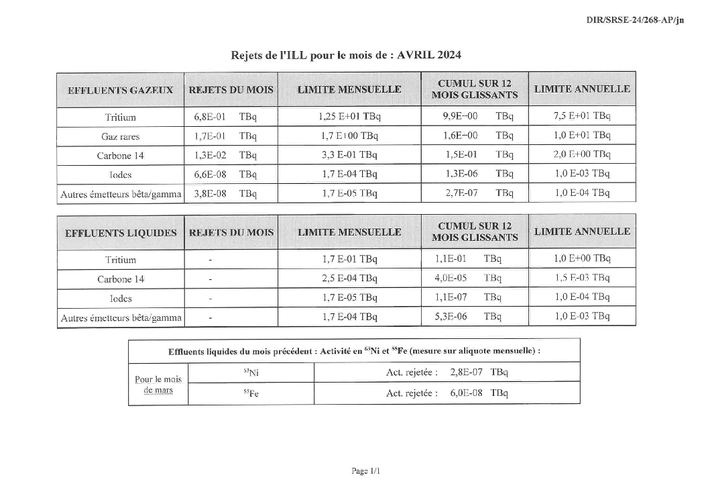
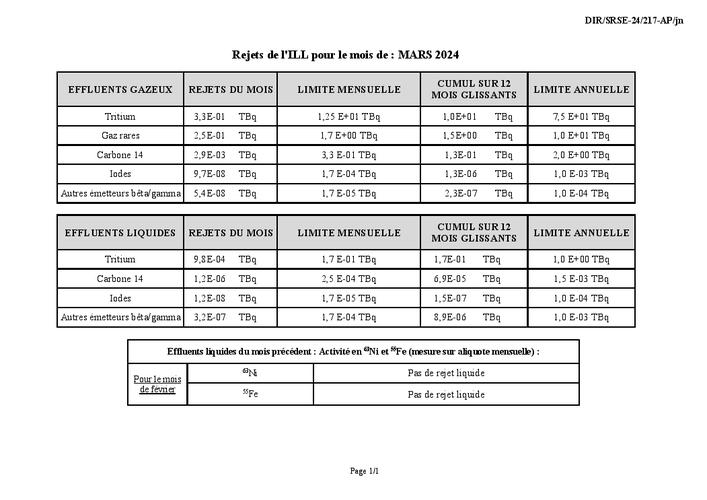
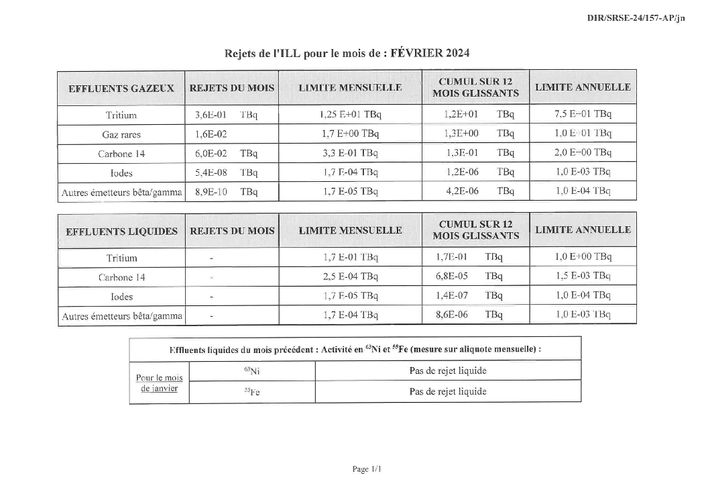
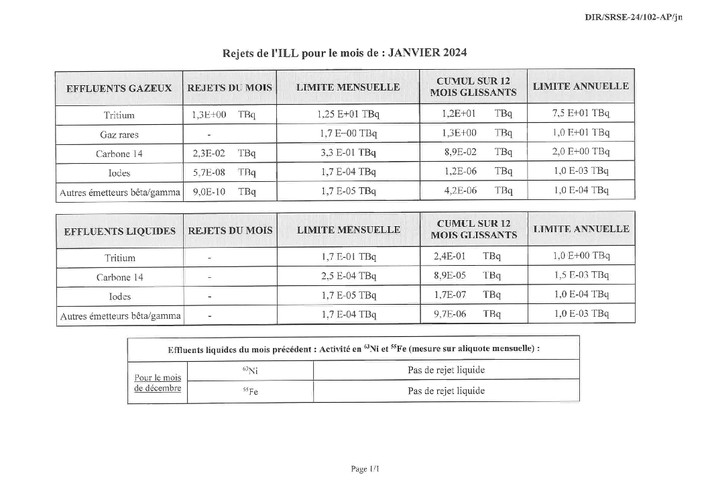
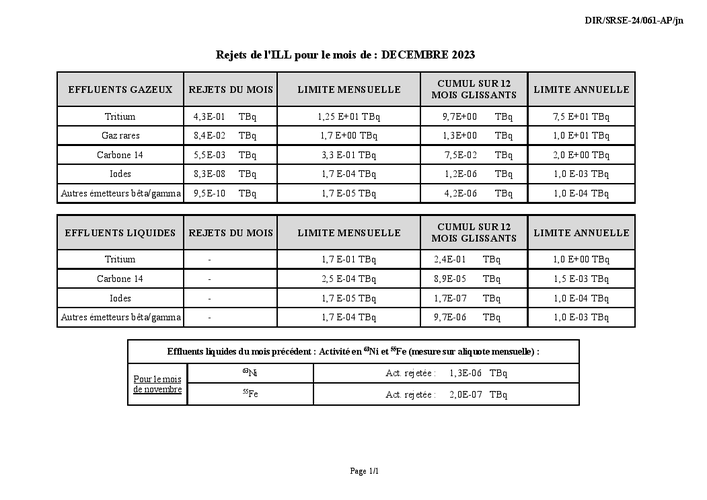
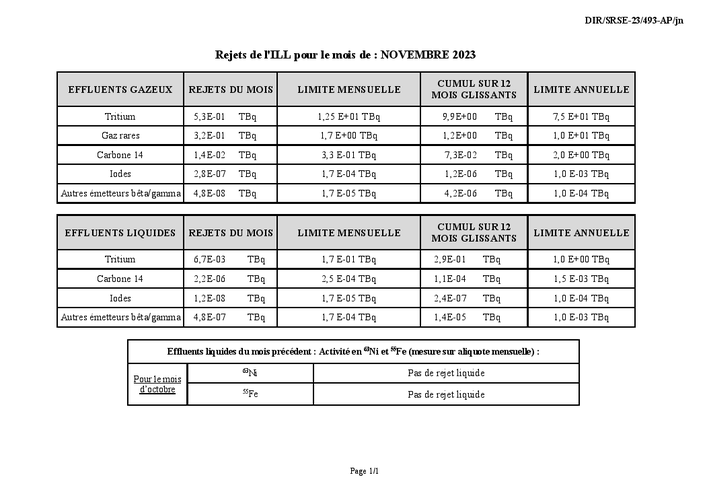
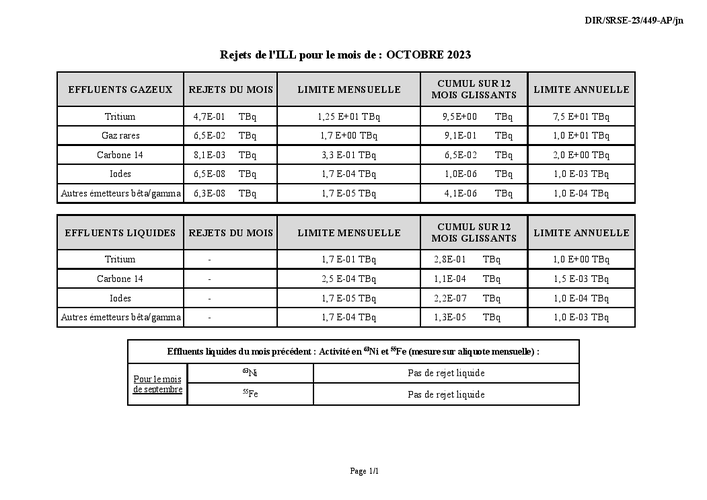
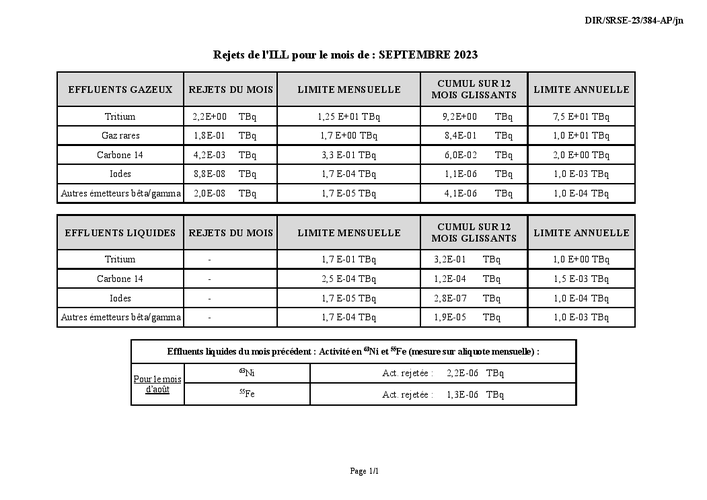
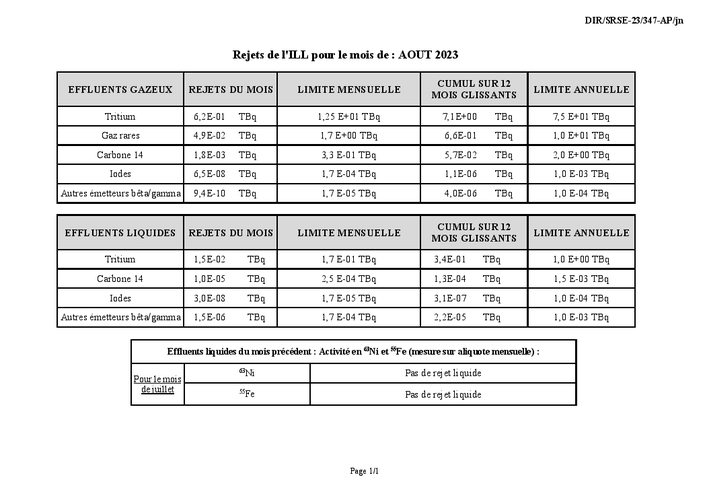
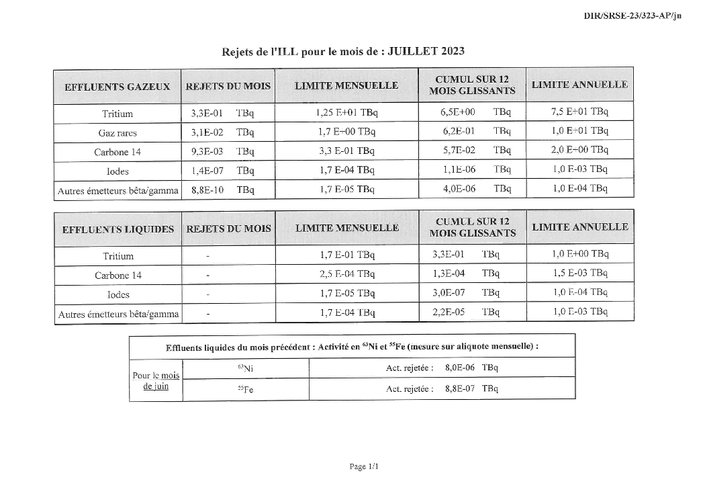
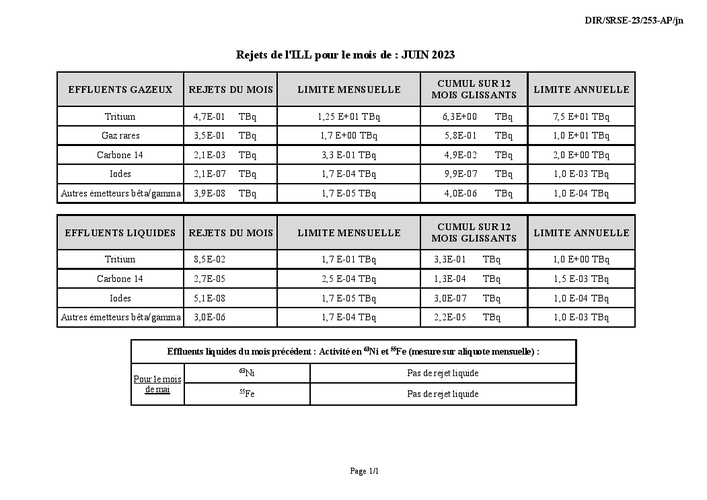
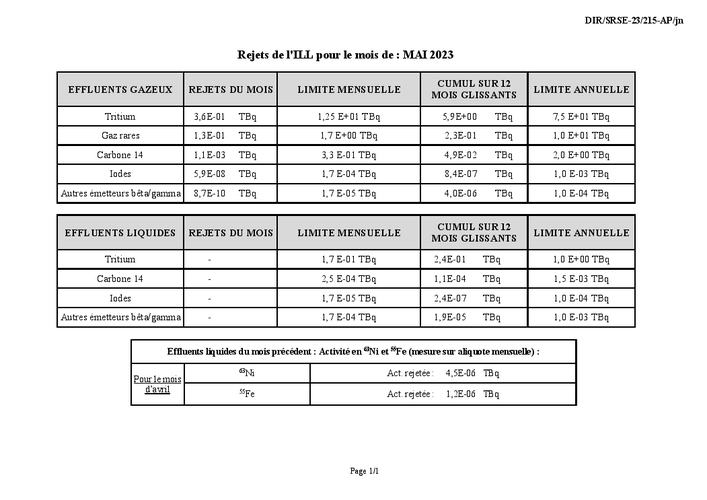
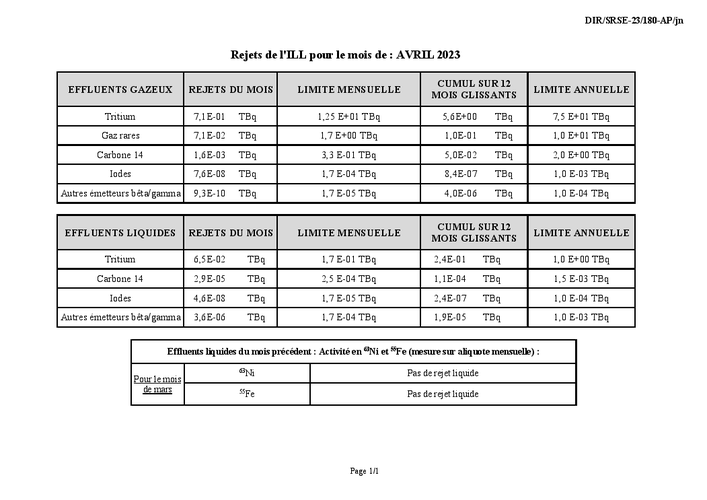
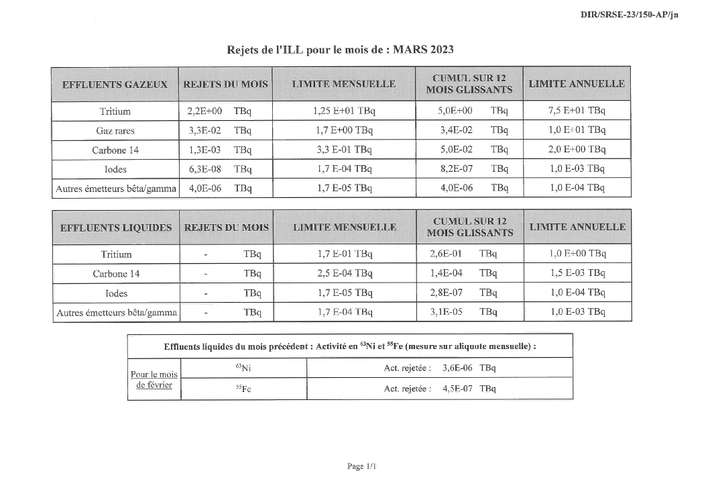
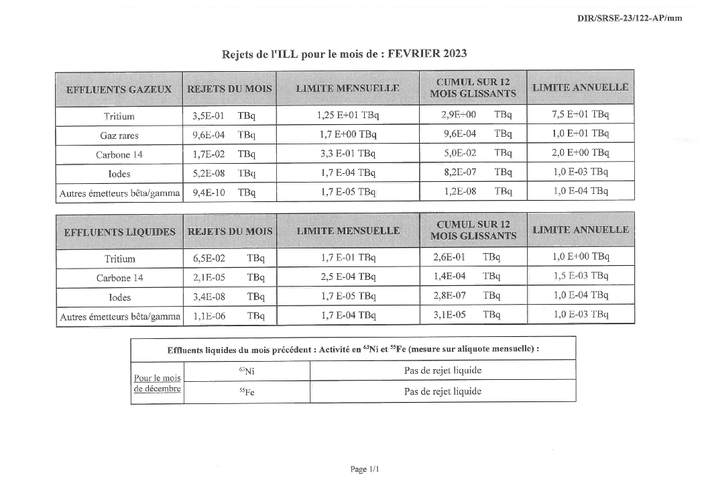
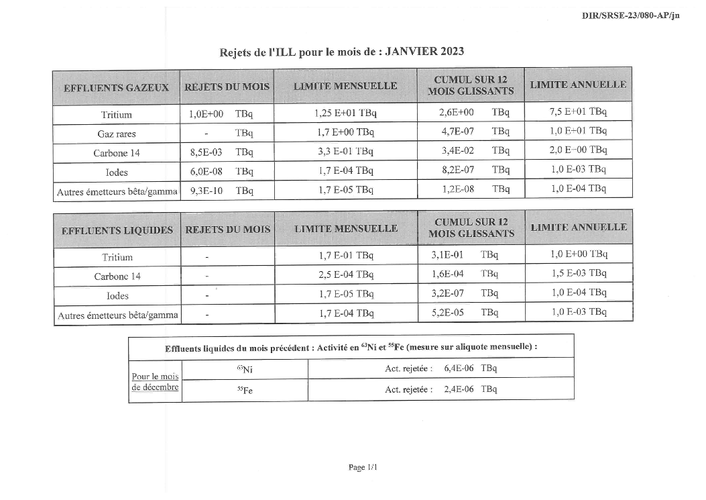
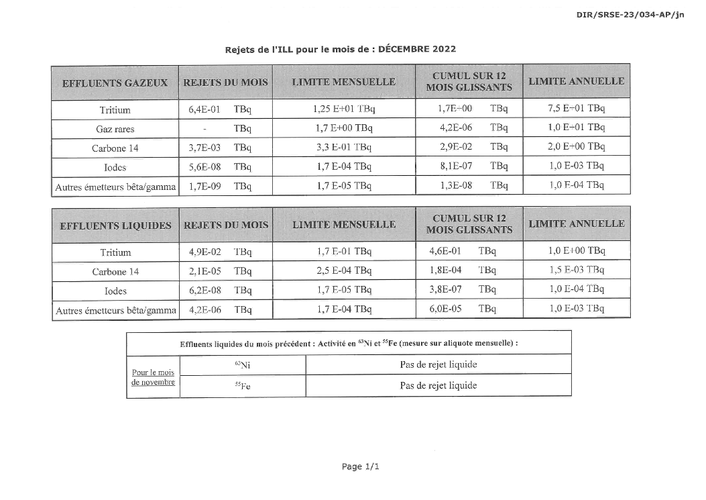
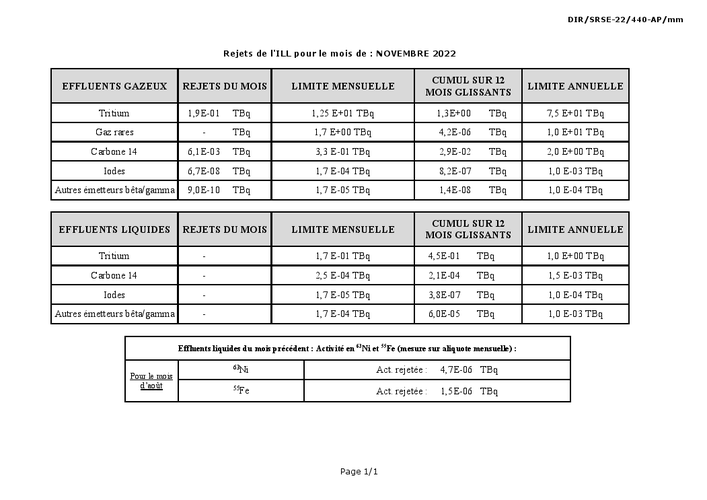
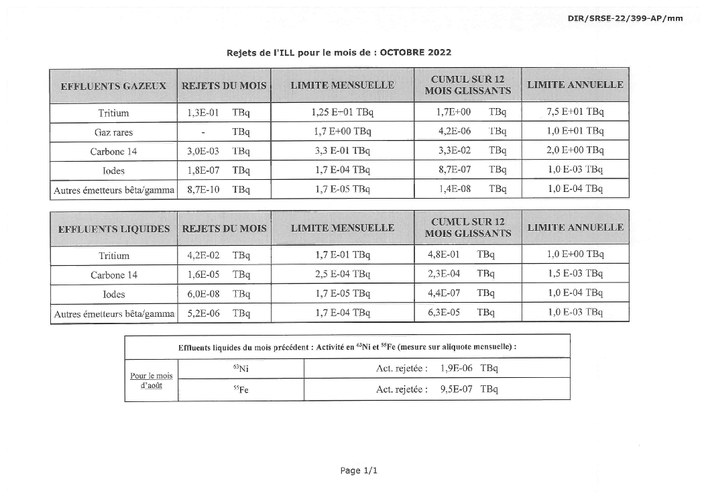
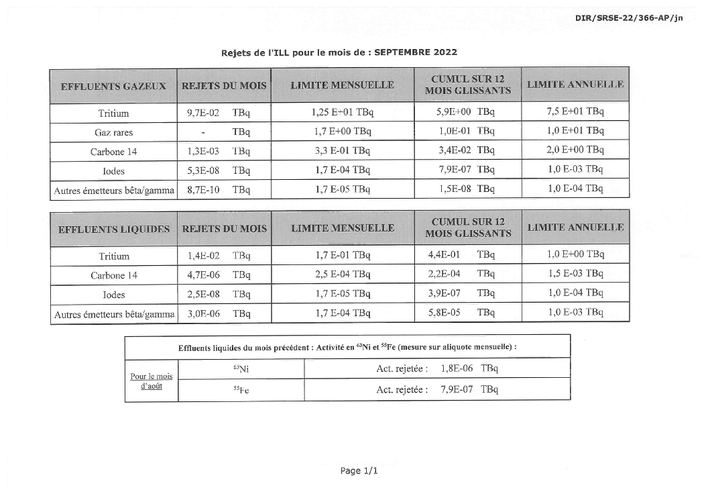
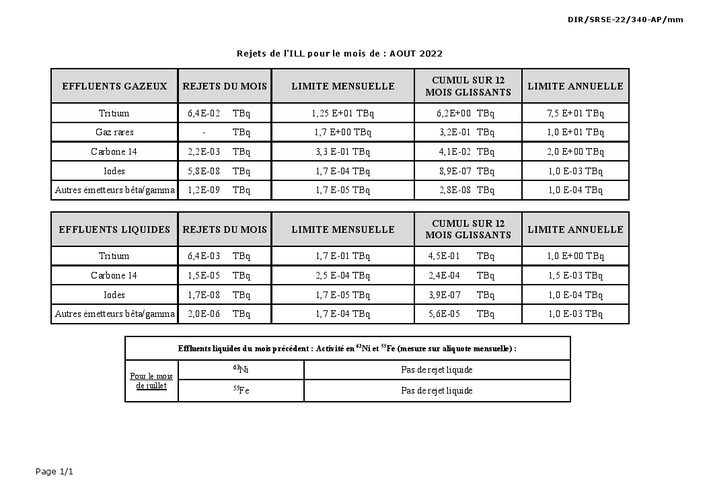
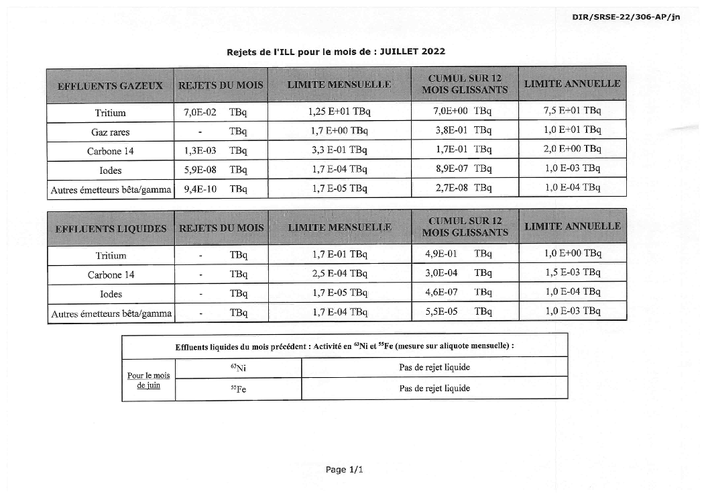
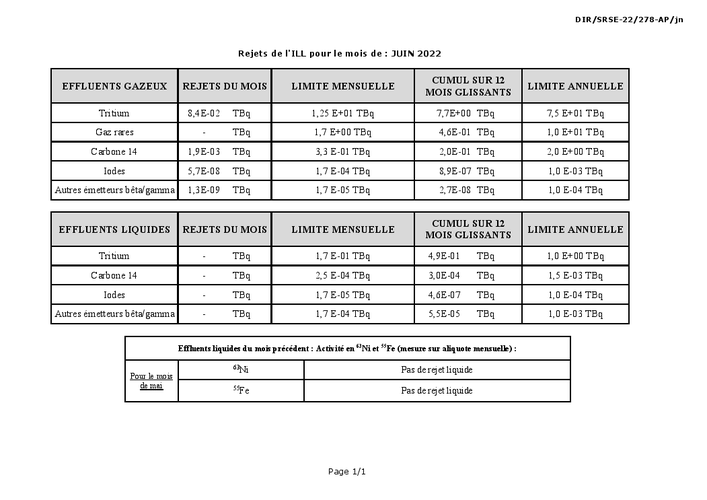
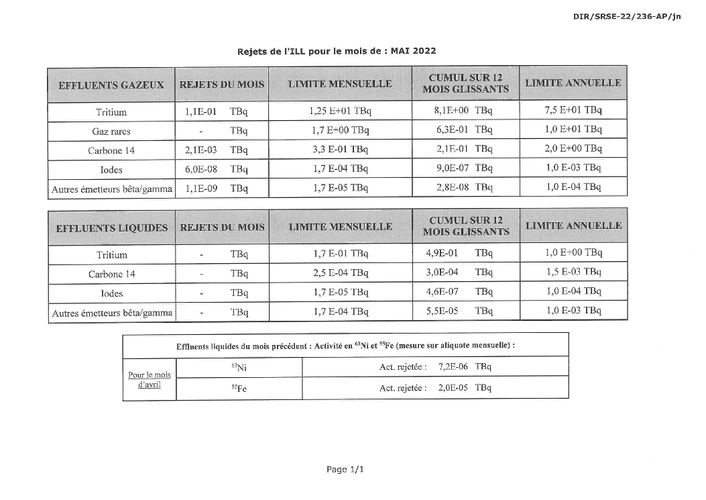
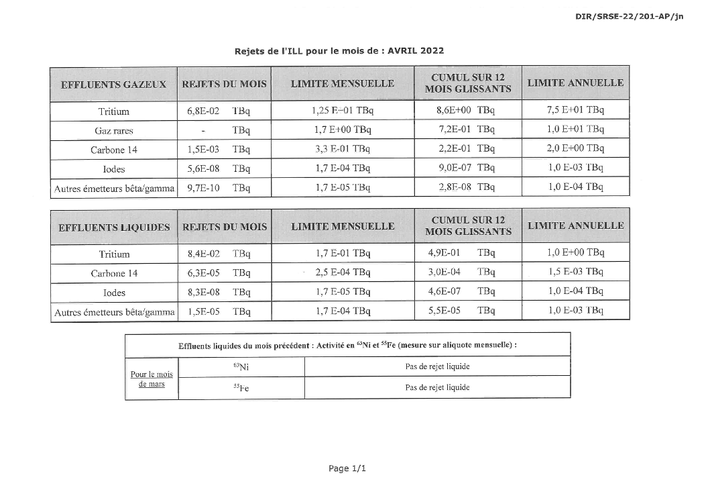
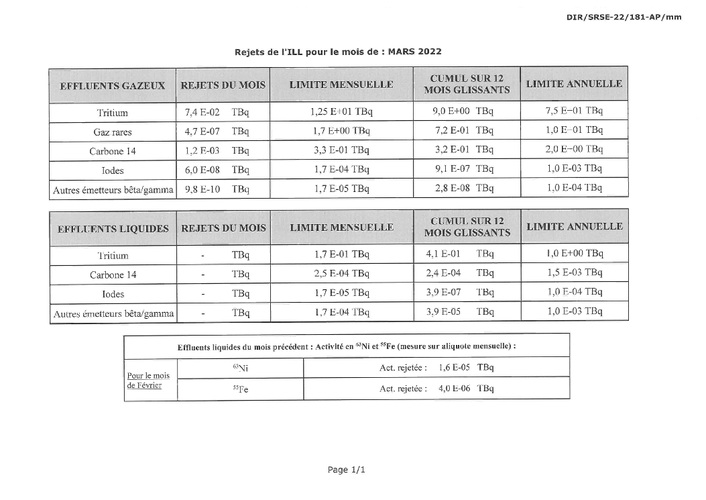
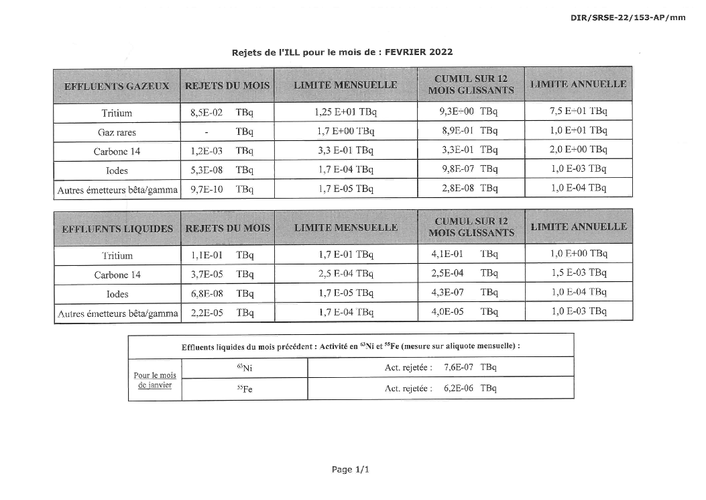
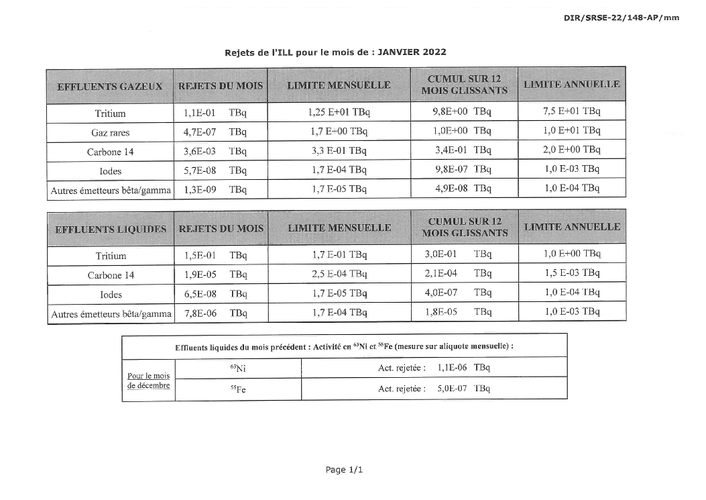
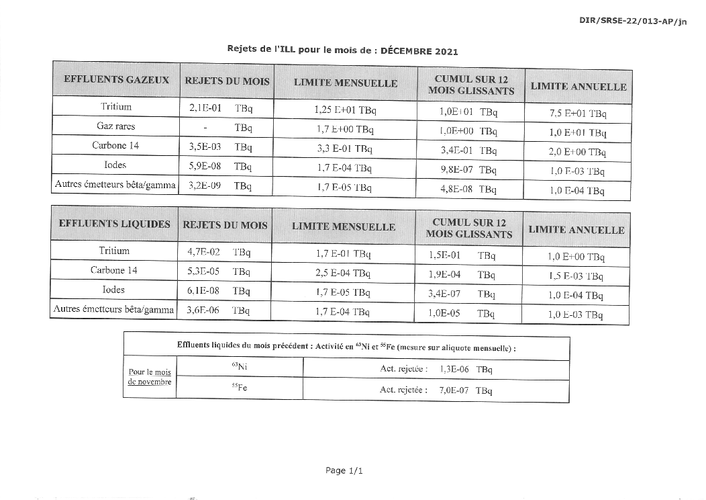
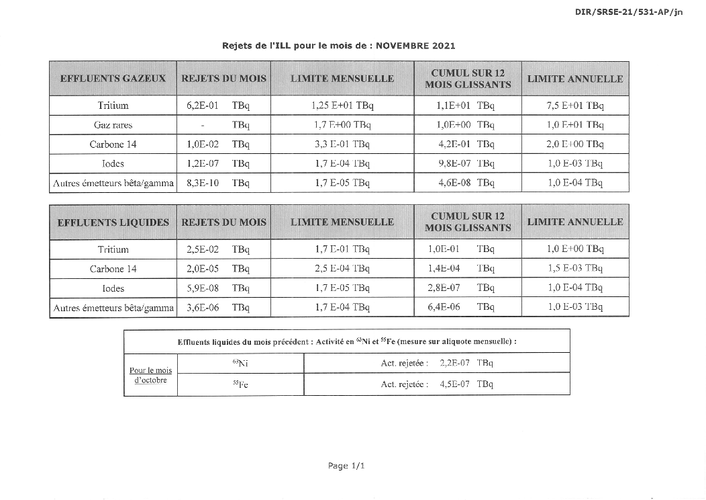
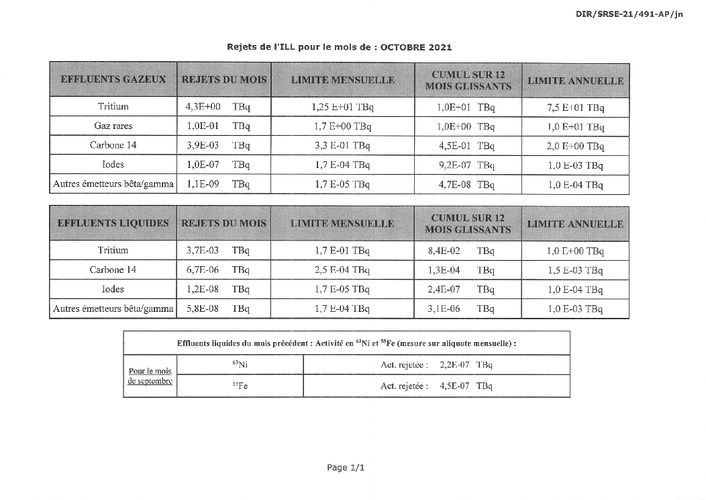
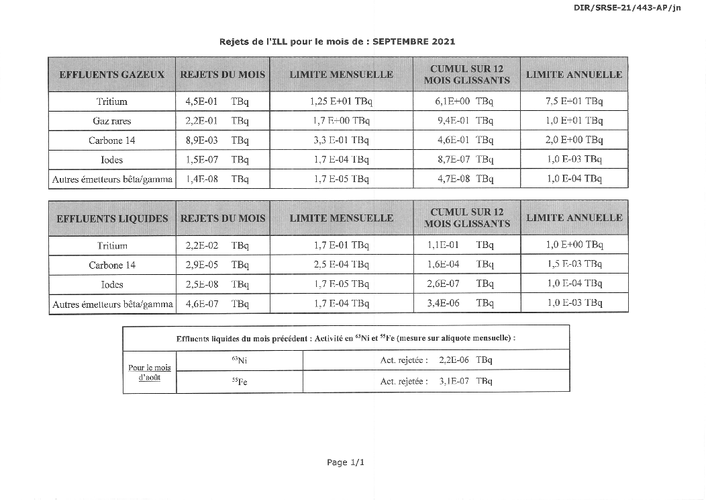
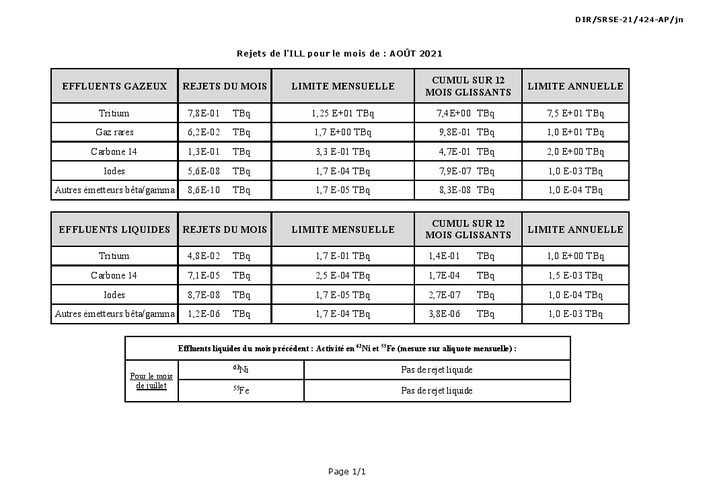
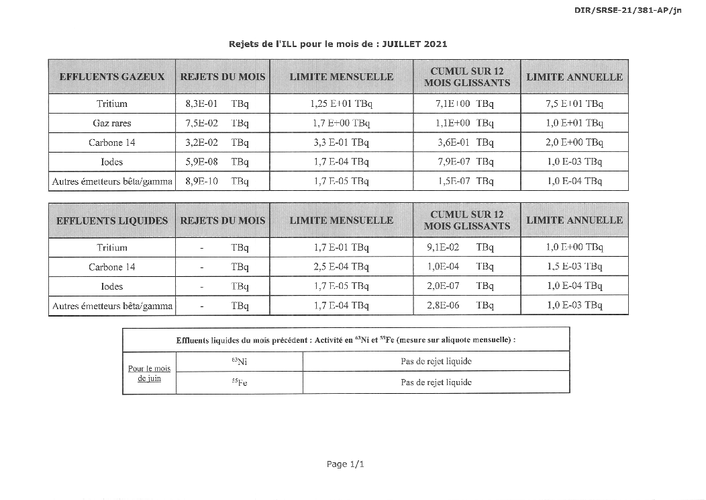
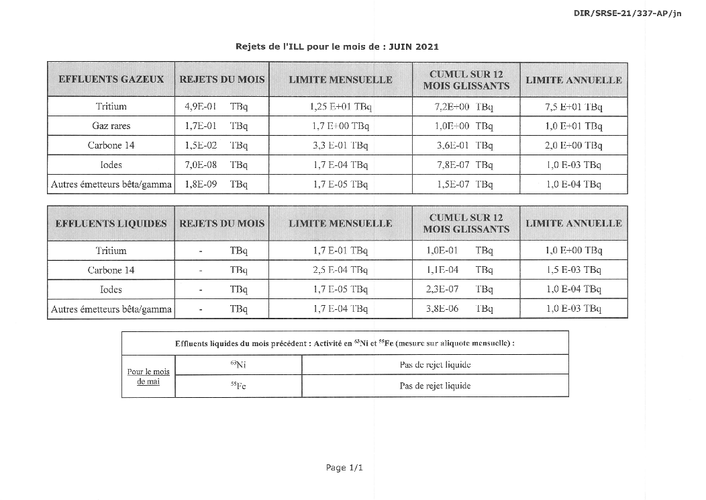
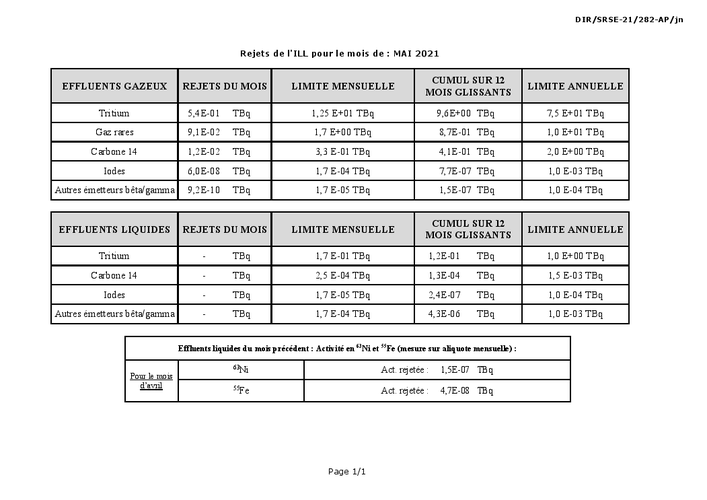
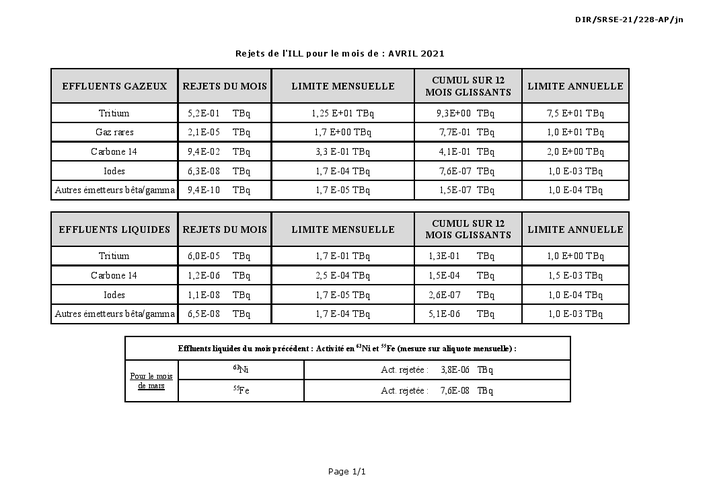
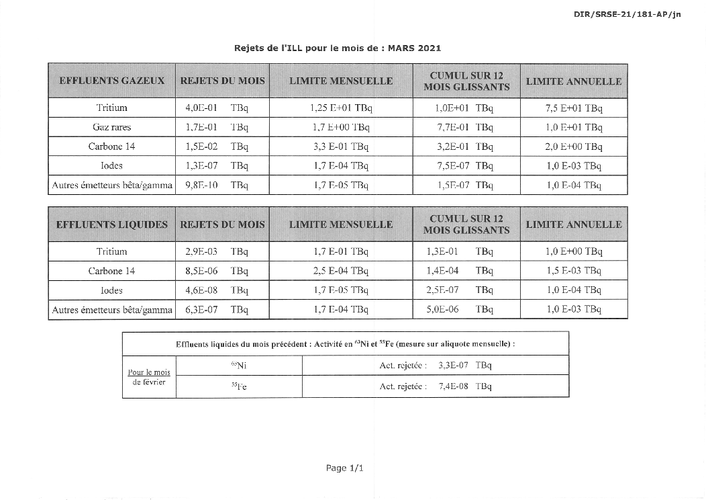
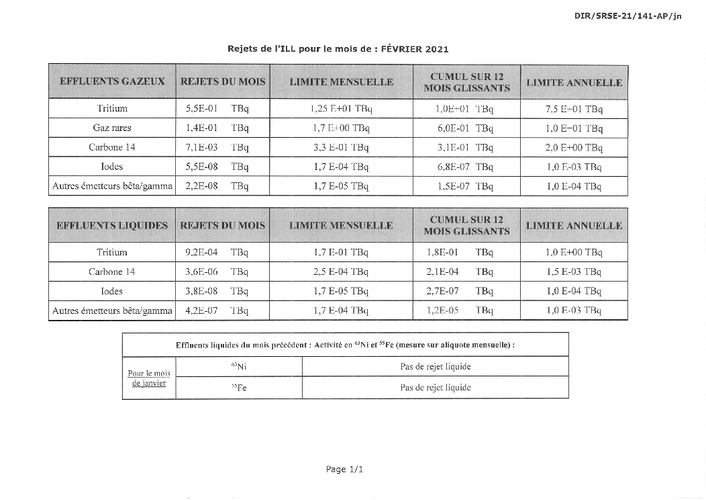
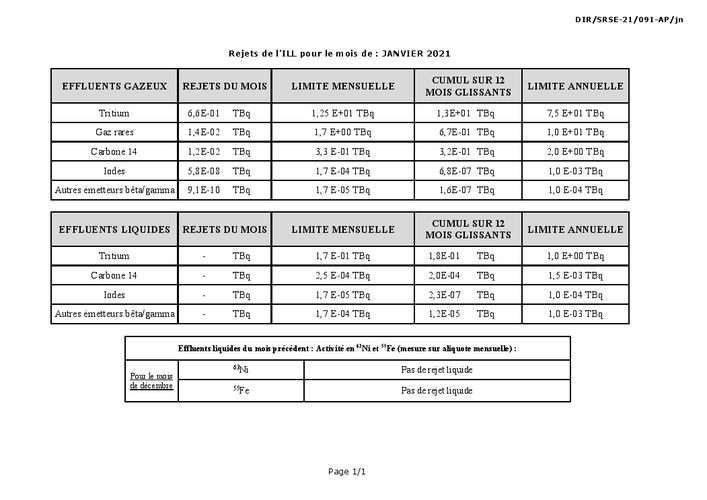
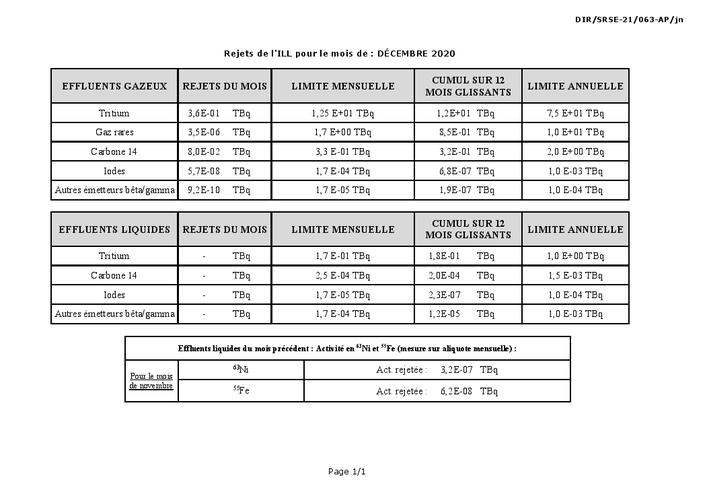
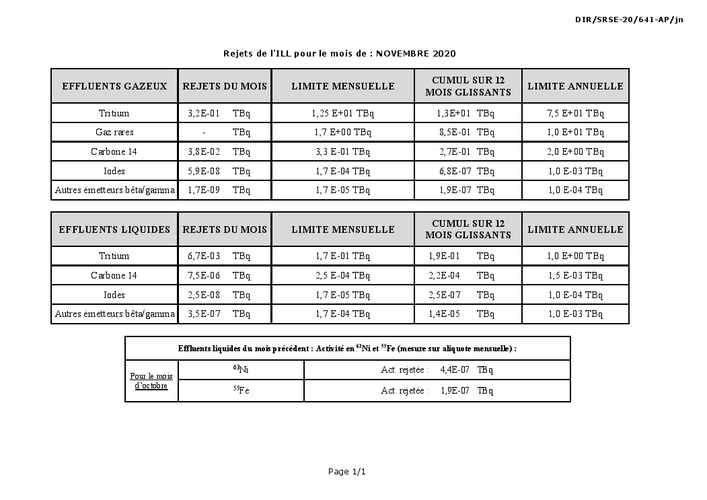
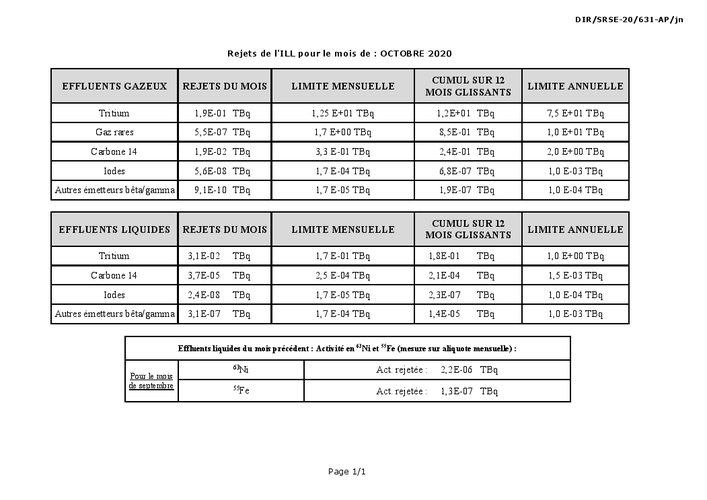
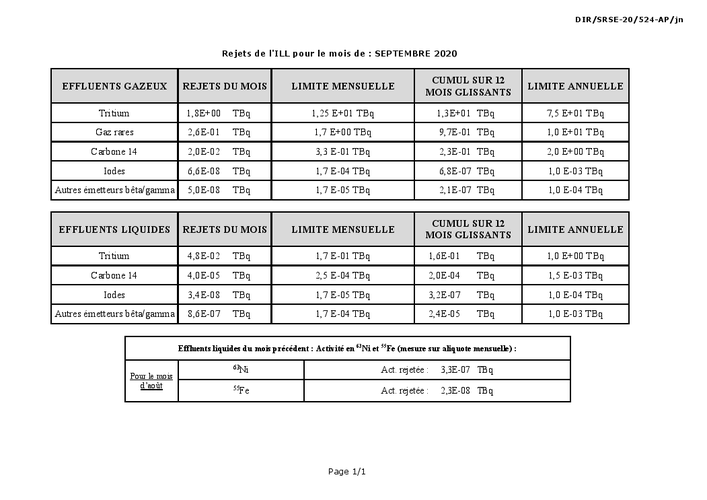
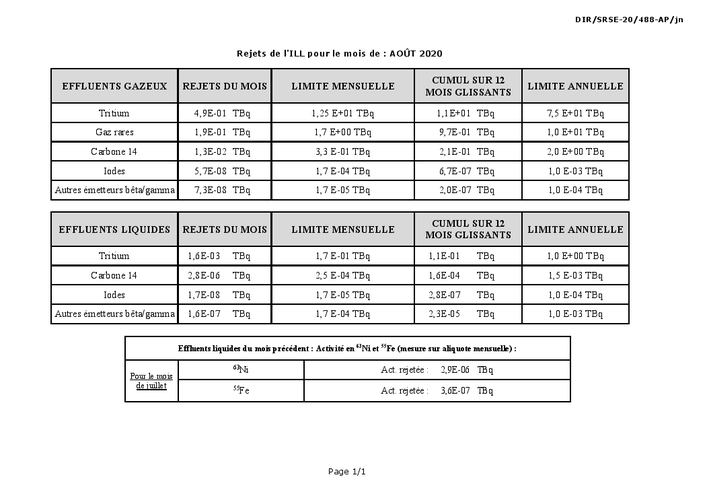
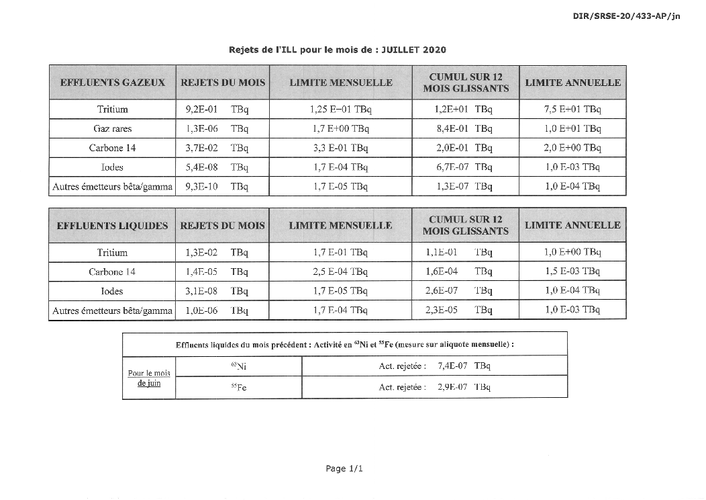
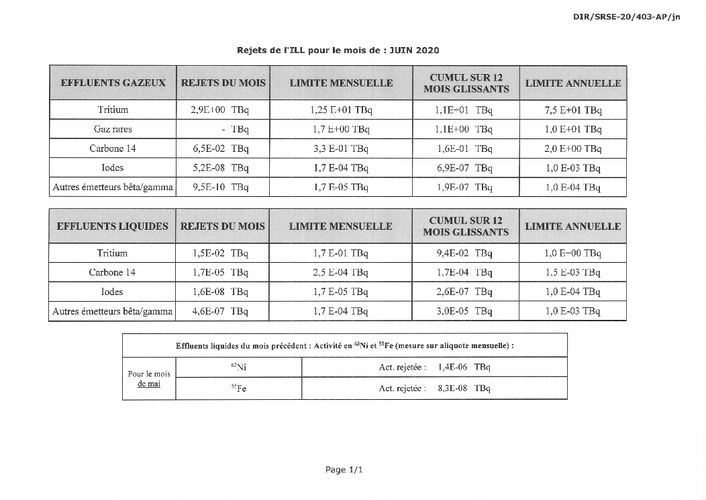
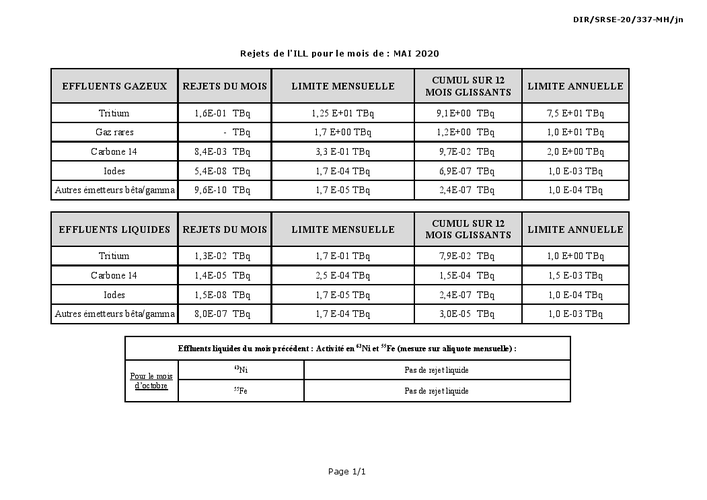
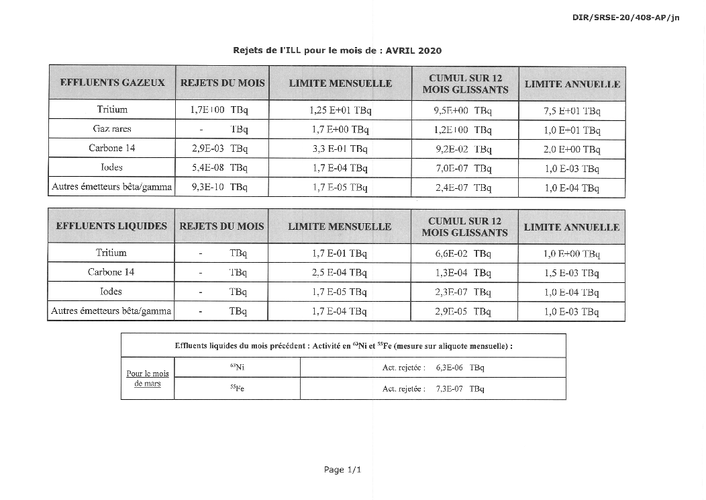
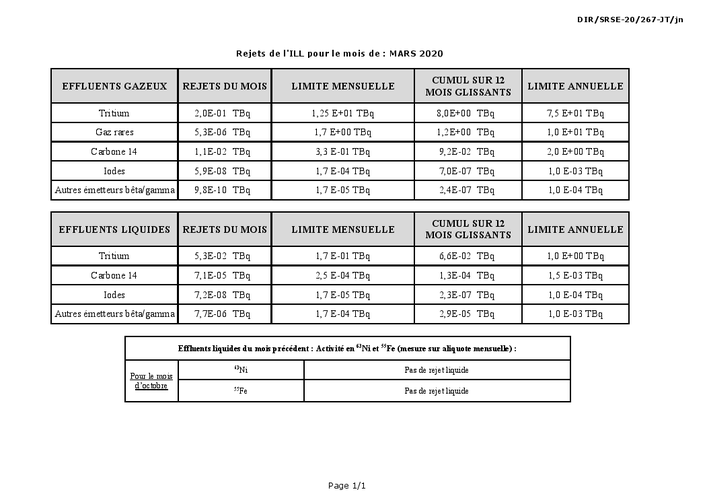
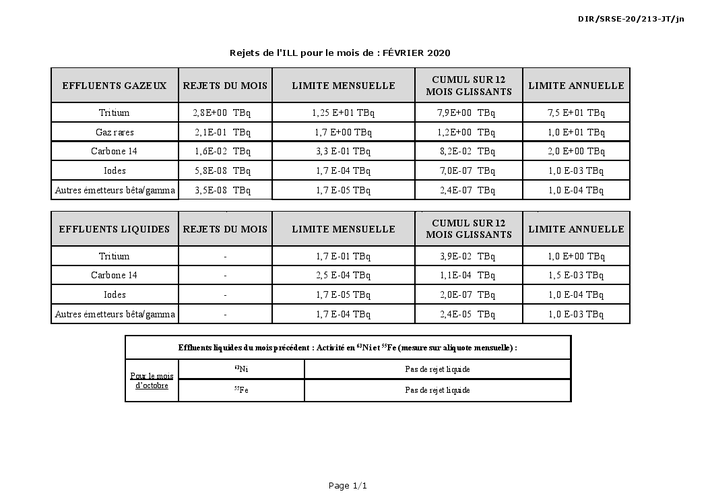
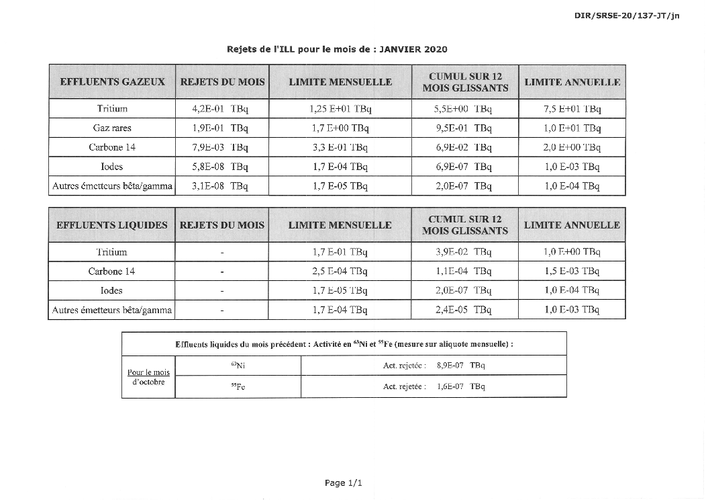
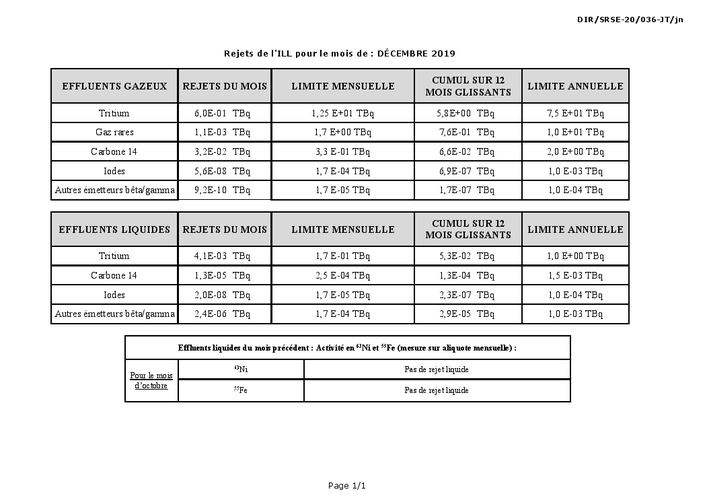
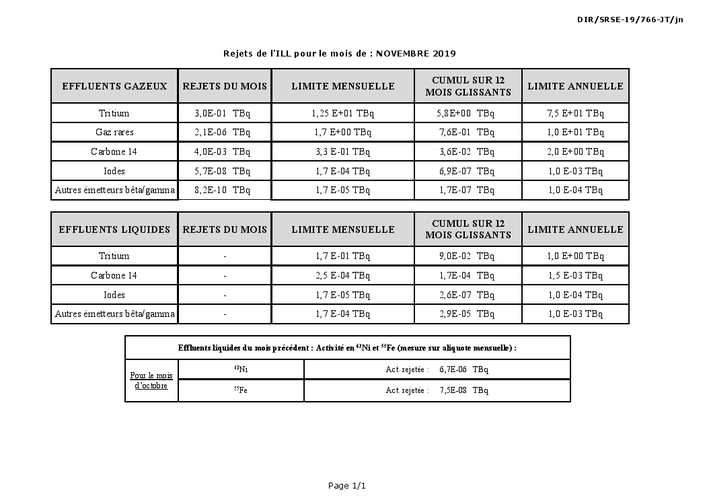
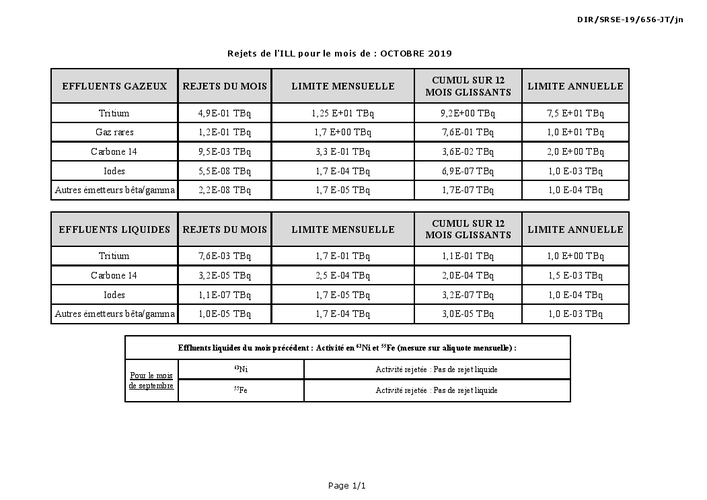
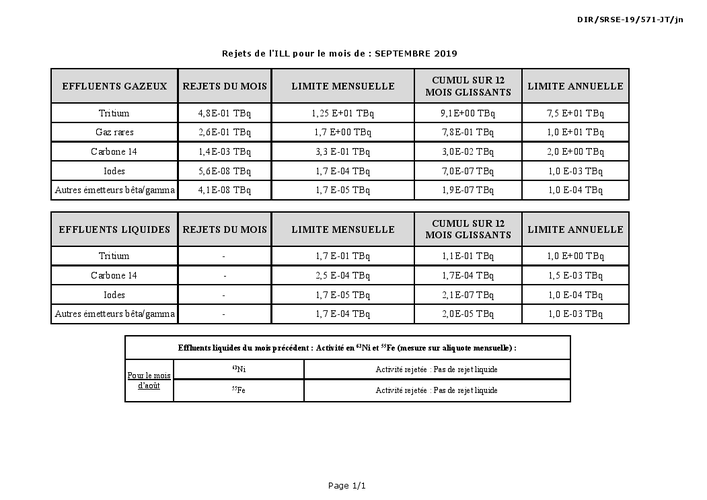
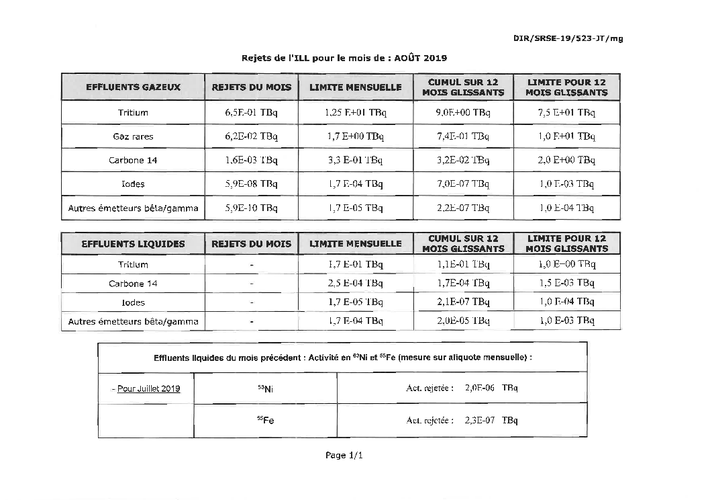
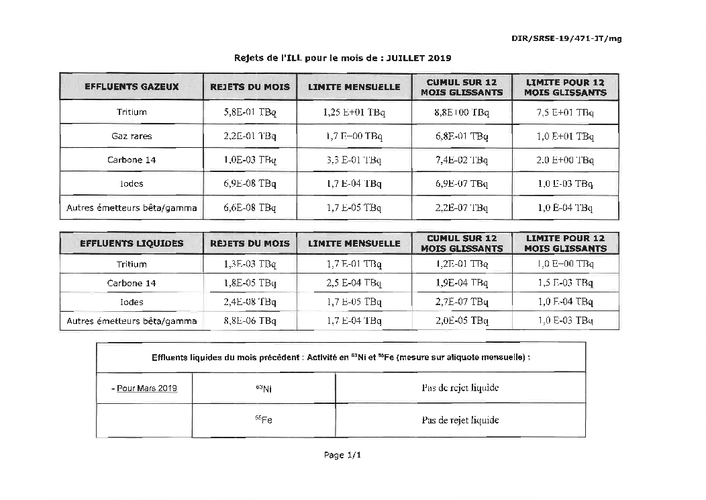
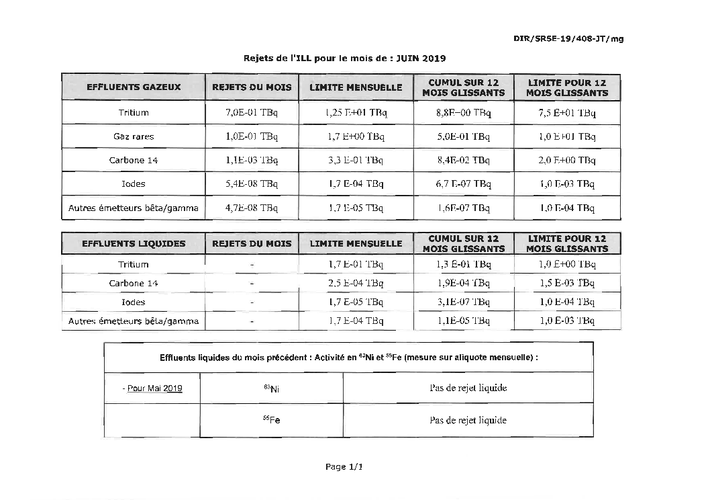
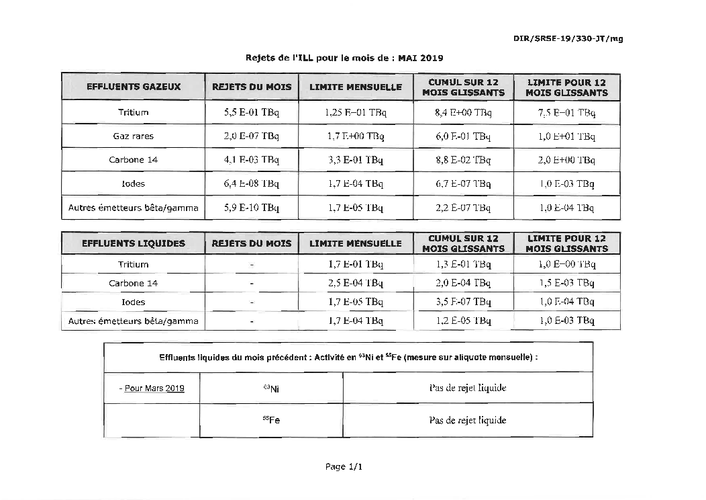
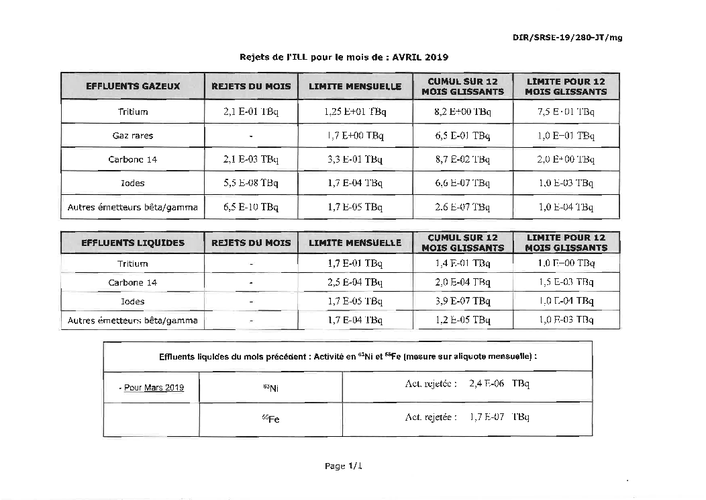
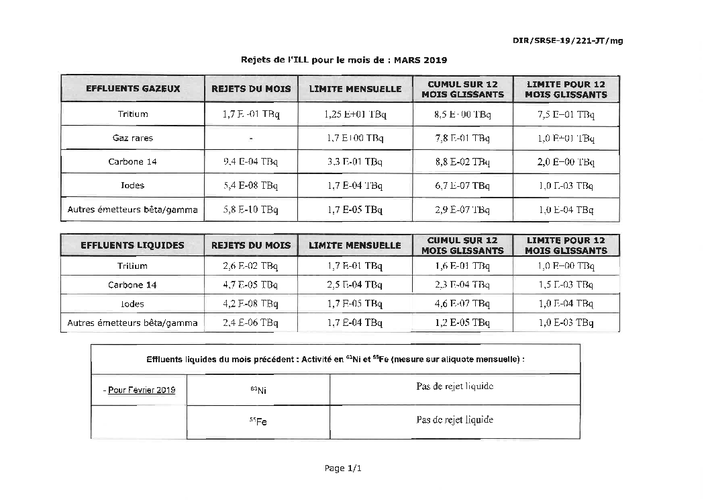
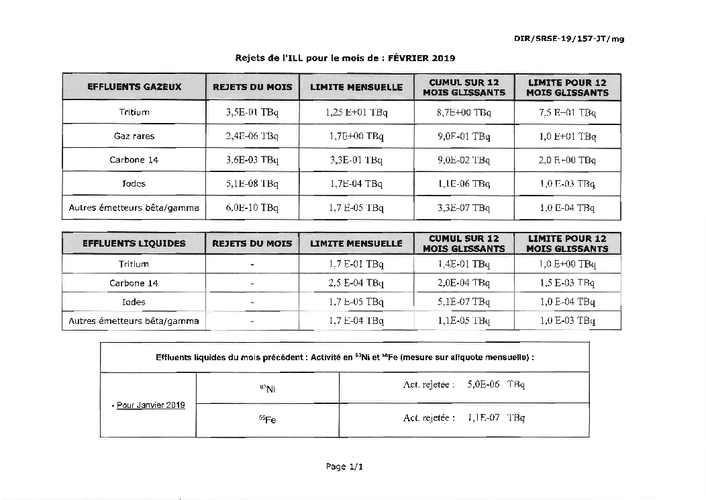
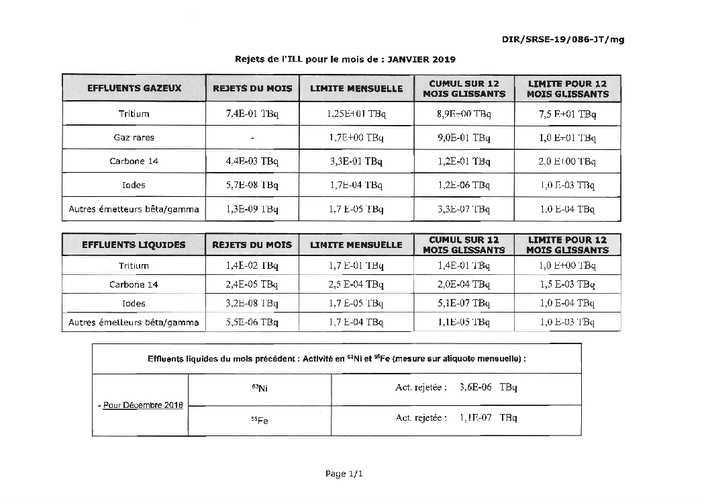
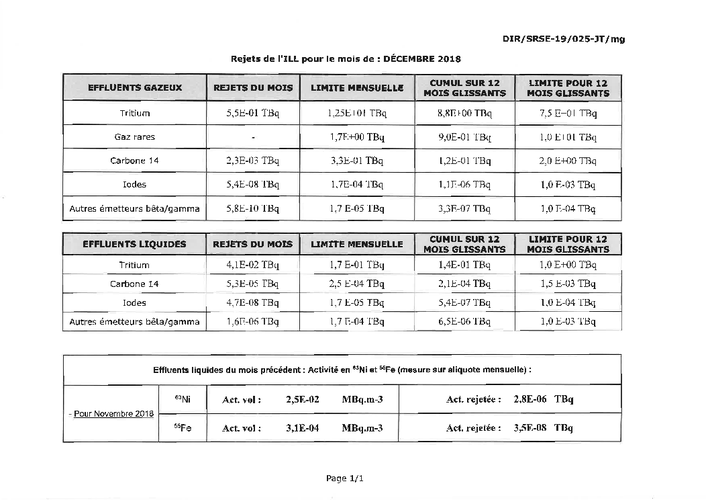
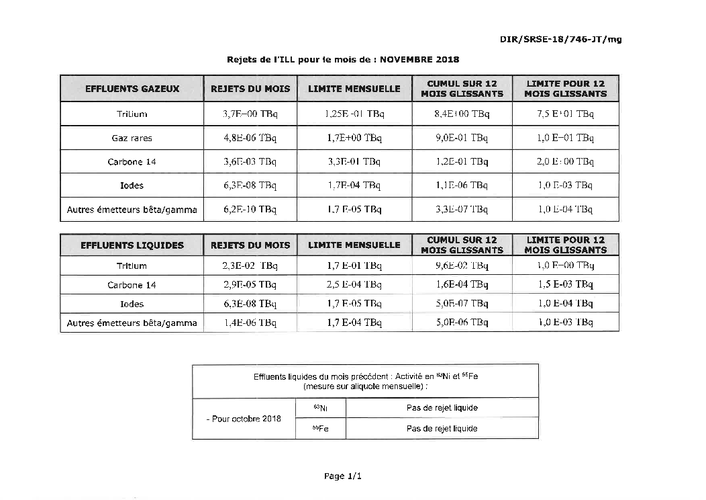
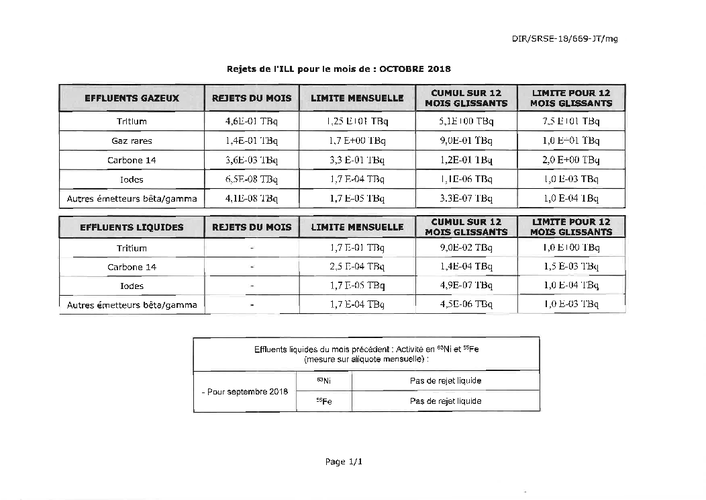
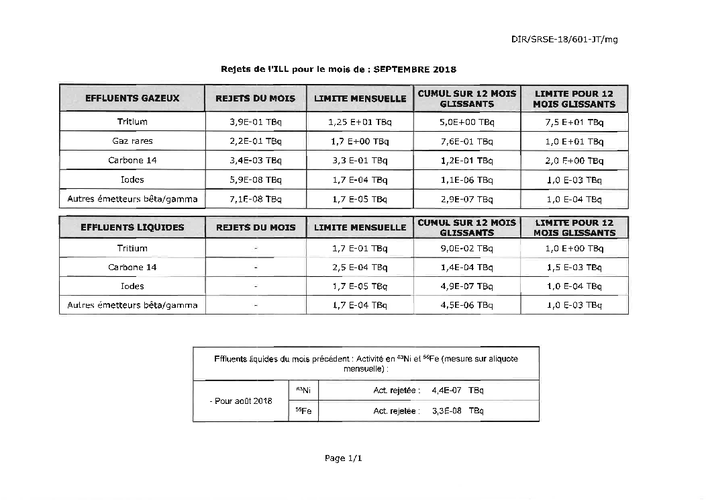
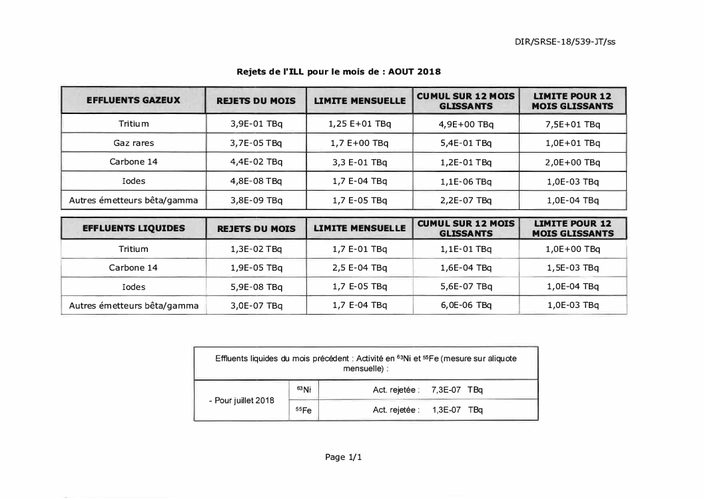
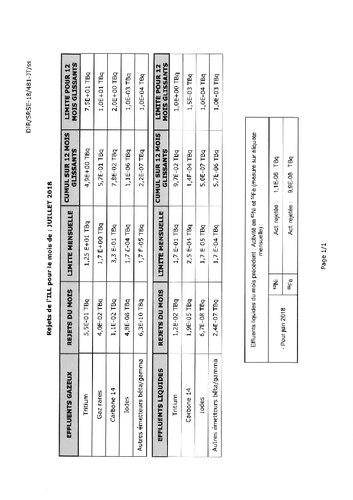
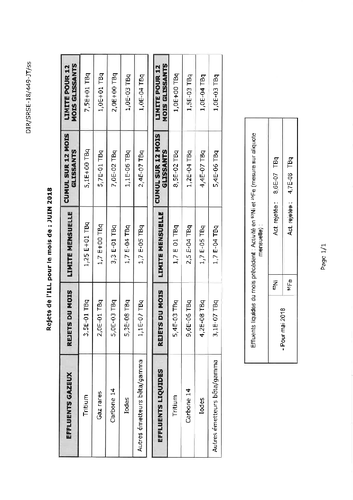
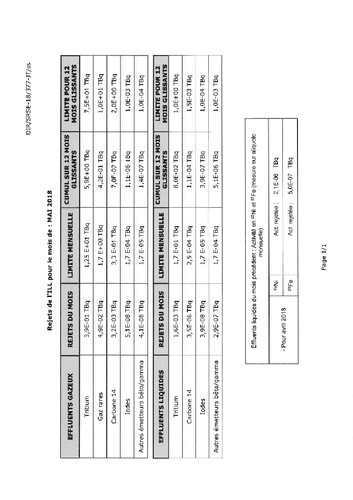
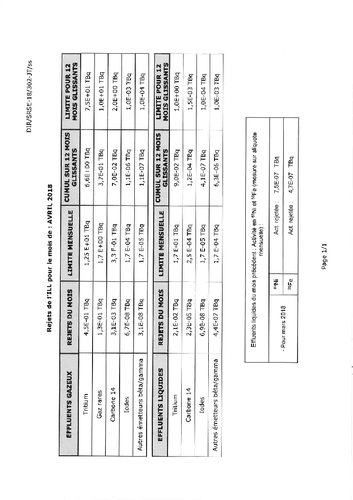
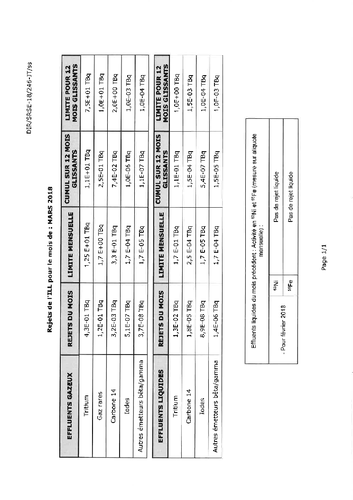
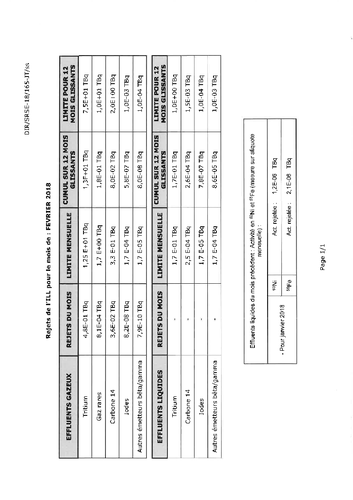
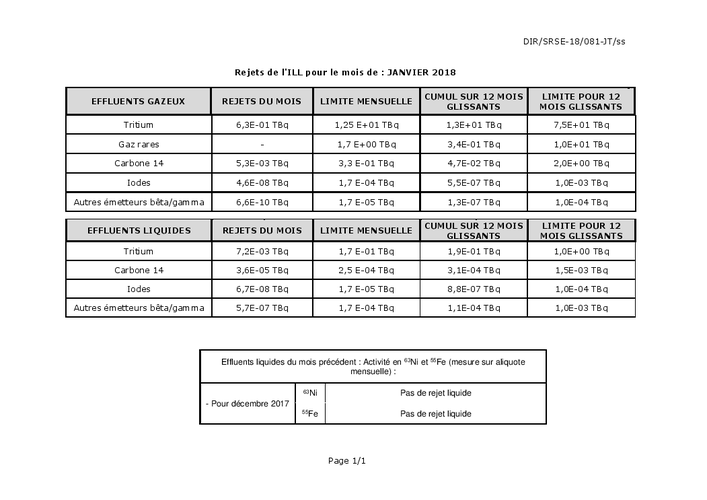
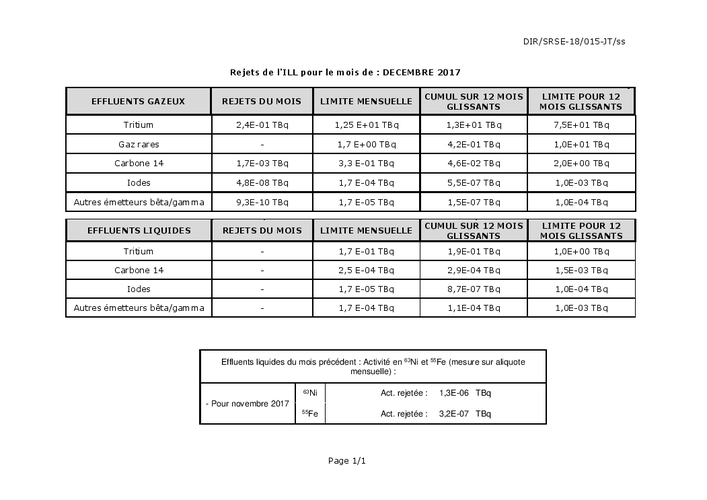
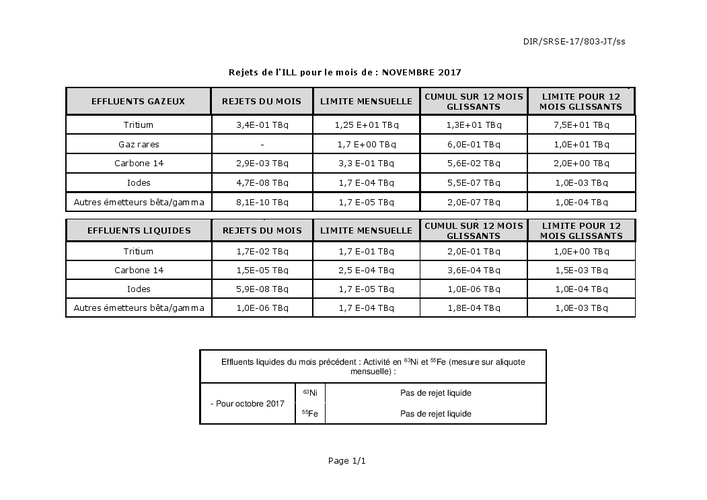
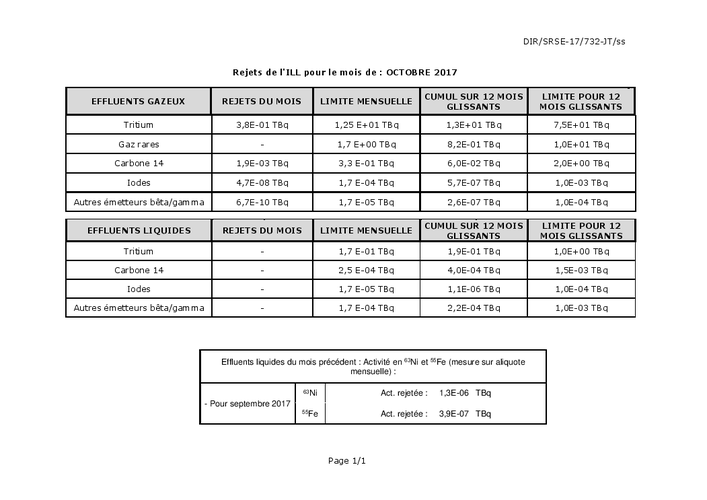
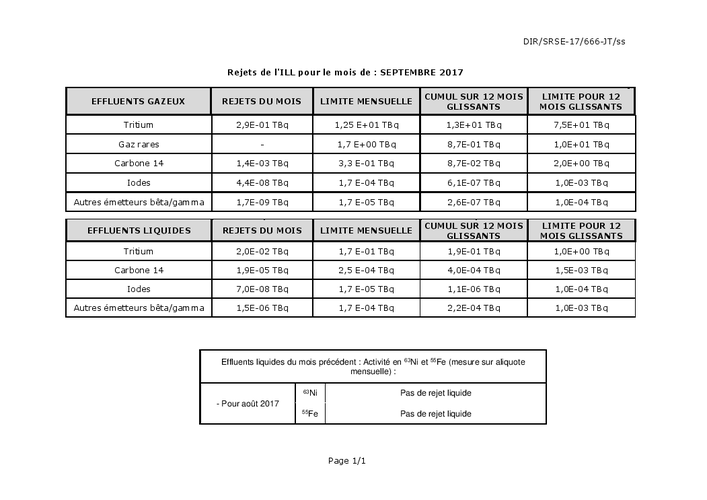
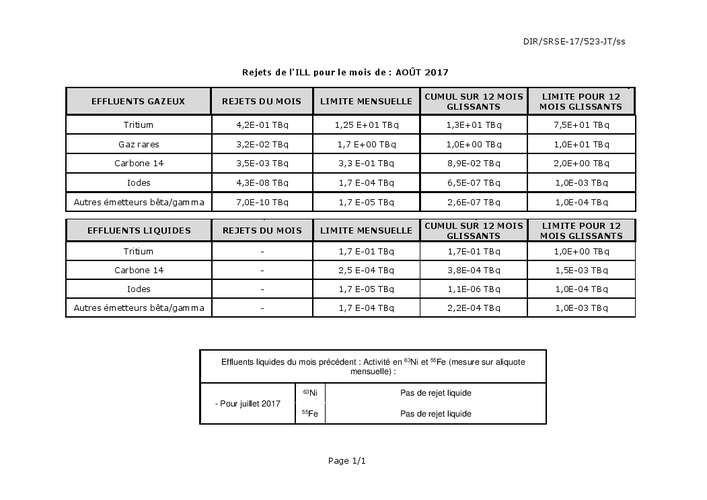
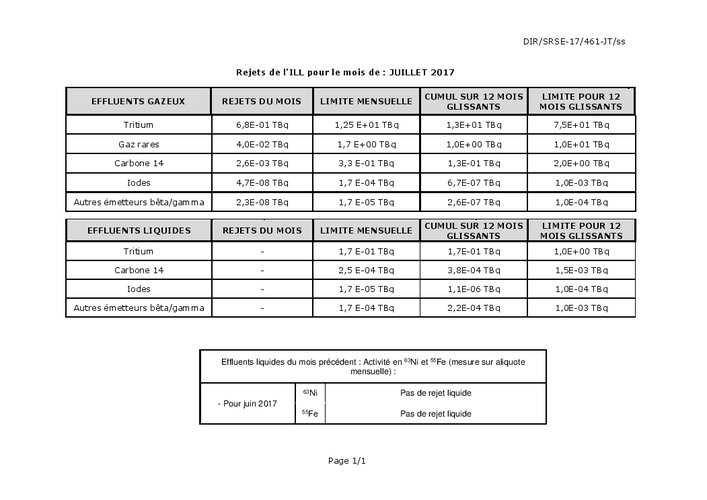
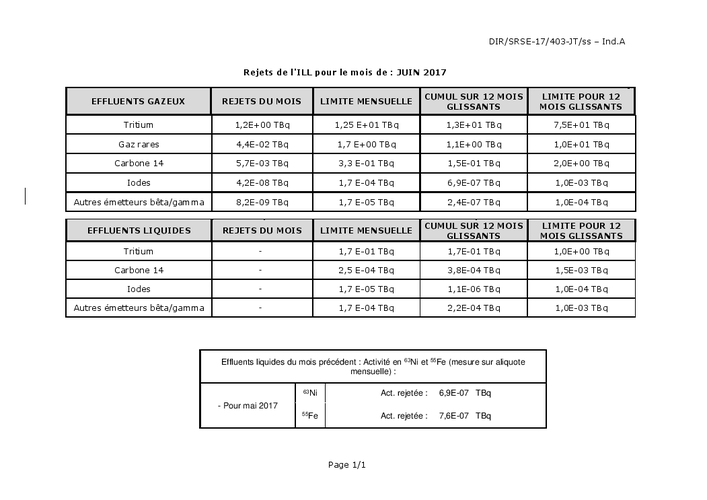
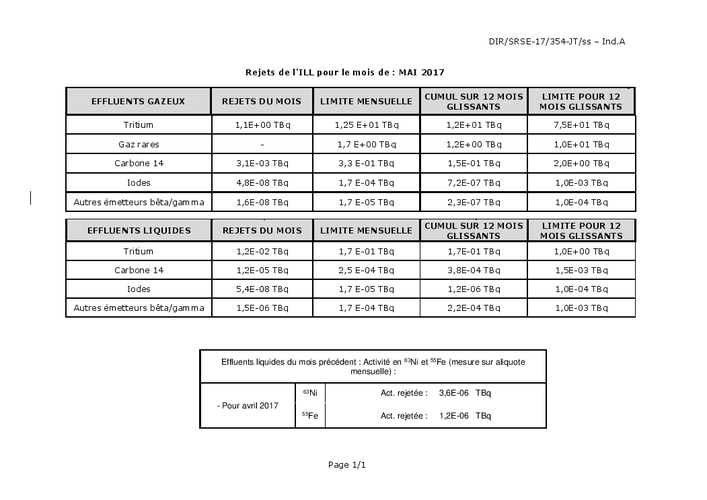
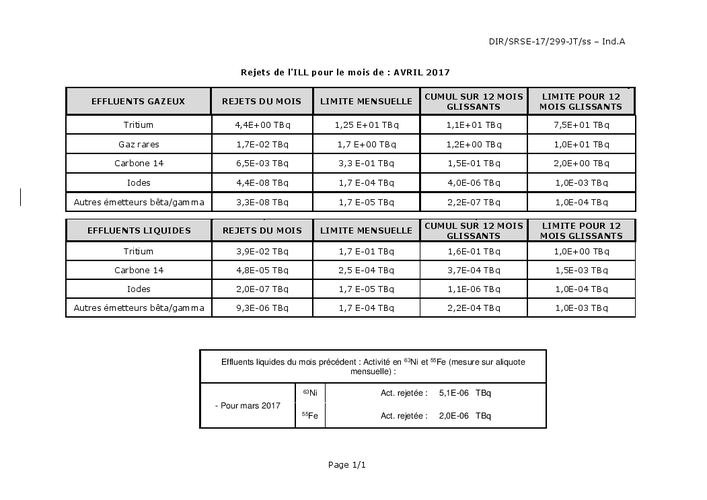
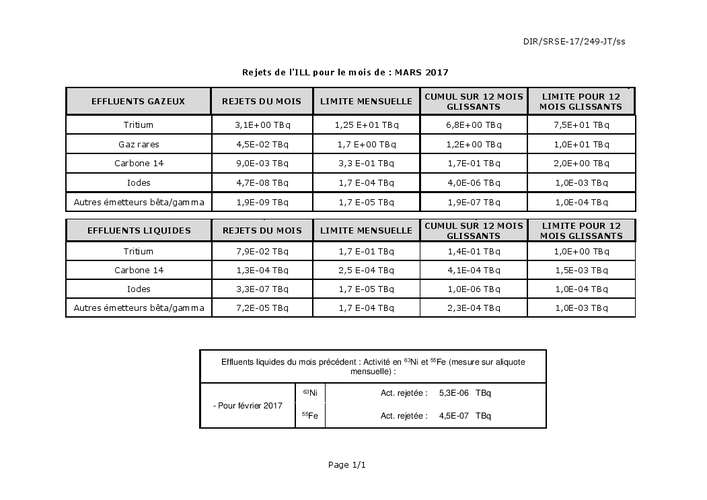
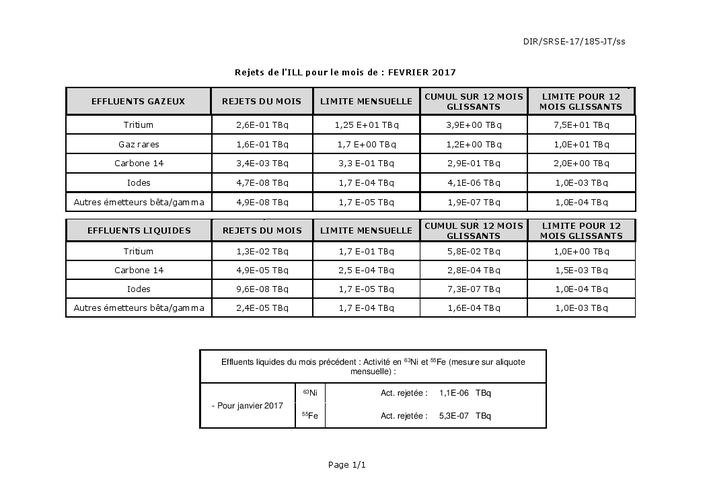
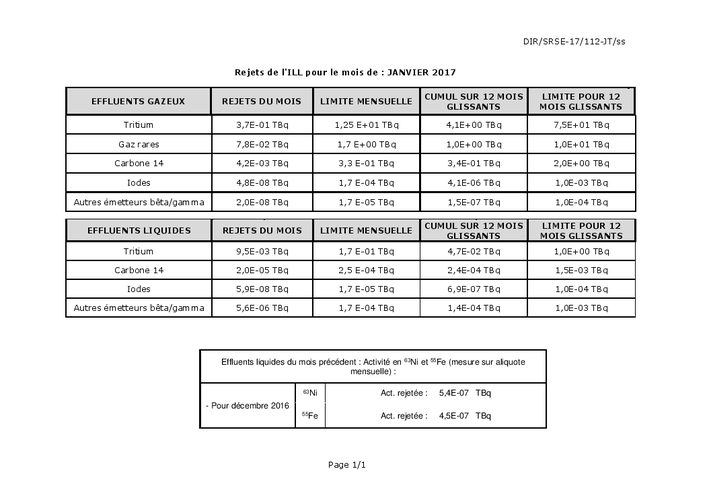
Les rejets liquides et gazeux de l’ILL sont régis par l’arrêté ministériel du 3 août 2007, qui l’autorise à poursuivre les prélèvements d’eau et les rejets d’effluents liquides et gazeux pour l’exploitation de son site de Grenoble. Outre leur suivi et leur contrôle en continu, les rejets font l’objet de plus de 2000 mesures par an en laboratoire. Leur quantification est présentée ci-dessous.
Certes la radioactivité est invisible, mais elle peut se mesurer de manière très précise. Plusieurs unités de mesure sont possibles, la plus fréquemment utilisée étant le mSv (millisievert)/an.
Le chiffre couramment pris en compte est le cumul des doses reçues en une année, exprimé en mSv.
En cas d'accident, il faut savoir que les doses reçues diminuent en fonction de la distance; en revanche elles augmentent en fonction du temps passé en un même point exposé.
Venons-en au cas particulier de l'ILL. En tenant compte de la puissance du réacteur et de ses caractéristiques techniques, on peut établir les conséquences de l'hypothèse accidentelle la plus pénalisante : celle de la fusion du coeur du réacteur à l'air, avec rejets immédiats. Dans ce cas les chiffres seraient les suivants.
Dose cumulée sur les 2 premières heures après l'accident :
Dose cumulée 48 heures après l'accident :
A titre de comparaison, la dose moyenne annuelle reçue due à la radioactivité naturelle est de 2,4 mSv. Sur terre elle varie de 0,7 mSv au minimum à 50 mSv sur certaines zones minéralisées en France et même 500 mSv au Kérala (Inde). Dans la cuvette grenobloise la moyenne est de 2,5 mSv par an. Il faut y ajouter environ 0,1 mSv par 100 mètres d’altitude par rapport à la cuvette.
D'autres évènements de la vie quotidienne peuvent être l'occasion d'intégrer des doses de radioactivité.
Ainsi :
Pour plus d'informations sur ces sujets, n'hésitez pas à nous contacter.
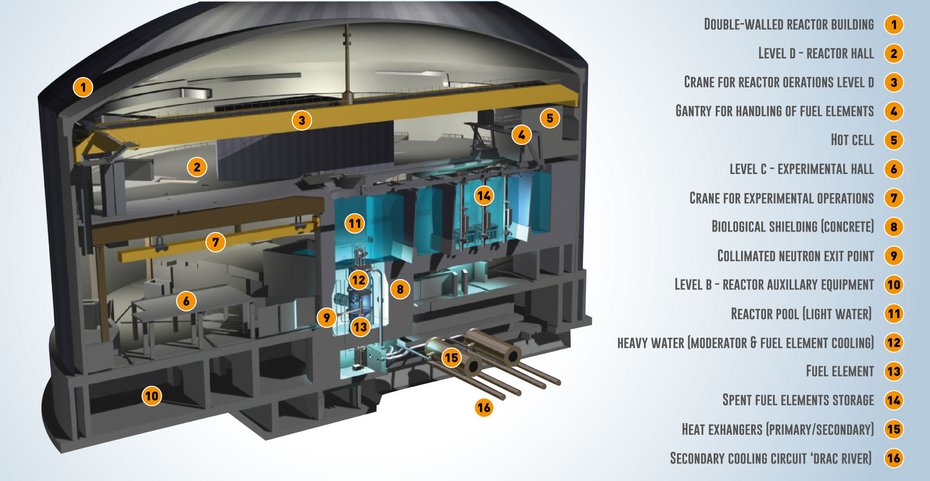
Le Réacteur Haut Flux de l’ILL est uniquement dédié à la recherche. Il fonctionne en continu durant des cycles de 50 jours.
Son cœur est constitué d’un élément combustible unique d’Uranium très enrichi (10 kg) refroidi à l’eau lourde. Il produit le flux continu de neutrons le plus intense du monde soit 1,5 x 10¹⁵ neutrons par seconde et par cm2. La puissance thermique, de 58 MW, n’est pas réutilisée et est évacuée par un circuit secondaire alimenté par l’eau du Drac.
La cuve à eau lourde contenant le cœur est située dans une piscine remplie d’eau déminéralisée qui assure une protection vis-à-vis des rayonnements neutrons et gammas émis par le cœur. Le réacteur est piloté au moyen d’une barre absorbante de neutrons que l’on extrait au fur et à mesure de la consommation de l’uranium. Il possède, en outre, 5 barres de sécurité, également absorbantes de neutrons, dont la fonction est l’arrêt d’urgence du réacteur.
Les neutrons produits dans le réacteur par la réaction de fission ont une très grande énergie (vitesse : 20 000 km/s). Ils sont ralentis par l’eau lourde afin de pouvoir à la fois provoquer de nouvelles fissions pour entretenir la réaction en chaîne (neutrons thermiques dont la vitesse est de 2,2 km/s) et alimenter les dispositifs expérimentaux des scientifiques.
Trois dispositifs situés à proximité immédiate du cœur permettent également de produire des neutrons chauds (10 km/s) ainsi que les neutrons froids et ultra-froids (700 m/s et 10 m/s) : il s’agit d’une part de la source chaude, constituée d’une sphère de graphite maintenue à 2600°C et de deux sources froides, dont la plus importante est constituée d’une sphère contenant 20 litres de Deutérium maintenue à l’état liquide à -248°C dans laquelle les neutrons, par une succession de collisions avec les atomes de deutérium sont ralentis à l’énergie recherchée. Les neutrons sont prélevés au sein de la cuve par une vingtaine de canaux, dont certains pointent sur l’une des sources froides ou chaude. Ces canaux, prolongés par des guides de neutrons alimentent ensuite une quarantaine d’aires expérimentales équipées d’une instrumentation de pointe, situées jusqu’à 100 mètres du réacteur.
Non
Il est vrai que l’ILL a été fondé en 1967 et que le réacteur à haut flux a divergé pour la première fois en 1971.
Cependant, la durée de vie d’un réacteur est liée au vieillissement des structures soumises au « bombardement » (au flux) par les neutrons, en particulier la cuve du réacteur. Sur les centrales de production, cette cuve ne peut pas être remplacée.
En revanche, sur le RHF de l'ILL toutes ces structures sont régulièrement remplacées. La cuve a été entièrement remplacée au début des années 1990, le redémarrage de l’installation « neuve » ayant été effectué en 1995. C'est un fait unique sur un réacteur. Cette cuve a actuellement l’équivalent de seulement 8 années de fonctionnement à pleine puissance.
De même, entre 2004 et 2007, 30 millions d’euros ont été investis dans le renforcement sismique du bâtiment réacteur. Celui-ci est par conséquent conforme à la règle fondamentale de sûreté la plus récente concernant le dimensionnement au séisme.
Tous les autres équipements font classiquement l’objet de maintenance, de jouvence et de remplacement.
A un séisme de magnitude 5,7 à 7 km de profondeur juste sous le réacteur.
A sa construction en 1970, le réacteur avait été dimensionné pour résister à un séisme répondant aux règles parasismiques de l'époque (intensité VIII selon les règles parasismiques PS 67 alors en vigueur). Depuis, les connaissances sur le risque sismique ont évolué, de même que la réglementation, devenue encore plus exigeante.
En 2004 les études visant à déterminer le niveau de séisme à prendre en compte et à vérifier le dimensionnement parasismique des installations de l’ILL ont été reprises. Ces études ont abouti à la réalisation d’importants travaux de renforcement sismique. Ces travaux ont été achevés en 2006 pour un coût de l’ordre de 30 millions d’euros. Le réacteur de l'ILL est désormais dimensionné pour résister à un séisme de 5,7 situé à 7 km de profondeur, précisément sous le bâtiment réacteur.
La démarche utilisée est celle préconisée dans la Règle Fondamentale de Sûreté (RFS 2001-01) édictée par l’Autorité de Sûreté Nucléaire pour évaluer l’aléa sismique sur les sites des installations nucléaires. Cette démarche comporte plusieurs étapes :
C’est ainsi le spectre de réponse calculé pour le SMS Corrençon, soit un séisme de magnitude 5,7 se produisant sous l’installation à une profondeur de 7 km, qui a été utilisé par les ingénieurs en génie parasismique pour calculer les renforcements nécessaires du bâtiment réacteur afin qu’il résiste au SMS tout en prenant en compte des marges de dimensionnement.
Suite à l’accident de Fukushima-Daïchi, l’Autorité de sûreté Nucléaire a demandé aux exploitants, en particulier de réacteurs (EDF, AREVA, CEA et ILL), de prendre en compte un séisme extrême plus fort que celui du dimensionnement.
Oui. Cependant un séisme est d’autant plus improbable qu’il est plus intense !
Pour définir l’aléa sismique sur son site, l’ILL a demandé à la société Géoter, qui a effectué la nouvelle étude de l’aléa sismique sur l’ensemble du territoire national, d’effectuer une étude probabiliste spécifique centrée sur le site d’implantation du réacteur à haut flux.
Le résultat de ce type d’étude n’est pas donné en magnitude, mais en accélérations aux différentes fréquences pertinentes pour les bâtiments et les équipements. L’intérêt de ce type de sortie de résultats est d’être immédiatement exploitable par les ingénieurs « génie civil et mécaniques » car les efforts auxquels doivent résister les bâtiments et équipements découlent simplement de ces accélérations sismiques.
La représentation la plus classique de l’aléa sismique est alors donnée sous la forme d’un « spectre » qui relie l’accélération en fonction de la fréquence.
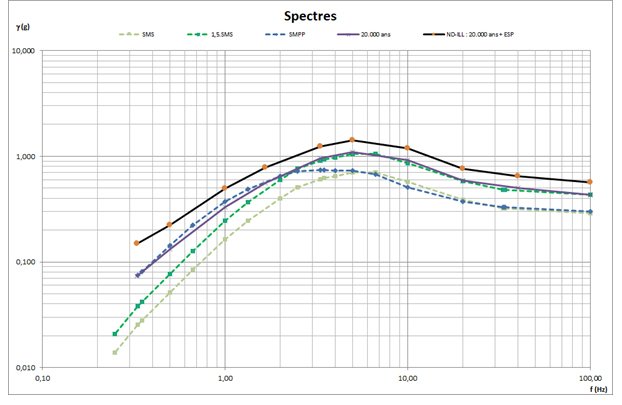
On constate sur ces courbes que le séisme finalement retenu par l’ILL suite à l’accident de Fukushima et tenant compte de façon forfaitaire des amplifications possibles de ces accélérations dues à un effet de site dans la cuvette grenobloise, conduit à des accélérations :
De façon approximative, ces accélérations correspondent à un séisme de magnitude 7,3, donc beaucoup plus intense que celui retenu pour le dimensionnement (SMS = 5,7).
Conformément aux prescriptions de l’ASN, c’est à ce niveau de séisme qu'est dimensionné le « noyau dur » du RHF.
Oui
Le bâtiment réacteur est dimensionné pour résister mécaniquement à la pression de l'eau. Même dans cette situation il resterait étanche à l’eau.
La montée d’eau due à la rupture du barrage de Monteynard n’affecterait donc pas les structures du bâtiment. En revanche elle conduirait à la perte totale des alimentations électriques. En effet les deux postes d’alimentation en 20 kV, ainsi que les deux diesels de secours seraient sous l’eau.
La perte de ces alimentations électriques provoquerait automatiquement l’arrêt du réacteur par la chute des barres de sécurité. Le refroidissement serait correctement effectué par simple convection naturelle avec l'eau de la piscine.
Non
Le réacteur dispose de trois capteurs (accéléromètre 3 axes) qui surveillent en permanence les mouvements du sol. Si deux de ces trois capteurs détectent une accélération supérieure à 0,01 g il y a un arrêt automatique du réacteur par chute des barres de sécurité. Cette accélération de 0,01 g correspond à un faible séisme de magnitude inférieure à 3, proche du réacteur.
Le réacteur dispose de cinq barres de sécurité indépendantes qui sont en permanence en position haute lorsque le réacteur fonctionne. Elles sont tenues dans cette position haute par un électro-aimant. L’action de chute de barres est donc une action à « sécurité positive » : tout défaut, toute perte d’alimentation électrique, coupure de câble, etc… conduit à la chute de ces barres sous l’action de la pesanteur, par la perte d’alimentation des électro-aimants. Cet arrêt automatique ne nécessite donc aucune énergie extérieure.
Pour accélérer la chute de ces barres celles-ci sont propulsées par de l’air comprimé sous 10 bars, disponible en permanence dans un petit réservoir situé au dessus des barres de sécurité. Une baisse de pression de l’air comprimé dans ces réservoirs conduit également automatiquement à la chute des barres.
Non
Après l’arrêt du réacteur, le refroidissement du cœur peut être assuré par simple convection naturelle, donc en l’absence de toute source d’énergie électrique.
Après l’arrêt du réacteur, qui correspond à l’arrêt de la réaction en chaîne de fission de l’uranium du combustible, le cœur continue cependant à dégager de l’énergie à cause de la radioactivité des produits de fission qu’il contient. Cette énergie par unité de temps est appelé la puissance résiduelle du cœur. Cette puissance résiduelle étant due à la radioactivité du cœur, elle va donc baisser au cours du temps en même temps que celle-ci.
Après un cycle de fonctionnement normal, c'est-à-dire 46 jours à la pleine puissance de 57 MW, le cœur du réacteur dégage la puissance résiduelle suivante :
Cette puissance résiduelle est non seulement faible mais elle décroît également très rapidement. Ceci est dû, d’une part à la faible puissance de fonctionnement du réacteur (57 MW), et d’autre part, au fait que la durée d’un cycle de fonctionnement est courte (46 j). Il faut ensuite changer l’élément combustible, élément unique constituant le cœur dans son ensemble. Cette durée de fonctionnement étant courte la radioactivité des produits de fission de longue durée de vie (longue période) n’a pas le temps de s’accumuler.
Il faut cependant continuer à refroidir le cœur pour qu’il ne monte pas en température et donc éviter tout risque de fusion du combustible.
Lors d’un arrêt normal on laisse fonctionner les pompes principales pendant 1 heure ; ces dernières assurent un débit à travers le cœur de 2400 m3/h ; ensuite, seules les pompes du circuit de refroidissement à l'arrêt assurent un débit de 150 m3/h à travers le cœur. La source froide est alors l’eau du Drac, la chaleur lui étant transférée à travers des échangeurs. Ce mode de fonctionnement permet d’éviter toute sollicitation thermique sur l’élément combustible et la cuve du réacteur.
En cas de perte des alimentations électriques externes, les pompes principales du circuit primaire vont s’arrêter entraînant automatiquement l’arrêt du réacteur. Cette perte des alimentations électriques externes entraîne automatiquement la mise en route des diesels de premiers secours. Ceux-ci permettent alors de ré alimenter les principaux circuits dont en particulier le circuit de refroidissement à l’arrêt.
Enfin, même en cas de perte totale des alimentations électriques externes et de premier secours, les pompes du circuit de refroidissement à l’arrêt vont continuer à fonctionner pendant une heure car elles disposent de batteries garantissant une telle autonomie. En cas de défaillance de cette alimentation par batterie, le refroidissement n’est pas assuré en convection forcée mais alors en convection naturelle, celle-ci suffisant largement à assurer le refroidissement correct du cœur.
Non
Le cœur du réacteur est au centre d’une cuve d'eau lourde, d’environ 15 m3, elle-même plongée au fond d’une piscine d'eau légère de volume égal à 450 m3. En cas de perte totale de toutes les alimentations électriques, externe et de premier secours, le cœur est refroidi en convection naturelle dans la cuve du réacteur, l’eau se stabilisant à une température d’environ 60 °C. Cette cuve est elle-même refroidie, également en convection naturelle, par l’eau de la piscine sa température se stabilisant à une valeur inférieure.
Non
Une explosion comme celle qui s’est produite sur le réacteur n° 4 de Tchernobyl, due à l’emballement de la réaction de fission est impossible avec le réacteur de l’ILL. En effet, le scénario similaire, appelé accident BORAX sur les réacteurs de recherche de notre type, ne conduit pas à une explosion capable d’endommager toutes les structures du réacteur y compris son enceinte de confinement. L’énergie stockée dans le cœur et dégagée dans « l’explosion » est beaucoup trop faible pour produire de tels dégâts. Ceci est évidemment dû à la très petite taille du cœur de l’ILL (10 kg d’uranium, à comparer avec les 190 tonnes du cœur du réacteur de type RMBK de Tchernobyl).
L’Autorité de Sûreté Nucléaire française (ASN) impose de prendre en compte, pour le dimensionnement des réacteurs expérimentaux du type de celui de l’ILL, un scénario de type « accident BORAX », du nom d’une installation de recherche américaine volontairement détruite dans les années 50 afin d’étudier ce phénomène.
Un accident du même type s’est réellement produit sur le réacteur SL1 (USA) lors du retrait accidentel et extrêmement rapide d’une barre de commande du réacteur. Ce retrait avait conduit à une augmentation exponentielle de la puissance nucléaire générée par la réaction en chaîne tellement rapide que la chaleur générée dans les plaques combustibles avait conduit à leur fusion avant d’être transférée à l’eau de refroidissement. La dispersion d’une masse importante d’aluminium fondu sous la forme de très fines gouttelettes dans l’eau de refroidissement avait alors conduit à une vaporisation brutale assimilable à une explosion, dite « explosion de vapeur ».
Pour revenir au réacteur de l’ILL, l’énergie dégagée dans un tel scénario, inférieure à 200 MJ, impliquerait la destruction partielle de la cuve du réacteur. De ce fait, la piscine réacteur et son cuvelage métallique ont été dimensionnés pour résister à cette « explosion » en conservant leur étanchéité. Une éventuelle gerbe d’eau pourrait accompagner ce phénomène, mais celle-ci resterait de faible ampleur et n’endommagerait donc pas l’enceinte de confinement.
Il faut noter qu’aucun scénario, même extrêmement improbable, ne permet d’atteindre les conditions nécessaires à un tel accident BORAX sur le réacteur de l’ILL. Ceci est d’ailleurs assez général sur les réacteurs de recherche équivalents dans le monde. L’hypothèse d’un accident BORAX n’est donc pas retenue par les autorités de sûreté dans la plupart des autres pays.
Oui
On a vu précédemment que le cœur est correctement refroidi, dès l’arrêt du réacteur, par simple convection naturelle. Bien sûr, pour que celle-ci puisse s’établir il faut que l’inventaire en eau de la cuve soit suffisant. Les accidents qui peuvent conduire à la perte de l’inventaire en eau de la cuve du réacteur conduisent donc à la fusion du combustible puisqu’il n’y a alors plus de convection naturelle possible.
Par conception de la cuve du réacteur et des circuits de refroidissement qui lui sont associés il faut systématiquement au moins deux défaillances indépendantes pour conduire à la perte de l’inventaire en eau et donc au dénoyage du cœur. La fréquence d’un tel événement est donc très faible, de l’ordre de 10-5 à 10-6 par an (il se produirait en moyenne une fois tous les cent mille à un million d’années).
Ce scenario a pourtant été prévu dans le cadre de la dernière réévaluation de la sûreté de l’installation. Un circuit de sauvegarde a été ajouté ; il permet, dans un tel scénario, de réinjecter de l’eau directement dans la cuve afin de garder un niveau d'eau suffisant pour que la convection naturelle puisse toujours refroidir le cœur. Des pompes de reprise ont été implantées dans le fond du réacteur pour réinjecter l’eau ayant fui de la cuve, et rétablir ainsi un circuit de refroidissement « fermé ».
Enfin dans un processus continu de renforcement de la sûreté de l’installation, l'ILL a proposé un nouveau circuit de sauvegarde, permettant le cas échéant de mettre en communication la cuve du réacteur, de volume 15 m3, avec la piscine du réacteur et sa piscine d’entreposage associée; l’ensemble du volume d’eau serait alors de 1000 m3. L’eau de la piscine remplira alors la cuve du réacteur par simple gravité, donc sans aucun besoin d’énergie extérieure, et permettra donc de continuer à assurer le refroidissement du cœur. Cette nouvelle disposition a été mise en service en 2012.
La probabilité de fusion du cœur avec ces nouveaux circuits de sauvegarde sera alors extrêmement faible, proche de la fréquence de 10-7 par an, valeur à partir de laquelle on estime que le risque est « résiduel » et ne nécessite plus d’être pris en compte dans le dimensionnement de l’installation.
Dans l’accident BORAX pris en compte forfaitairement, le cœur est également en parti fondu mais se trouve toujours immergé dans l’eau de la piscine. La radioactivité relâchée lors de la fusion est alors en grande partie retenue dans la piscine, qui joue alors le rôle d’un filtre. Une petite partie de cette radioactivité, essentiellement les gaz rares de fission, Krypton et Xenon, se trouve directement dans l’enceinte de confinement.
L’accident le plus grave serait la fusion du cœur après la perte de l’inventaire en eau.
Dans un tel accident la fusion du combustible aurait deux conséquences :
Les produits de fission radioactifs seraient donc relâchés dans le circuit primaire du réacteur.
Dans le scénario le plus grave retenu pour dimensionner l’installation de l’ILL, on postule de façon extrêmement pessimiste que le circuit primaire, qui constitue la deuxième barrière de confinement des produits radioactifs, est lui-même endommagé. Dans cette hypothèse les produits radioactifs sont relâchés directement dans l’enceinte de confinement, troisième et dernière barrière, et non dans l’eau de la piscine qui entoure la cuve du réacteur. Cette hypothèse est très pénalisante car l’eau de la piscine joue le rôle d’un filtre très efficace pour retenir une très grande partie des produits de fission radioactifs.
Dès la conception, puis suite aux améliorations continues de la sûreté de l’installation, ce scénario le plus grave a été pris en compte. Il fait l’objet de dispositions de prévention, pour rendre la probabilité de son occurrence la plus faible raisonnablement possible, et de dispositions de limitation des conséquences, pour rendre la gravité de cet accident, s’il devait néanmoins survenir, la plus faible raisonnablement possible.
C’est ce scénario très pessimiste qui dimensionne le plan d’urgence d’interne et le plan particulier d’intervention. C’est sur lui, même s’il est très peu probable, que sont basés les calculs des « cercles de danger » de 300 m - évacuation des personnels des entreprises -, et de 500 m - mise à l’abri des quelques centaines d’habitants du quartier Bastille de Fontaine.
Oui
Lors de l’accident de fusion du cœur l’enceinte de confinement est immédiatement isolée. Dans les heures qui suivent l’accident elle peut monter légèrement en pression la valeur maximale se stabilisant autour de 0,1 bar donc sans risque d’endommagement de l’enceinte. Pour garantir de façon absolue l’absence de tout rejet radioactif non filtré et non contrôlé, il est cependant préférable de maintenir la pression dans l’enceinte à une valeur légèrement inférieure à la pression atmosphérique. Ceci est effectué en rejetant régulièrement de faibles volumes d’air de l’enceinte par la cheminée de 45 m à travers des filtres de très haute efficacité pour les aérosols et des pièges à iode. Ces rejets sont alors évalués, contrôlés et maîtrisés, on parle de rejets concertés.
Lors de l’accident le plus grave pris en compte, c'est-à-dire la fusion du cœur à l’air, une fraction des produits de fission radioactifs est directement relâchée dans l’enceinte de confinement.
Celle-ci est surveillée en permanence par trois détecteurs de radioactivité dans l’enceinte elle-même et par trois autres détecteurs sur le circuit de ventilation. Si deux des trois détecteurs identiques dépassent un seuil de radioactivité, l’enceinte est automatiquement et totalement isolée.
Cependant, cet isolement total de l’enceinte implique l’arrêt de toutes les ventilations y compris le conditionnement d’air permettant son refroidissement. La pression dans l’enceinte va donc s’élever sous l’action des divers dégagements de chaleur dans l’enceinte, en particulier à cause de la puissance résiduelle du combustible. La vaporisation de l’azote ou l’hélium liquide utilisés pour des raisons expérimentales va également conduire à une faible augmentation de la pression dans l’enceinte.
Dans la situation la plus défavorable, c'est-à-dire une très chaude journée d’été, la pression dans l’enceinte s’élèvera en quelques heures pour se stabiliser à environ 0,1 bar.
C’est pour cette raison que l’enceinte de confinement du réacteur de l’ILL est double, avec une enceinte interne en béton de 40 cm d’épaisseur et une enceinte externe en acier de 11 mm d’épaisseur. Entre ces deux enceintes une surpression de 0,135 bar est maintenue en permanence avec de l’air extérieur propre. De mini-fuites sont inévitables sur une enceinte d’une telle dimension : 60 m de diamètre, et 35 m de hauteur. La double enceinte de confinement garantit que les échanges se font de l’extérieur vers l’intérieur et non l’inverse. C’est de l’air propre de l’extérieur qui rentre dans l’enceinte de confinement et non de l’air éventuellement pollué par des produits radioactifs qui sort à l’extérieur.
Il est cependant préférable de ramener la pression à l’intérieur de l’enceinte béton à une valeur légèrement inférieure à la pression atmosphérique. Cette mesure garantit, cette fois de façon absolue, l’absence de toute fuite non contrôlée, même en cas de défaillance des circuits de gonflage de l’espace annulaire entre les deux enceintes. Ce dégonflage de l’enceinte interne en béton, après évaluation de l’activité qui sera rejetée, est effectué par la cheminée de 45 m après passage sur des filtres très haute efficacité et des pièges à iodes. L’activité rejetée est évidemment mesurée et contrôlée à la cheminée.
Les conséquences pour les personnes situées dans l’environnement proche d’une installation nucléaire accidentée sont toujours évaluées en termes de dose de rayonnement (radiation) reçue.
Dans le cadre du Plan d’Urgence interne (PUI) qui est de la responsabilité de l’exploitant de l’installation, et du Plan Particulier d’Intervention (PPI) qui est de la responsabilité des pouvoirs publics et en particulier du préfet, deux cercles de danger sont définis autour de l’installation :
Ces valeurs réglementaires sont utilisées dans la plupart des pays. Elles sont issues de recommandations de l’OMS, traduites en droit français par l'arrêté du 20.11.2009.
Au-delà de ces cercles la dose n’est évidemment pas nulle (le nuage ne s’arrête pas à la frontière) mais elle décroit avec la distance. Au bout d’une semaine les doses sont les suivantes pour une personne située dans le panache radioactif sans aucune protection (la personne est dehors et respire l’air du panache pendant toute une semaine) :
A titre de comparaison :
Fondamentalement il existe deux types d’exposition aux rayonnements :
Lors d’un accident dans le réacteur de l’ILL, les doses de rayonnement reçues par les personnes situées dans le cercle de 300 m sont essentiellement dues à l’exposition externe, la source de rayonnement étant le bâtiment réacteur lui-même. De par son épaisseur, l’enceinte atténue à la source ce rayonnement, d’un facteur d’au moins 100.
Le débit de dose maximal est inférieur à 1 mSv/h à 170 m de l’enceinte, sur le périmètre de l’ILL, et de l’ordre de 0,1 mSv/h à 300 m. Ces débits de dose faibles laissent le temps d’effectuer les gestes nécessaire dans le calme sans précipitation. C’est pourquoi, par exemple, dans une telle situation le personnel de l’ILL évacuerait le site à pied. Cette mesure est d’ailleurs plus efficace puisqu’elle résout de fait les éventuels problèmes d’embouteillage.
Pour les personnes situées au delà du cercle de 500 m les doses sont essentiellement liées aux rejets effectués par la cheminée. Par exemple, par vent du sud, cas typique le matin, les habitants de Grenoble ne recevraient strictement aucune dose. L'après-midi, par vent du nord, ils seraient susceptibles de recevoir une fraction des faibles doses mentionnées ci-dessus.
L’accident de fusion du cœur par perte de l’inventaire d’eau correspond à une cinétique relativement lente : le nombre de dispositions de sauvegarde disponibles permet de maintenir un inventaire en eau suffisant pour que la convection naturelle refroidisse toujours correctement le cœur.
L’application des Règles Fondamentales de Sûreté conduit à postuler la défaillance de certains circuits de sauvegarde au bout de 24 heures d’utilisation. C’est cette défaillance supplémentaire qui dans ce scenario conduirait au dénoyage du cœur et à sa fusion à l’air.
L’exploitant et les pouvoirs publics ont donc le temps de mettre en place leur organisation de crise respective (PUI et PPI) avant que l’accident radiologique lui-même, c'est-à-dire la fusion du cœur, ne survienne.
En ce qui concerne l’accident BORAX, imposé forfaitairement, la cinétique est extrêmement rapide. Une petite fraction des produits de fission sont relâchés immédiatement dans l’enceinte de confinement, la part la plus importante étant retenue dans la piscine. Bien que cet accident relève alors de la phase dite réflexe du PPI, les débits de dose qu’il génère autour de l’installation sont nettement plus faibles que ceux dus à l’accident de fusion à l’air. Les éventuelles contre-mesures (évacuation et/ou mise à l’abri) pour protéger les populations situées dans les cercles de 300 et 500 m pourraient donc être effectuées de manière calme et réfléchie, sans précipitation.
Oui et non
Les calculs effectués pour l’accident le plus grave, c'est-à-dire la fusion du cœur en tenant compte de l’efficacité nominale des pièges à iode, montrent que la dose équivalente à la thyroïde est de l’ordre de 10 mSv pour les enfants (public le plus sensible) dans le cercle de 500 m.
Le niveau d’intervention associé à la mise en œuvre de l’administration d’iode stable étant fixé par l’arrêté du 20 novembre 2009 à 50 mSv en dose équivalente sur la thyroïde, cette administration n’est pas obligatoire.
Le préfet peut cependant tout à fait ordonner cette administration pour les personnes situées dans les cercles de 300 et 500 m par mesure de précaution supplémentaire.
Il peut être utile de rappeler que :
Pour en savoir plus : www.distribution-iode.com
Oui
La piscine, dans laquelle le combustible usé est entreposé en attente de son retraitement à La Hague, est située dans l’enceinte de confinement du réacteur comme la piscine du réacteur elle-même. Les exigences de dimensionnement (résistance aux diverses sollicitations et agressions possibles) sont strictement les mêmes que pour la piscine du réacteur.
Un élément combustible usé peut être refroidi correctement seulement avec de l’air à partir du 242ème jour après l’arrêt du réacteur. Comme l’ILL fait au plus 4 cycles de fonctionnement de 50 jours par an, il y a donc quatre cœurs utilisés par an, dont trois seulement peuvent avoir une durée de refroidissement (temps écoulé depuis la fin de l’utilisation du cœur) inférieure à 242 jours. Les autres cœurs entreposés au fond de la piscine ont tous plus de 242 jours de refroidissement donc peuvent tout à fait supporter d’être à sec sans pour autant être endommagés et risquer de relâcher la radioactivité qu’ils contiennent encore.
Les conséquences d’une perte totale de l'eau de la piscine d’entreposage, événement qui relève du risque « résiduel », sont plus faibles que celles de l’accident le plus grave retenu pour le dimensionnement, la "fusion du cœur à l’air".
Les rayonnements ionisants provoquent deux grandes classes d’effets :
Ce sont des effets qui surviennent à forte dose, typiquement à partir de 1000 mSv, et qui se manifesteront chez toute personne recevant une telle dose. Ces effets déterministes ont trois caractéristiques essentielles :
Pour une irradiation globale de l’organisme, les symptômes (fatigue, nausée, vomissements) sont d’autant plus aigus que la dose reçue est forte. La baisse des lymphocytes, globules et plaquettes explique les hémorragies et infections constatées au-delà de 2000 mSv.
Ce sont des effets qui surviennent, à faibles et fortes doses, de façon aléatoire sur quelques individus dans une population exposée de la même façon à une même dose de rayonnement. Ces effets se manifestent essentiellement sous la forme de cancers, dit radio-induit, cancers par ailleurs strictement identiques aux différents cancers que l’on observe dans toute population humaine en l’absence de toute exposition aux rayonnements autre que naturels. Ces effets stochastiques ont pour caractéristique le strict opposé des effets déterministes :
Ces effets stochastiques sont démontrés sur l’homme, par l’épidémiologie, au-dessus de 100 mSv. L’étude de référence pour l’établissement des relations dose-effet reste celle effectuée sur les populations irradiées d’Hiroshima et Nagasaki. Plus de 86000 personnes ont été, et sont encore suivies, pour ceux qui sont toujours vivants 66 ans après les explosions. Ces études ne permettent pas de mettre en évidence d’excès significatifs du taux d’apparition de cancer sur les sous groupes dont l’exposition est inférieure à 100 mSv. Cela ne veut pas dire qu’il n’y a pas d’effet sous cette valeur de dose mais seulement que si ces effets existent, ils sont trop faibles en nombre de cas excédentaires pour être significatifs sur le plan statistique. Cette difficulté, et ce n’est pas la seule, est inhérente à toute étude épidémiologique quel que soit le paramètre testé.
La Commission Internationale de Protection Radiologique (CIPR), dont les recommandations sont à la base de toute la doctrine de protection radiologique et des textes réglementaires qui en découlent, a alors décidé d’extrapoler ces relations dose-effet dans le domaine des faibles dose par une relation linéaire et sans seuil, par application du principe de précaution.
Le coefficient de risque pour un individu quelconque de la population est actuellement estimé à 0,07 par Sv reçu. Un individu qui est donc exposé à 10 mSv voit son risque de cancer augmenter de 0,0007 sachant qu’il est de façon « naturelle » typiquement de 0,25 (une personne sur 4 développe au cours de sa vie un cancer).
Enfin, il faut noter que cette hypothèse d’absence de seuil fait l’objet de nombreux travaux de recherche en particulier dans le domaine biologique. Un nombre significatif de chercheurs pense que cette hypothèse est peu crédible sur le plan de la biologie moléculaire au regard de la complexité des mécanismes de cancérisation des tissus.
Voir aussi le site de l'IRSN, l'Institut de Radioprotection et de Sûreté Nucléaire.
Suite à l’accident de Fukushima, autorités de sûreté ont imposé aux exploitants nucléaires :
1. La prise en compte d’agressions externes extrêmes, significativement plus fortes que celles initialement retenues pour le dimensionnement des installations, de façons indépendantes et cumulées. Ces situations extrêmes sont dites « situations noyau dur ». Pour l’ILL les situations retenues sont les suivantes :
2. La mise en place d’un petit sous ensemble de structure, système et composants (SSC), dimensionné pour résister aux agressions précédentes retenues en « situation noyau dur », et visant à :
Ce sous ensemble est alors appelé le « noyau dur » de l’installation.
Sur le RHF comme sur tout réacteur, l’accident le plus grave susceptible de se produire est la fusion du cœur (voir glossaire).
Le noyau dur du RHF est donc pourvu de systèmes permettant de prévenir ce risque de fusion dans les situations « noyau dur » extrêmes :
Il est à noter que l’ILL a décidé, de sa propre initiative, d’imposer à ces trois systèmes de prévention du noyau dur d’être totalement redondants. Ainsi les fonctions d’arrêt réacteur et de maintien de l’inventaire en eau sont tolérantes à au moins une défaillance chacune sans que cette défaillance ne remette en cause le succès de la mission de chacun de ces systèmes.
Le noyau dur du RHF est également pourvu de systèmes permettant de limiter les rejets dans le cas où, malgré les systèmes en place de prévention du risque de fusion du cœur (parfait exemple d’application du principe de défense en profondeur), cette fusion surviendrait lors d’une agression externe extrême :
Ce système automatique permet le maintien du confinement dynamique du réacteur. Il consiste à extraire un débit d’air, aussi petit que possible, du bâtiment réacteur pour maintenir celui-ci en légère dépression par rapport à l’extérieur. L’air extrait est filtré sur un piège à iode et deux étages de filtres très haute efficacité et contrôlé avant rejet par la nouvelle cheminée dédiée à ce circuit, installée sur le dôme du réacteur à 50 m de hauteur. Ce système permet donc d’effectuer des rejets concertés et contrôlés plutôt que de risquer d’avoir des rejets non concertés à travers les éventuelles petites fissures de l’enceinte après un séisme extrême. Ce système est en service depuis fin 2016.
Ce système automatique permet le maintien d’une surpression, avec de l’air extérieur propre, de l’espace entre les deux enceintes du réacteur par rapport à l’intérieur du bâtiment réacteur. Ce système renforce considérablement le confinement dynamique lors des phases transitoires où la pression dans le bâtiment réacteur pourrait être supérieure à la pression atmosphérique. En effet, même dans ces phases transitoires ou le bâtiment réacteur est en surpression, c’est encore de l’air propre de l’extérieur qui entre dans le bâtiment réacteur à travers les éventuelles petites fissures de l’enceinte béton après le séisme extrême. Ce système est en service depuis fin 2016.
Il est à noter que, comme pour les circuits de prévention, l’ILL a décidé d’imposer à ces deux systèmes de limitation des rejets du noyau dur d’être totalement redondants.
Le noyau dur du RHF est également pourvu d’un ensemble de moyens permettant de gérer la crise déclenchée par une agression externe extrême :
L’ILL a mis en place un nouveau poste de contrôle de secours dimensionné à l’ensemble des agressions externes extrêmes retenues comme « situations noyau dur », y compris leur cumul éventuel. Il faut savoir que l’ILL disposait auparavant d’un poste de contrôle enterré dimensionné au séisme maximal de sécurité. Ce poste de contrôle était également dimensionné à une inondation du site consécutive à une crue du Drac et/ou de l’Isère. Par contre, ce poste n’était pas opérationnel en cas de submersion consécutive à la rupture d’un ou plusieurs barrages.
Le nouveau poste, opérationnel depuis fin 2016, est ainsi conçu pour :
Ce poste de contrôle est équipé de tous les systèmes de contrôle commande permettant le fonctionnement automatique, ou manuel à la demande des opérateurs en cas de besoin, des circuits du noyau. En particulier une alimentation électrique, diesel d’ultime secours avec onduleur et batteries associées pour éviter toute coupure lors du basculement des alimentations électriques externes sur ce réseau, permet l’alimentation de l’ensemble des équipements du noyau dur.
Il est à noter qu'une recopie de ce contrôle commande est également en place en salle de contrôle du réacteur. Celle-ci permet, en dehors d'un séisme, l'utilisation de l'ensemble des moyens du noyau dur depuis la salle de contrôle en cas de besoin.
Ce poste de contrôle regroupe également toute l’instrumentation permettant le diagnostic et le suivi de l’état des quatre principales fonctions de sûreté :
4. Moyens de communication
Le poste de contrôle dispose de moyens de communication pour permettre l’alerte des autorités dans ces situations extrêmes. En particulier un système de communication satellite, système Iridium, permet de maintenir la communication avec l’extérieur du site même en cas de perte de tous les systèmes terrestres, téléphone classique ou GSM.
Enfin, pour permettre aux équipiers de crise d’éventuelles interventions dans le bâtiment réacteur pendant et après une éventuelle submersion du site, une passerelle (de type himalayenne) relie le toit du poste de secours à une nouvelle coursive fixée sur l’enceinte métallique du réacteur. Celle-ci permet ensuite de rejoindre le toit du bâtiment ILL4, renforcé pour être stable lors du séisme et de la submersion extrême, puis les sas d’entrée dans le bâtiment réacteur.
Comme précédemment, à l’exception du bâtiment abritant le poste de secours, tous ces moyens (alimentations électriques, conditionnement d’air, moyens de surveillance et de communication) sont totalement redondants.
La mise en place de l’ensemble du noyau dur du RHF, ainsi que tous les renforcements nécessaires pour garantir l’absence d’agression de ce noyau dur par des équipements non dimensionné au séisme, a couté 30 millions d’euros. Les travaux seront totalement achevés au redémarrage du réacteur début 2018.
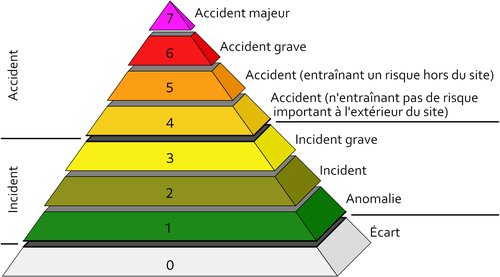
L'échelle internationale de classement des évènements nucléaires est utilisée pour classer les évènements nucléaires en fonction de leur gravité, Elle compte 8 niveaux, du simple écart, niveau 0, à l’accident majeur au niveau 7.
NB: le site web de l'autorité de sûreté nucléaire et radioprotection française fournit des informations sur les événements importants survenus à l'ILL, comme dans toutes les autres installations nucléaires françaises.
L’ILL (Institut Laue Langevin) est un organisme de recherche international situé à Grenoble qui exploite un réacteur à haut flux neutronique (RHF) de 57 MW, classé Installation Nucléaire de Base n° 67. Il fournit des faisceaux de neutrons très intenses pour la recherche fondamentale, notamment dans les domaines de la santé, de l’énergie, de l’environnement et des matériaux quantiques.
Le 3 septembre 2025, lors de l’essai mensuel du conditionnement d’air du poste de contrôle de secours, les alarmes signalant une surpression trop basse entre le poste de contrôle de secours et l’extérieur ne sont pas déclenchées. Le poste de contrôle de secours a été construit à la suite des études complémentaires de sûreté initiées après l’accident de Fukushima au Japon pour garantir la gestion des situations de crises extrêmes.
Après une investigation approfondie consécutive à la découverte de l’événement, il a été constaté que la valeur de consigne de la surpression n’était pas réglée conformément à la valeur de 0,0015 bar indiquée dans le rapport de sûreté. Dans ces conditions, la légère surpression du poste de contrôle de secours en situation de crise extrême n'aurait pas été assurée, compromettant ainsi son habitabilité.
La durée d’indisponibilité définie dans les règles générales d’exploitation du conditionnement d’air du poste de contrôle de secours a été dépassée. Par conséquent cet évènement est classé en niveau 1 sur l’échelle INES des évènements nucléaires qui en compte 8 (du simple écart, niveau 0, à l’accident majeur au niveau 7).
Cet événement n’a eu aucune conséquence pour les opérateurs, le public et l’environnement.
L’ILL (Institut Laue Langevin), organisme de recherche internationale, abrite un réacteur à haut flux neutronique (RHF) de 57 MW, Installation Nucléaire de Base n° 67, qui produit des faisceaux de neutrons très intenses destinés à la recherche fondamentale, notamment dans les domaines de la physique du solide, de la physique neutronique et de la biologie moléculaire.
Le 28 février 2019, lors d’une opération normale de vidange de la piscine du réacteur et du canal d’entreposage adjacent, la porte amovible de séparation piscine / canal a été levée de trente centimètres, sans toutefois sortir de la gorge où elle est logée. Le levage de cette porte de 4 tonnes a été réalisé dans un premier temps à l’aide du crochet 6 tonnes du pont roulant. La manœuvre s’est révélée infructueuse. Le crochet 20 tonnes a ensuite été utilisé alors que le câble de manutention de la porte n’est pas prévu pour un tel effort potentiel ; sa CMU (Charge Maximale Utile) est de 4 tonnes[1]. Le dépassement de la charge admissible aurait pu créer un risque de chute de 30 centimètres de la porte, conduisant à déformer la gorge de guidage. Compte tenu de cette conséquence potentielle en cas de chute, l’évènement a d’abord été classé en incident significatif de niveau 0.
A la suite d’un examen approfondi, il a été constaté que les opérateurs n’avaient pas adopté l’attitude interrogative qui convient avant de poursuivre leurs manipulations et de changer de crochet. Par ailleurs le levage de la porte piscine/canal pendant la vidange n'était pas prévu au départ. La procédure n’avait donc pas été appliquée correctement.
L'évènement a alors été reclassé en niveau 1 sur l’échelle INES des évènements nucléaires qui en compte 8 (du simple écart, niveau 0, à l’accident majeur au niveau 7).
Il n’a eu aucune conséquence pour les opérateurs, pour le public et l’environnement.
L’ILL, institut de recherche international, exploite un réacteur nucléaire classé INB (Installation Nucléaire de Base).
Le 17 mai 2017 un élément combustible usé s’est bloqué dans sa hotte de manutention, pendant une opération de transfert à l’intérieur de la piscine de refroidissement.
Pratiquée totalement sous eau, l’opération consistait à déposer l’élément combustible usé au fond de la piscine de refroidissement. Elle n’a pas pu s’achever correctement. A ce jour l’élément combustible est toujours bloqué sous l’eau, en position intermédiaire. Sa puissance résiduelle est faible, environ 20 kW.
L’élément est toujours resté sous eau, il ne présente donc ni risque radiologique ni risque d’élévation de température. Une fois dégagé de la hotte de transfert il sera positionné au fond de la piscine comme pratiqué normalement.
Les transferts des éléments usés sont des opérations habituelles, déjà effectuées près de 200 fois à l’ILL sans incident.
Conformément à la pratique pour ce type d’anomalie, le classement retenu est le niveau 1 sur l’échelle INES des incidents nucléaires, qui en compte 8 (du simple écart, niveau 0, à l’accident majeur au niveau 7).
A aucun moment l’évènement n’a induit de risque, ni pour l’installation, ni pour les opérateurs, ni pour l’environnement.
L’ILL, institut de recherche international, exploite le réacteur nucléaire à haut flux classé Installation Nucléaire de Base (INB n°67).
Les paramètres de fonctionnement de l’installation sont systématiquement relevés pour contrôle toutes les douze heures. Le 9 juillet à 9h, le chef de quart a constaté que certaines zones situées dans l’enceinte interne du réacteur étaient en légère surpression (0,5 à 1 mbar). Lors du relevé précédent, ces paramètres étaient conformes au référentiel de sûreté. Cette anomalie n’a pas été immédiatement détectée car l’alarme associée à la surveillance des dépressions dans l’enceinte de confinement interne du réacteur était inhibée.Il convient également de souligner que le réacteur dispose d’une enceinte de confinement double, et que la pression dans l’enceinte de confinement externe était bien maintenue à sa valeur nominale de 135 mbar.
Cet évènement n’a conduit à aucune conséquence, ni sur l’environnement ni sur les personnes. L’inhibition de l’alarme ayant été effectuée sans analyse formalisée, il est déclaré au niveau 1 de l’échelle INES. A ce titre il fait l’objet d’une information publique.
L'Institut Laue-Langevin (ILL), exploitant le réacteur à haut-flux de neutrons sur son site de Grenoble, a déclaré à l’ASN le 26 juin 2015, un évènement significatif pour la radioprotection relatif à l’exposition de la main d’un opérateur au-delà du quart de la limite annuelle réglementaire de dose, fixée à 500 mSv pour les extrémités.
Cette exposition s’est produite le 24 juin 2014 lors d’un contrôle d’un appareil de radioprotection par un opérateur de l’ILL. Ce contrôle est réalisé à l’aide d’une source radioactive d’étalonnage, qui est fixée à l’extrémité d’une canne afin de pouvoir approcher celle-ci au plus près des appareils de mesure situés en hauteur.
Lors de son contrôle, l’opérateur a saisi la canne du mauvais côté et a donc tenu la source dans sa main pendant quelques minutes. C’est en reposant la canne que l’opérateur s’est aperçu de son erreur. L’exploitant estime que l’opérateur a tenu la source dans sa main pendant une durée de 3 à 4 minutes.
L’estimation par l’ILL de la dose reçue par la paume de la main de l’agent est d’environ 250 mSv, soit la moitié de la limite annuelle règlementaire. Aucune dose efficace significative n’a été mesurée par le dosimètre passif de l’opérateur, du fait de la distance à la source.
En raison du dépassement avéré du quart d’une limite de dose radiologique annuelle réglementaire, l’ASN classe cet évènement significatif au niveau 1 de l’échelle INES, graduée de 0 à 7 par ordre croissant de gravité.
L'Institut Laue-Langevin (ILL), exploitant le réacteur à haut-flux de neutrons sur son site de Grenoble, a déclaré le 15 juillet 2013 un événement significatif pour la radioprotection relatif à la présence d’un faisceau de rayonnements ionisants issu d’un dispositif expérimental, en dehors du bâtiment réacteur, dans une zone non prévue à cet effet.
Samedi 13 juillet 2013 vers 23h15, deux expérimentateurs qui stationnaient à proximité du bâtiment réacteur ont été alertés par leur dosimètre opérationnel de la présence d’un débit de dose significatif. Les investigations du service de radioprotection ont permis de déterminer l’origine de cette anomalie et d’y mettre un terme. Cette anomalie était présente depuis le vendredi 12 juillet en fin de journée. Elle était occasionnée par la mise en service d’un instrument expérimental dont la protection radiologique n’était pas complètement en place et qui a été arrêté dès la découverte de l’anomalie.
Le relevé des dosimètres opérationnels des deux expérimentateurs montre qu’ils auraient reçu une dose efficace maximale de 15µSv pour l’expérimentateur le plus exposé, pour une limite autorisée de 20mSv ou 20 000µSv par an. Des investigations complémentaires ont été engagées pour les seize personnes ayant potentiellement circulé dans la zone pendant la période concernée. Ces investigations n’ont pas mis en évidence d’exposition radiologique supérieure aux seuils d’enregistrement.
L'ASN a procédé à une inspection réactive à l’ILL le 17 juillet 2013. Cette inspection a mis en évidence que l’événement résultait notamment d’un mauvais positionnement du dispositif d’arrêt du faisceau de rayonnements ionisants. Les inspecteurs ont également vérifié les actions immédiatement engagées par l’exploitant.
A la lumière des résultats des investigations conduites sur les personnes ayant circulé dans la zone considérée, l'incident n'a pas eu d'impact sur le personnel, le public ou l’environnement.
Toutefois, en raison de la dégradation de la défense en profondeur mise en évidence par cette anomalie et de l’impact potentiel sur la radioprotection des travailleurs, cet incident a été classé au niveau 1 de l'échelle internationale des événements nucléaires (INES) qui en compte 8.
Depuis juin 2006, tous les exploitants nucléaires sont tenus de établir un rapport annuel sur la transparence et la sûreté nucléaires (rapport TSN).
Conformément à l'article 21 de la loi n° 2006-686 relative à la transparence et à la sûreté nucléaires, les rapports TSN doivent détailler :