D22 - Large dynamic range small-angle diffractometer
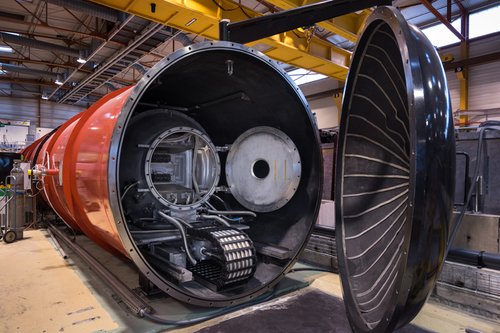
Small-angle neutron scattering (SANS) is a technique that measures the deviation at small angles (much less than one degree to several degrees) of a neutron beam due to structures of small size in the sample. "Small" means dimensions of a few tenths to about 100 nanometres, such as clusters in alloys, polymers, or biological macromolecules. In general, these structures are disordered.
The high neutron flux and the flexibility of its setup make D22 an instrument that is particularly suited for real-time experiments and weakly scattering samples.
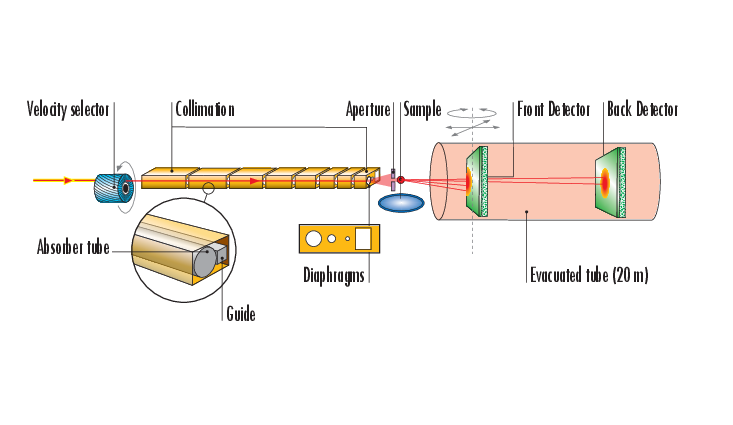
D22 is the SANS facility with the highest flux at the sample in a wavelength range of 4.5 to 40 Å. This is due to:
- the brilliant horizontal cold source
- the short rotor (25 cm) and high transmission of its velocity selector
- the relatively large beam cross-section of 55 x 40 mm of the guide H512.
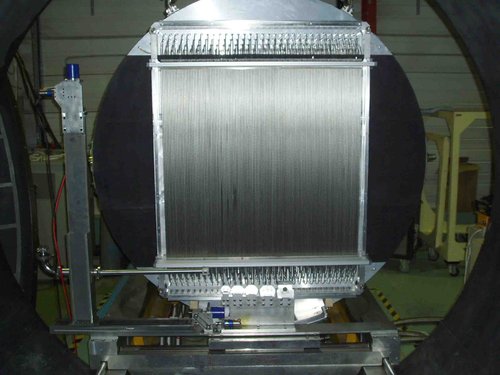
D22 possesses the largest area multidetector (3He) of all small-angle scattering instruments. This real-time multitube detector is capable of counting more than 5 MHz of neutrons on the whole surface rather than the 50 kHz of the classical ones.
Applications
Study of nanoscale materials, taking advantage of the sensitivity of neutrons towards isotopes and magnetic spin direction.
- Polymers and colloids (micelles, dendrimers, liquid crystals, gels, reaction kinetics of mixed systems)
- Materials Science (phase separation in alloys and glasses, morphologies of superalloys, microporosity in ceramics, interfaces and surfaces of catalysts)
- Biological macromolecules (size and shape of proteins, nucleic acids and of macromolecular complexes, biomembranes, drug vectors)
- Magnetism (magnetic correlations, flux line lattices in superconductors)