Switch instrument:
Tour virtuel
D22
Large dynamic range small-angle diffractometer
How it works
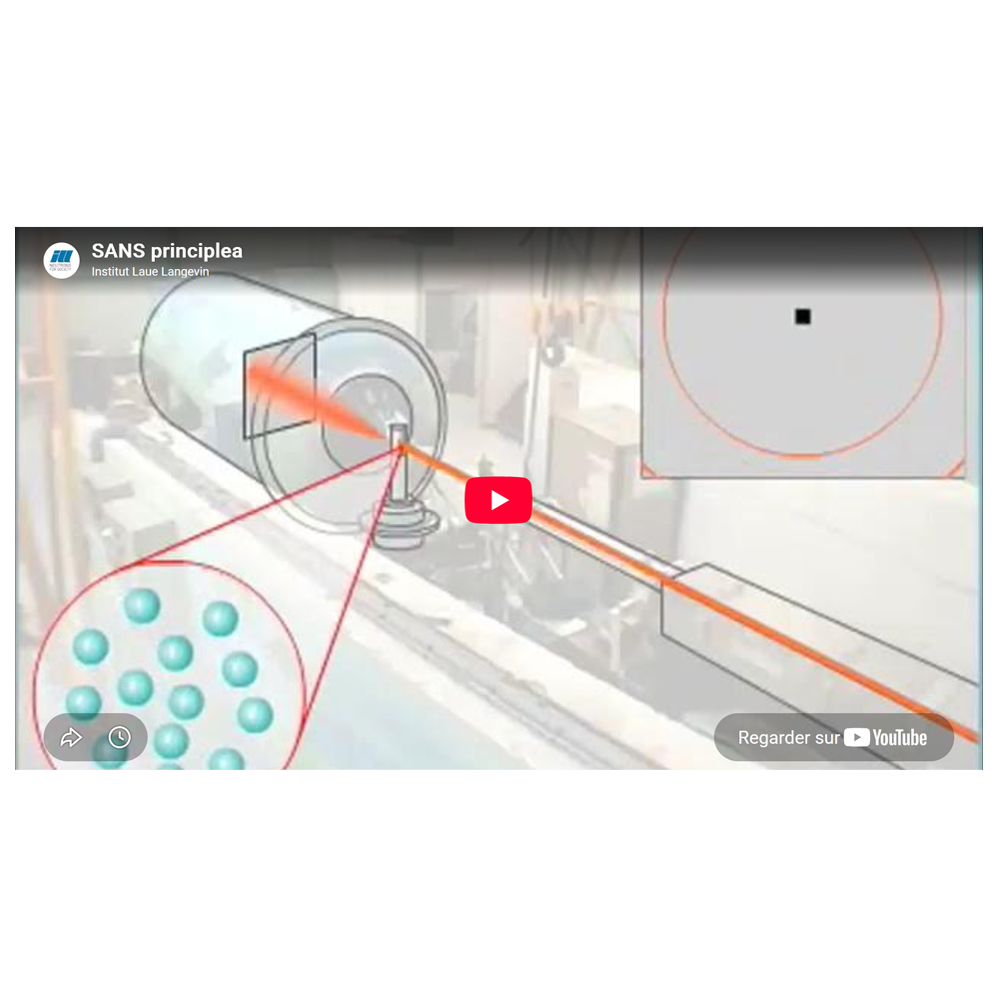
Neutron scattering is the process of collision between neutrons emitted by a source and a target which is the studied sample. When the scattering angles of these collisions are very small, the emitted neutrons are very close to the axis of the emerging beam. This process is thus referred to as Small Angle Neutron Scattering (SANS) In the animation, the sample is made up of identically sized spheres in suspension in a homogeneous medium. The influence on the measured pattern of the particle size, the sample to detector distance and the neutron wavelength is demonstrated.
Video
SANS principle
Small Angle Neutron Scattering (SANS)

Typical SANS patterns
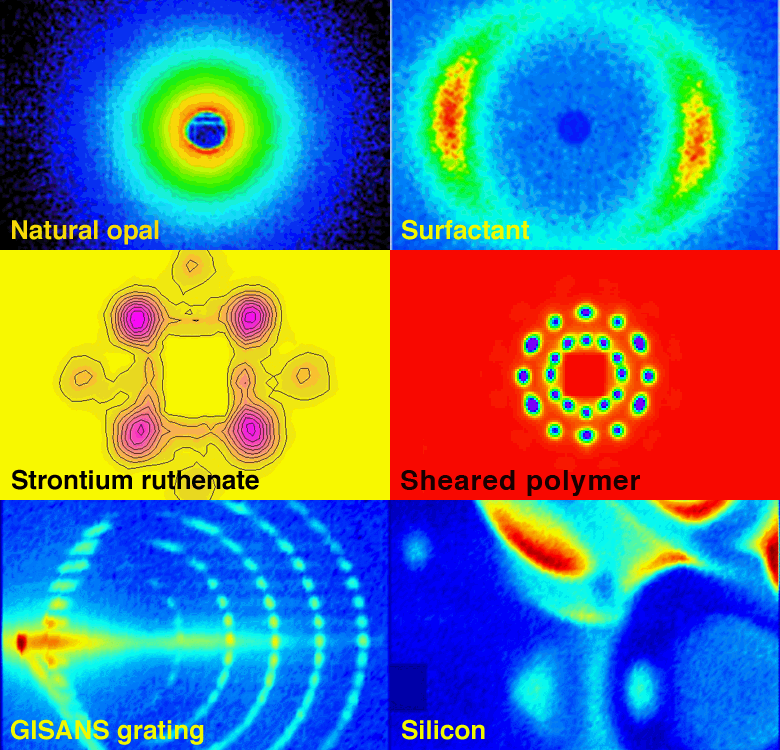
SANS patterns are often quite beautiful with a reminiscence of Vasareli art painting.
Why Neutrons?
- No charge, very penetrating, and non destructive to samples
- Neutron wavelengths are comparable to atomic sizes and inter-distance spacing
- Neutron interactions with hydrogen and deuterium are widely different making the deuterium labeling method an advantage.