How it works
Single crystal diffraction experiment
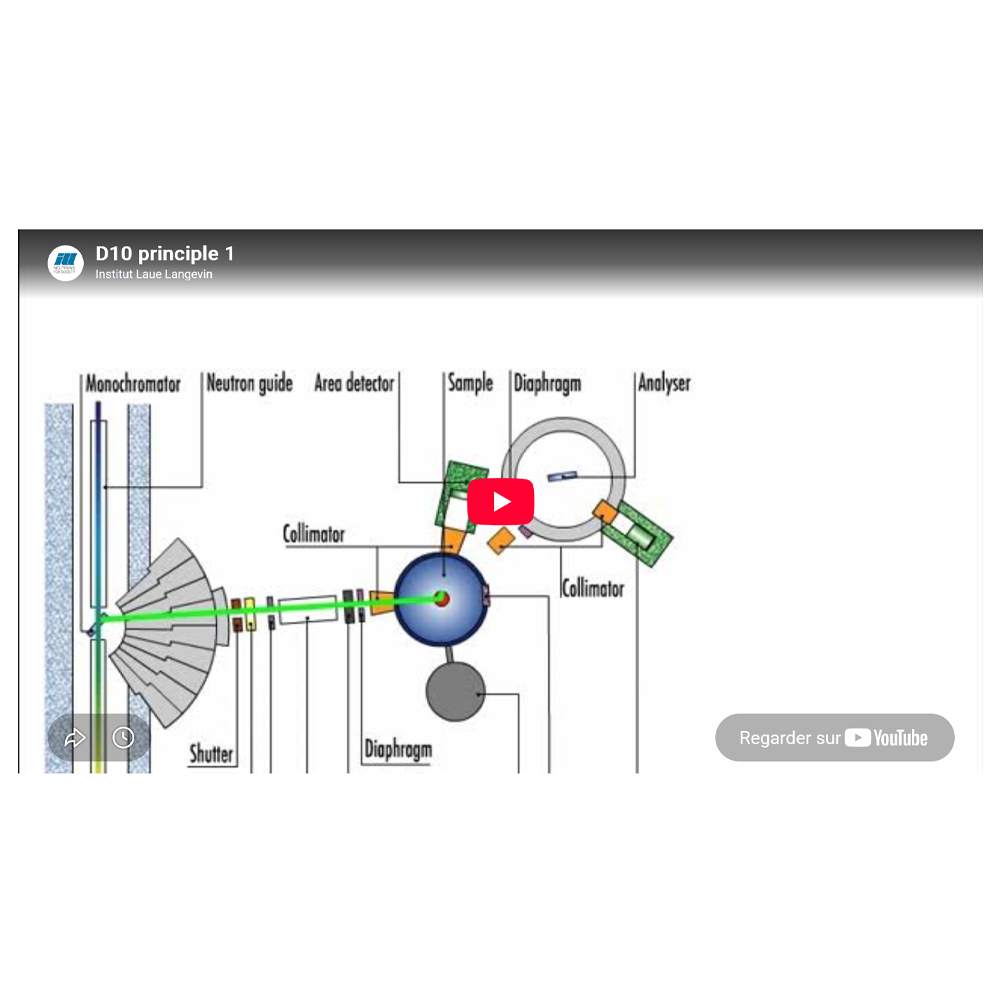
- Here D10 is set for a single crystal diffraction experiment in the 4-circle geometry.
- The polychromatic beam from the thermal neutron guide H24 arrives on the monochromator, which selects a given wavelength.
- The monochromatic beam passes through slits to limit its size before reaching the sample.
- The sample, usually a single crystal in a gas flow helium cryostat, is at the center of the eulerian cradle.
- The three axes ω,χ,ϕ of the Eulerian cradle are rotated until a given set of atomic planes diffract into the equatorial plane.
- The detector is rotated to the location of the diffracted beam, which is then scanned step by step.
This makes it possible to record the intensities of a large number of Bragg reflections, from which the atomic structure of the sample can be obtained.
TAS geometry
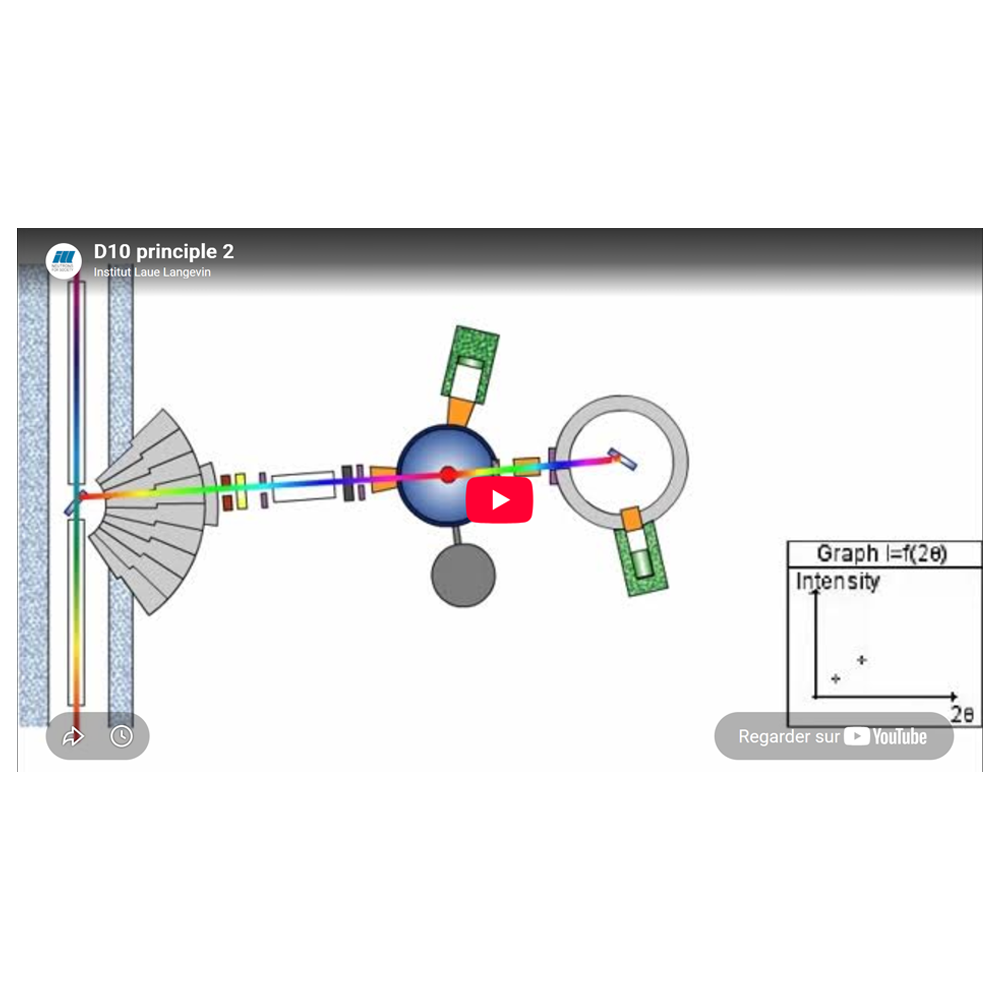
D10 is set in the 3-axis geometry (TAS geometry) for an inelastic scattering experiment.
- The polychromatic beam from the thermal neutron guide H24 arrives on the monochromator, which selects a given wavelength.
- The monochromatic beam passes through slits to limit its size before reaching the sample.
- The sample, usually a single crystal in a gas flow helium cryostat, is at the centre of the Eulerian cradle.
- The sample is first rotated to the desired orientation.
- The scattered beam, which may have a different wavelength from the incident beam, arrives on the analyser.
To obtain the wavelength (or energy) of the scattered beam, a scan is performed by the analyser and detector.
This makes it possible to study the dynamics of materials and also to measure very small signals, e.g. diffuse scattering, and very weak magnetic peaks.
4-circle diffraction with a 3He dilution cryostat
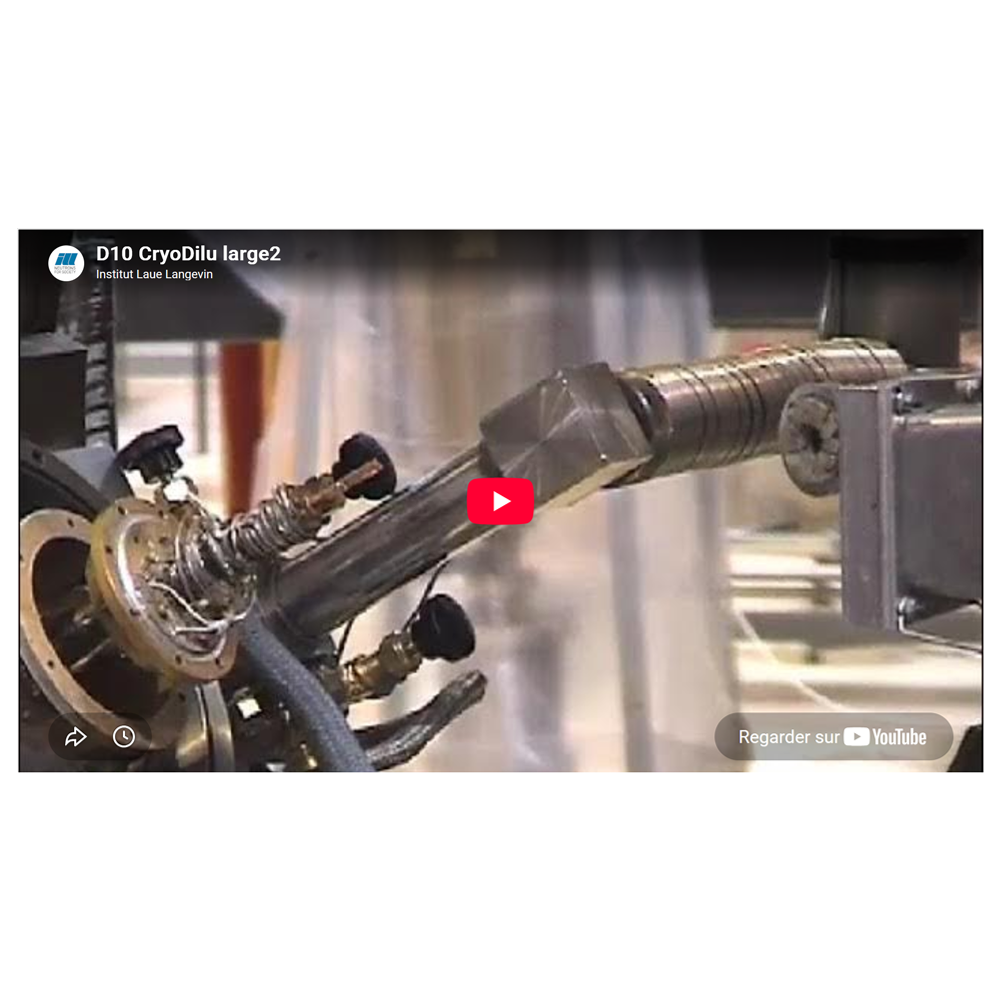
In the four-circle mode, the offset C-shaped Eulerian cradle can be equipped with a helium-flow cryostat (1.6 K to 450 K, or 0.1 K to 10 K in dilution mode). This dilution cryostat is of an innovative design which allows it to work in any orientation and to follow all the movements of the diffractometer. A similar technique is used for satellite cryostats.
The movie shows the mounting of a new sample into the cryostat.
- the detector and the eulerian cradle are rotated to a position suitable for dismounting the previous sample
- the three vacuum/thermal shields of the cold head of the cryostat are removed to give access to the sample holder
- a new crystal (blue) is mounted and aligned
- a new indium vaccum seal is placed
- the three shields are re-mounted
- various cables, nitrogen & vacuum supply are disconnected or reconnected
- the diffractometer is ready to use in the four-circle mode for low temperature diffraction studies.
The trick of the advanced dilution cryostat of D10
A neutron radiograph film recorded at the ILL in 2005 on NEUTROGRAPH shows the progressive dilution of helium-3 into helium-4 inside a capillary which is at the heart of ultra-low temperature space cryostats. Such an in situ observations is possible only using neutrons where there is a marked isotopic effect for helium (helium-4 is transparent, helium-3 is opaque to neutrons).
Ref.: M. Enderle, S. Pujol, A. Hillenbach (Institut Laue-Langevin), A. Benoit (CRTBT CNRS) (2005) communication privée.
Explicative video
Explicative video
Explicative video
Explicative video