
Characteristics
| Guide hall n°1, vertical cold source V1, in-pile H1 insert, cold guide H15, channel H153 (deflector) |
|---|
| Monochromator | |
|---|---|
| velocity selector | |
| Eleanore/ Felicia (ASTRIUM standard selectors) | variable, typically Δλ/λ = 9 % (FWHM) |
| incident wavelength | variable, 0.46 ≤ λ [nm] ≤ 4 |
| max. wavelength at max. detector dist. (39 m) | λ = 2.2 nm |
| selector rotation normal to n-beam possibleminimum wavelength at rotation -7° | -7° to + 7° λ = 0.32 nm |
| Collimation | |
|---|---|
| 17 guide sectionsstraight glass guides, m=1 (SwissNeutronics)elliptical focussing guides, m=1.5 (SwissNeutronics) | side of square cross section14 straight guides 45 mm over 28.8 m 45 mm -> 47.65 mm from 5.6 to 4.1 m 47.65 mm -> 46.10 mm from 4.1 to 3.1 m 46.10 mm -> 38.0 mm from 3.1 to 1.6 m |
| guide-to-sample distances | 1.6, 3.1, 4.1, 5.6, 6.7, 7.7, 10.2, 12.7, 15.2, 16.5, 17.8, 20.3, 22.8, 24.8, 26.9, 29.4, 31.9, 35.2 m (18 discrete distances) |
| 4 variable-aperture slits (10B4C) | at 34.63, 27.85, 6.74 and 1.65 m from sample |
| 5 multiposition (8) aperture changer (10B4C) | at 26.92, 20.38, 15.31, 10.28 and 5.70 m from sample |
| Attenuators |
|---|
| choice between 3 slitted cadmium sheets of different transmissions that can be combined to achieve 7 attenuation factors fa:fa=4.63 (att 1), fa=16.9 (att 2), fa=72.7 (att 3), fa=77.7 (att 1 + 2), fa=348 (att 1 + 3), fa=1165 (att 2 + 3), fa≈8200(att 1 + 2 + 3) |
| Sample area | |
|---|---|
| flux at specimen at lowest resolution | 1.2 · 10\(^{8}\)n·cm\(^{-2}\)·s\(^{-1}\) at λ = 0.6 nm at 55 MW (as measured on the detector) |
| typical sample size | 7 × 10 mm\(^{2}\) |
| Detector | |
|---|---|
| sample-to-detector distancesL | continuously variable between 1.35 m and 38.9 m |
| typical momentum transfer range | 3·10\(^{-3}\)≤ q [nm\(^{-1}\)] ≤ 6 |
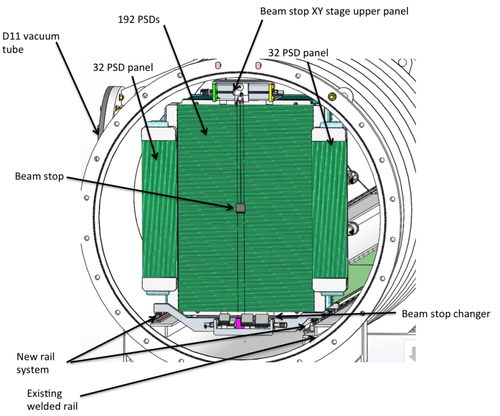
| detector type (since January 2021) | \(^{3}\)He gas detector (256 1-m long, 8 mm outer diameter stacked tubes from Reuter-Stokes, installed in 3 panels, shaped as a cross of 1.5×1.5 m\(^{2}\): 192 horizontal tubes + 2 side panels of 32 tubes each. \(^{3}\)He at 10 bars. Stop-gas: Ar/CO2mix at 1.5 bars. Stainless steel 304 of 0.4 mm wall thickness. Operated at HV=1500 V. |
| efficiency | 90, 95 and 99.5 % at λ = 0.45, 0.6 and 1 nm within the tubes. Due to the geometry of tubes assembly, 12 % of neutrons avoid the detection area. |
| area | 2 m\(^{2}\) |
| pixel size | 8 mm across (rectangular psf), 3 mm FWHM along tubes (Gaussian psf) |
| background | 1.2 Hz on whole detector |
| detector deadtime | 1.5 µs per tube (~1/10 event loss at 66 kHz per tube, at 225 kHz) |
Technical description
The polychromatic beam from the cold source is monochromated by a helical slot (ASTRIUM) velocity selector which selects neutrons of ±9 % about a mean wavelength determined by the rotation speed of the drum. The neutrons are then collimated by a series of moveable glass guides. Guide sections are inserted into or removed from the beam depending on the incident beam divergence required.
The sample zone, situated 35 m down-stream from the velocity selector, may be equipped with various sample environments such as an automatic temperature controlled sample changer, cryostat, magnet, shearing cell, Bohlin rheometer, dilution refrigerator, horizontal sample-changer under vacuum, etc.
Neutrons scattered from the sample are detected on a 1.5 x 1.5 m2 multi-PSD 3He detector mounted on a moveable trolley within the evacuated detector tube. The detector may be placed at any distance between 1.35 and 38.9 metres from the sample position, giving a typical momentum transfer range of 3 10-3 to 6 nm-1 that can be a bit extended for specific cases.
The D11 collimation system has been completely renovated between 2021 and 2025 (Endurance 2 renewal project).