


Atomic order and disorder
18 Nov 2026Neutron diffractometry visualises tiny atomic motions in lithium compounds - the key to future battery technologies
-
 Energie

One of the most fundamental quests of the 21st century is designing sustainable, high-performing batteries. Solid-state lithium batteries, which run based on solid electrolytes as opposed to liquids used in standard batteries, are promising candidates. Research is ongoing to optimise their performance and sustainability profiles, including the type of solid electrolytes that these batteries rely on.
So-called lithium argyrodites are ordered atomic structures with a lot of potential for use in the next generation of solid-state batteries - offering enhanced performance and sustainability profiles.
Both standard and next-generation lithium batteries rely on the movement of lithium ions within their electrolytes. This parameter is known as conductivity. The higher the conductivity of lithium argyrodites is, the better their application potential. Until now, computational models assumed that these movements were mainly governed by chemical composition, but a recent study performed on ILL’s neutron diffractometer D2B challenges this view. The researchers involved in this project demonstrated that production conditions, notably the synthesis temperature of lithium argyrodites, plays an important role in determining their conductivity. Exploiting the exceptional sensitivity of neutrons to different elements, the study also revealed that changing atomic compositions also had an influence on argyrodite conductivity.
These findings imply that optimising the synthesis conditions and tuning the composition of argyrodites can enhance their conductive power, thereby making them even more desirable building blocks for batteries of the future.

Lithium argyrodites: a promising candidate for next-generation batteries
Materials containing lithium (Li), a light metal, are of particular interest especially in the development of novel solid-state batteries (SSB). As opposed to standard lithium ion batteries in which an electrolyte solution is used to shuttle ions between electrodes, SSB run on a solid electrolyte. The main advantages of this technology are a higher energy density, increased lifetime, faster charge times and a better sustainability profile.
In the context of SSB development, so-called lithium argyrodites are gaining increasing attention as useful solid electrolytes materials due to their ability to achieve exceptionally high conductivities (the ease at which electrical charges move through a material) which are necessary for practical applications.
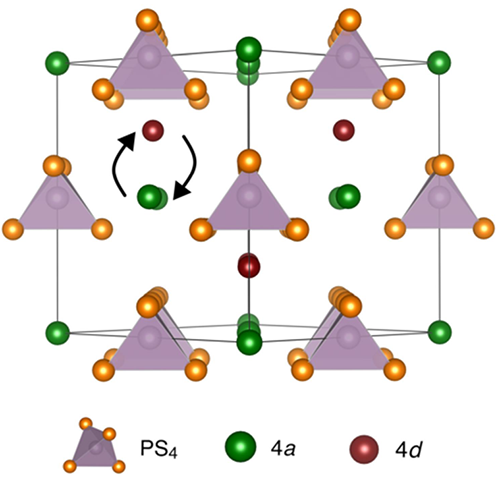
It has been shown that argyrodite conductivities can be modified by different parameters, notably their elemental composition. To keep optimising their performance, the exact impact of their composition therefore needs to be understood in as much detail as possible.
The chemical formula of lithium argyrodites reads Li6PS5X (where Li = lithium, P = phosphorous, S = sulphur and X = halide ions such as chlorine, bromine or iodine). All of these atoms form crystals characterised by a precise atomic arrangement. In particular, it is known that the lithium ions are arranged in cage-like structures around sulphur ions. The spatial arrangement and mobility of lithium ions, and thereby, the argyrodite conductivity, is governed by different parameters. A very important parameter is the rearrangement, or disorder, of the halide and sulphur atoms. The conditions, in particular the temperatures, at which lithium argyrodites are synthesised also play a hugely important role in controlling the degree of disorder.
When neutron experiments challenge theories
Interestingly, commonly used theoretical models assume that this disorder is governed only by chemical composition, while experimental data shows that the temperature at which the samples are synthesised also plays a role: in fact, higher temperatures favour dynamic processes leading to atomic disorder. A recent study performed by a team of academic and industrial researchers from the UK, Germany and the US in collaboration with ILL scientists took on the challenge of exploring and analysing this phenomenon in great detail.
The team employed neutron diffraction experiments on ILL’s instrument D2B as their main technique. Neutron diffraction is of particular interest for studying the exact atomic composition of different materials, whether they are ordered crystals or amorphous mixtures. It can also reveal temperature-dependent atomic motions and distinguish different atoms in a non-invasive way - aspects which were key to the team’s research.
The scientists measured argyrodites with different atomic compositions (i.e., with progressively increasing lithium and silicon content) which had been rapidly cooled down (“quenched”) from temperatures between 550 and 350°C, mimicking the industrial, temperature-dependent production process of argyrodites. The team noticed that the degree of disorder varied sensibly as a function of the initial, pre-quench temperature even for samples with rather similar elemental composition. Challenging existing theories, their data confirmed that disorder indeed persists at high temperatures.
By exploiting the sensitivity of neutrons to different atoms, the researchers further showed that composition differences such as an increased silicon and changing lithium content decreased the degree of disorder, thus revealing the subtle atomic effects which govern the behaviour of conducting materials.
A glimpse into the future of battery technology
These findings suggest that targeted changes of the composition of argyrodites and of their synthesis conditions can tune their conductive properties, paving the way towards optimising future generations of lithium-based, solid-state batteries. With the quest for novel, highly efficient portable energy sources remaining a crucial challenge of the 21st century, these results show just how important collaborations between industry and academia are to make progress in cutting-edge technology research.
Reference: Fallon, M. J., Faka, V., Lange, M. A., Kraft, M. A., Suard, E., Connolly, E. T., Francisco, B. E., Squires, A. G. & Zeier, W. G. (2025). Exploring the anion site disorder kinetics in lithium argyrodites. Journal of the American Chemical Society, 147(12), 10151-10159. DOI: 10.1021/jacs.4c14466
ILL instrument: D2B
ILL contact person: Emmanuelle Suard
Institutions involved in the research: University of Münster, Helmholtz-Institut Münster, Diamond Light Source, Solid Power Inc., University of Birmingham,