

Safety
jkln:nnkl!lien vers waste
This section sets out some basic guidelines for the use of the ILL chemistry laboratories. However, it cannot replace in-depth chemistry and safety training or provide detailed information on chemical hazards and potential risks.
Work in chemistry laboratories often involves the handling of hazardous substances and the use of fragile apparatus requiring a sound knowledge of chemistry and physics. The work you perform in the ILL chemistry laboratories is at your own risk, so please only conduct experiments you are familiar with.
You can minimize these hazards simply by observing the following:
- Use the personal protective equipment (e.g. lab coats, safety glasses, gloves) provided in the lab
- Consult the Material Safety Data Sheets (MSDS) of the chemicals you will be using
- Replace hazardous chemicals with less hazardous ones
- Keep the amount of chemicals in use to the smallest quantities possible
- Work in a fume hood
For your own safety and the safety of other lab users, please read the following pages carefully. Should you have any doubts concerning your work in the chemistry laboratories or if you have any suggestions on how to improve our safety standards, please do not hesitate to contact the Lab Manager.
Emergencies
Emergency Phone Numbers:
12 Emergency number, Security Command Post (medical and technical emergencies, fire)
31 Health Physics
14 Reactor Entrance
15 Site Entrance
A Red Telephone connects you directly to the Security Command Post.
First Aiders
Several First Aiders can be found in almost every building on the ILL site.
Medical Emergency
In the case of a serious injury or poisoning, dial 12 on an ILL phone or pick up a red telephone. The Medical Service is available Monday to Friday from 08:00 to 12:15 and 13:15 to 17:00. Outside those hours use a Red Telephone or dial 12 to contact the Security Command Post.
Action to be taken in case of emergency:
- Provide the Security Command Post with the following information:
- Your name
- Exact location of the incident
- Nature of the incident
- Number of victims
- Never hang up first!
- Contact the nearest First-Aider.
- Protect the victim, but first and foremost protect yourself.
- In the case of a chemical incident, try to provide the MSDS.
Please report any minor injuries (e.g. cuts, burns, etc.) to the Medical Service located in ILL50 (map).
Fire Emergency
In the event of a fire, dial 12 on an ILL phone or pick up a red telephone.
Action to be taken:
- Provide the Reactor Control Room with the following information:
- Your name
- Exact location of the fire
- Nature of the incident
- Number of victims
- Never hang up first!
- If you are trained, fight the fire with the portable extinguishers in your vicinity. Do so only in the early stages of the fire and don't put yourself in danger
- If the fire takes hold, evacuate.
- Protect any victims, but first and foremost protect yourself.
- If there is smoke, stay low as any fresh air is close to the ground. Never enter a smoke-filled area.
- Do not use the lifts.
- In case of evacuation, reach the gathering point close to ILL1 (map).
Personal Protective Equipment
Always wear the appropriate personal protective equipment when working in the laboratories!
You will find the following equipment in the labs:
- Lab coats
- Safety glasses
- Disposable gloves
If you need anything else or if personal protective equipment is missing, please contact Martina SANDRONI (tel 7090) or Sandrine VERDON (tel 7206).
Work clothing:
- For adequate protection wear long trousers and closed, flat-soled shoes.
- Lab coats with press studs are recommended, as they can be taken off quickly.
- Lab coats only provide adequate protection when worn closed.
- Do not wear lab coats outside the laboratories, especially not in offices or kitchens.
Safety glasses:
- To protect your eyes always wear safety glasses when handling chemicals or glassware under vacuum or high pressure.
- Normal viewing glasses do not provide adequate protection; always wear additional safety glasses on top.
- Wearing contact lenses is not recommended when working in the laboratories.
- Although safety glasses reduce the risk for your eyes, you must know where the nearest emergency eye wash station is located!
Gloves:
- Nitrile disposable gloves are available in the laboratories. Use them whenever necessary.
- Please note: Disposable gloves are only meant as temporary protection against brief contact from splashes.
- For the handling of highly aggressive chemicals (e.g. piranha acid, bromine), special gloves must be worn. Please contact the Lab Manager beforehand.
The chemical resistance of disposable gloves can be quite different for different chemicals – make sure to choose the right material.
Substance/Breakthrough time [min] | Nitrile | Latex |
|---|---|---|
Aceton | 1 | 1 |
Dimethyl sulfoxide (DMSO) | 48 | 84 |
Ethanol | 22 | 3 |
Isopropanol | 54 | 6 |
Methanol | 6 | 0 |
Toluene | 1 | - |
Ammonium hydroxide | 33 | 9 |
Hydrochloric acid 37% | 141 | 39 |
Hydrogen peroxide 30% | 55 | - |
Nitric acid 50% | 63 | 21 |
Sodium hydroxide 40% | 480 | 480 |
Sulfuric acid 98% | 8 | - |
Nitrile: SHIELDskin Orange Nitrile 300, Latex: SHIELDskin Bright Latex 300 (Chemical Resistance Guide)
CAUTION
- Wearing (disposable) gloves for long periods may cause them to tear. Your skin may also sweat underneath. Both these factors facilitate the penetration of chemicals through the glove and your skin. Therefore you should only wear gloves when needed!
- Be careful not to contaminate your surroundings with chemicals by touching objects (e.g. door handles) that others may touch without gloves. Gloves must not be worn outside the laboratories!
Fume Hoods
When using flammable, explosive or toxic substances or substances that are classified as CMR (carcinogenic, mutagenic and/or toxic for reproduction), you must work in a fume hood. This generally protects you from unacceptably high levels of exposure. However, additional precautions may be necessary:
- Before you start working in a fume hood, check that the ventilation is working correctly.
- To maximize both the ventilation and the protective shielding, only open the sashes as far as you need to work comfortably. If possible, use the horizontal sashes rather than the vertical sash.
- Keep your head outside the fume hood.
- Work at least 15 cm inside the fume hood.
- Keep the sashes closed if you are not working in the fume hood. As well as a loss in performance when sashes are open, people passing an open fume hood may create turbulence inside the fume hood causing chemical substances to escape. This is also true of open doors and windows.
CAUTION
- Toxic and CMR compounds must not be handled in the fume hood in the ILL22 laboratory (Guide Hall II, ILL22), as the exhaust duct leads into the guide hall.
- Fume hoods must not be used as storage space. Tidy up after you have finished working and store chemicals in the appropriate storage cabinets.
Emergency Equipment
Before you start working, make sure that you locate the nearest emergency equipment, such as emergency showers, eye wash stations, fire extinguishers, phones. Familiarise yourself with the use of this equipment, especially with the eye wash station (as it is much more difficult to use when you have acid in your eye). On each sink you will find a container of TRIVOREX (pdf - 3.57 Mi) for cleaning up spills of liquid chemicals and a MINI DAP (pdf - 88 Ki) bottle (Diphoterine) for washing off chemical splashes on your skin.
Eye Wash Station
Familiarise yourself with the use of the eye wash stations before you start work. If you accidentally get a chemical substance in your eye, every second counts for preventing major eye damage. Proceed immediately to the eye wash station and start rinsing your eye(s). Call out for help as you will need assistance to keep your eye lids open during rinsing. Try to prevent the rinse water from entering the unaffected eye. Wash until medical assistance arrives.
Emergency Shower
If a large area of your body surface is affected by a chemical spill, call out for help and proceed immediately to the nearest emergency shower. Start the water and when you are completely drenched, take off any contaminated clothing (including underwear). Wash until medical assistance arrives.
Working with Chemicals
Working in laboratories often involves working with hazardous substances. To minimize the dangers associated with handling such substances, please take note of the following:
- Find out about about the chemica you will usel and its hazards before you start work, e.g. consult the Material Safety Data Sheet.
- Check whether a hazardous substance can be replaced by a less hazardous alternative.
- Keep the amount of chemicals in use to an absolute minimum.
- Always wear the appropriate Personal Protective Equipment and make use of the fume hoods.
- If you have any questions about handling a specific chemical, do not hesitate to contact the Lab Responsible.
Identifying the hazard potential of a substance
The new “Globally Harmonized System of Classification and Labelling of Chemicals (GHS)” classes chemical substances by the type of their hazards and includes a system of harmonized labels to identify hazards quickly. The types of hazards are as follows:
- Physical hazards
- Health hazards
- Environmental hazards
Each label describes different hazard classes
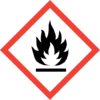
Flammables
Self-reactives
Pyrophoric
Self-heating
Emits flammable gas
Organic peroxides
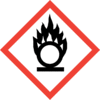
Oxidisers
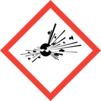
Explosives
Self-reactives
Organic peroxides

Gases under pressure
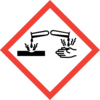
Corrosives
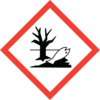
Environmental toxicity

Irritant
Skin sensitiser
Harmful
Narcotic effects
Respiratory tract
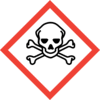
Acute toxicity
(toxic, fatal)
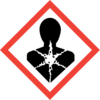
Carcinogen
Mutagenicity
Reproductive toxicity
Respiratory sensitizer
Target organ toxicity
Aspiration toxicity
Material Safety Data Sheets
GHS labels only provide you with limited information on the hazards of a compound. More detailed information can be found in the Material Safety Data Sheet (MSDS) of a specific compound, e.g.:
- Possible hazards, stability and reactivity
- First-aid and emergency measures
- Handling, storage and transport
- Adequate personal protection
- Physical and chemical properties
- Toxicological information
- Disposal considerations
You can obtain MSDSs from the Lab Responsible. In the online catalogues of chemical suppliers (e.g. Acros, Roth, Sigma-Aldrich) MSDS information is provided for each chemical product.
CAUTION
Mixing chemicals may result in hazardous reactions not indicated in the MSDSs of the respective substances. Therefore MSDSs cannot replace a solid education in chemistry!
Storage of Chemicals
Acids and bases must be stored separately in the acid/bases cabinets in the Chemistry Lab (ILL20, 205) and the ILL7 Lab.
Organic solvents must be stored in the ventilated storage cabinets in the Chemistry Lab (ILL20, 205) and the ILL7 Lab or in the cabinets under the fume hoods in the IN-FIG Lab (ILL7) and the ILL22 Lab.
CAUTION
- Peroxide-forming solvents such as ethers must be stored away from light and must be kept in brown glass bottles with tightly sealed caps. The same applies for chlorinated solvents such as chloroform or dichloromethane, as light and oxygen catalyses their degradation to highly toxic compounds such as phosgene.
- Put all chemicals back in there respective storage places immediately after use, so that other users can find them.
A fridge/freezer can be found in the Chemistry Lab, the Soft Matter Lab and the ILL22 Lab. A cold room can be found in ILL20 and in the ILL7 Lab. Please label your chemicals/samples accurately (Name, compound, date,...) if you need to store them there. Please note that these places are not meant for long-term storage. Users that need to store their samples over a longer period of time must contact the Lab Responsible.
Use the buckets/containers available in the labs for transporting chemicals (and don't forget to bring back both the chemicals and the containers).
The transport, reception and handling of deuterated molecules is subject to special safety rules. These compounds are therefore kept in locked boxes. Please contact David HESS or Sandrine VERDON.
Waste Disposal
The incorrect disposal of chemical waste is a significant source of danger, both for people working in the laboratory as well as for those concerned with processing the disposed waste. If you have any doubts about correct disposal or if you think your sample does not fit into any of the following categories, please do not hesitate to contact the Lab Responsible.


For mineral acids and bases use the containers provided in the labs. Solutions containing fluoride or cyanide ions must not be disposed of in the mineral acids container! A separate container is provided for the disposal of piranha acid in the Chemistry Lab (ILL20, 205). Please consult the instructions (pdf - 487 Ki) given there before handling piranha acid.

A container for inorganic solutions, e.g. aqueous solutions of heavy metals, can be found in the Chemistry Lab (ILL20, 205) or will be provided for you on request by the Lab Responsible.


For halogenated and non-halogenated organic solvents, please use the containers provided in the labs. Halogenated organic solvents are solvents that contain one or more chemically bound halogen atoms, e.g. chloroform, dichloromethane. Non-halogenated organic solvents (e.g. ethanol, isopropanol, acetone, toluene, diethyl ether) do not contain chemically bound halogen atoms. Mixing of both types of solvent may result in unexpected reactions, so please make sure you use the right container for disposal.


Dispose of used gloves, contaminated tissue paper, pipette tips, syringes and falcon tubes in the respective waste bins provided in the lab. Syringes and falcon tubes must be emptied before disposal. Leave tissue paper soaked with organic solvents in the fume hood for evaporation of the solvent before you discard it.
Do not throw sharp objects into these bins as only the bags are changed!

For syringes and blades, use the yellow containers on the benches.


For empty glass bottles and broken glassware, please use the respective containers at the entrance to the labs. Glassware must be free of any chemical residue.
If you have any chemicals in their original containers to dispose of, please contact the Laboratory Responsible.