
DALI - Extending the capacity and capability for neutron macromolecular crystallography

To extend the capabilities and capacity for neutron macromolecular crystallography at the ILL, a second quasi-Laue diffractometer DALI has been commissioned at H141 as part of the ILL Endurance Programme. DALI utilises a neutron velocity selector to provide higher transmission and a narrower bandwidth (δλ/λ ~10%) than LADI-III, both required to extend capabilities to the study of larger proteins.
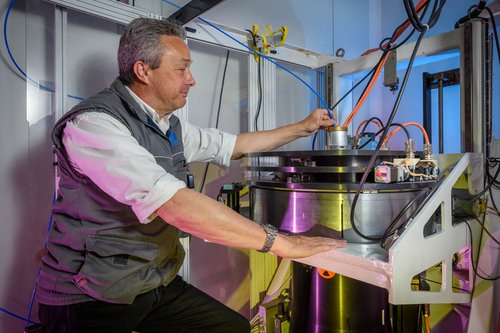
DALI allows high-resolution (~1.8 - 2.5 Å) studies of large proteins (>70kDa), in order to locate hydrogen/deuterium (H/D) atoms and protons/deuterons (H+/D+) of special interest, revealing important information on protonation, H-bonding and hydration. Neutron macromolecular crystallography is unique in its ability to provide these invaluable details at room-temperature, and without radiation damage.
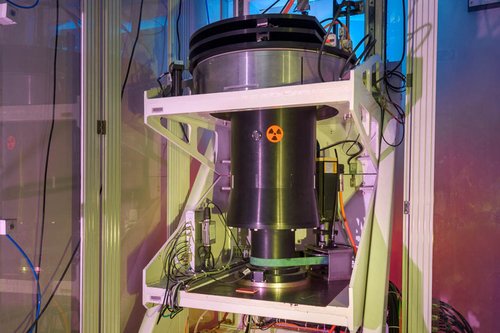
DALI uses a large cylindrical area detector composed of neutron-sensitive image-plates, which completely surround the crystal and allows large numbers of reflections to be recorded simultaneously. Data are collected using quasi-Laue methods in order to provide a rapid survey of reciprocal space, while reducing the background on the detector compared to use of the full white beam.
Applications
Neutron macromolecular crystallography projects typically aim to address questions concerning:
- Enzyme mechanisms
- Small-molecule (e.g. drug, ligand) binding interactions
- Rational drug-design

A huge advance for high-resolution studies of large proteins
In October 2025, a completely new neutron-sensitive cylindrical image plate detector was built and installed on DALI. Neutron diffraction tests and analyses were performed using crystals of proteins covering a wide range of molecular weights, from the very small (6 kDa) to the very large (271 kDa). The results show that the LADI-III and DALI macromolecular crystallography diffractometers are highly complementary.
LADI-III delivers higher quality diffraction data for small to medium-sized proteins (5-70 kDa) and DALI, with its new detector and narrow bandwidth velocity selector, now delivers diffraction data of higher quality for large proteins (70-150 kDa). In addition, the tests indicate that DALI can even be used to study very large proteins (>150 kDa) that were previously out of range. This represents a step change in capabilities for neutron protein crystallography research and further cements the ILL’s position as world-leading in the field.
Below shows a 16-hour exposure from a crystal of 105 kDa protein (LecA/PheGal complex, unit-cell, a = 74, b = 111, c = 113 Å / P212121). Complete data set collected to 2.0 Å resolution. [LecA protein is a virulence factor of the pathogenic bacteria Pseudomonas aeruginosa. Specific ligands - molecules binding to specific sites of the protein to form molecular complexes – can counteract P. aeruginosa infections if they block specific protein sites involved in the process.]