

Quantum entanglement detected inside a centimeter-sized strange metal
18 Jun 2026Researchers from TU Wien and collaborators used inelastic neutron scattering at the ILL to study a strange metal. A high degree of quantum entanglement has been detected for the first time in a centimetre-sized crystal. The results have now been published in Nature Physics.
top image: © TU Wien / Harald Ritsch
What’s so strange about strange metals?
The so-called strange metal behaviour refers to an unusual temperature dependence of the electrical resistivity at low temperatures (linear instead of the usual square-in-temperature dependence). First observed in high-temperature superconductors (cuprates), strange metals have been identified in several other classes of materials.
Strange metals display highly intriguing quantum properties, many of which are still not fully understood. They are exotic states of correlated quantum matter, and intensive efforts are ongoing to understand its nature.
The new results bring entanglement into the picture. Behind the odd behaviour of strange metals may be a deeper organising principle, one in which many quantum entities act together in a highly entangled state.
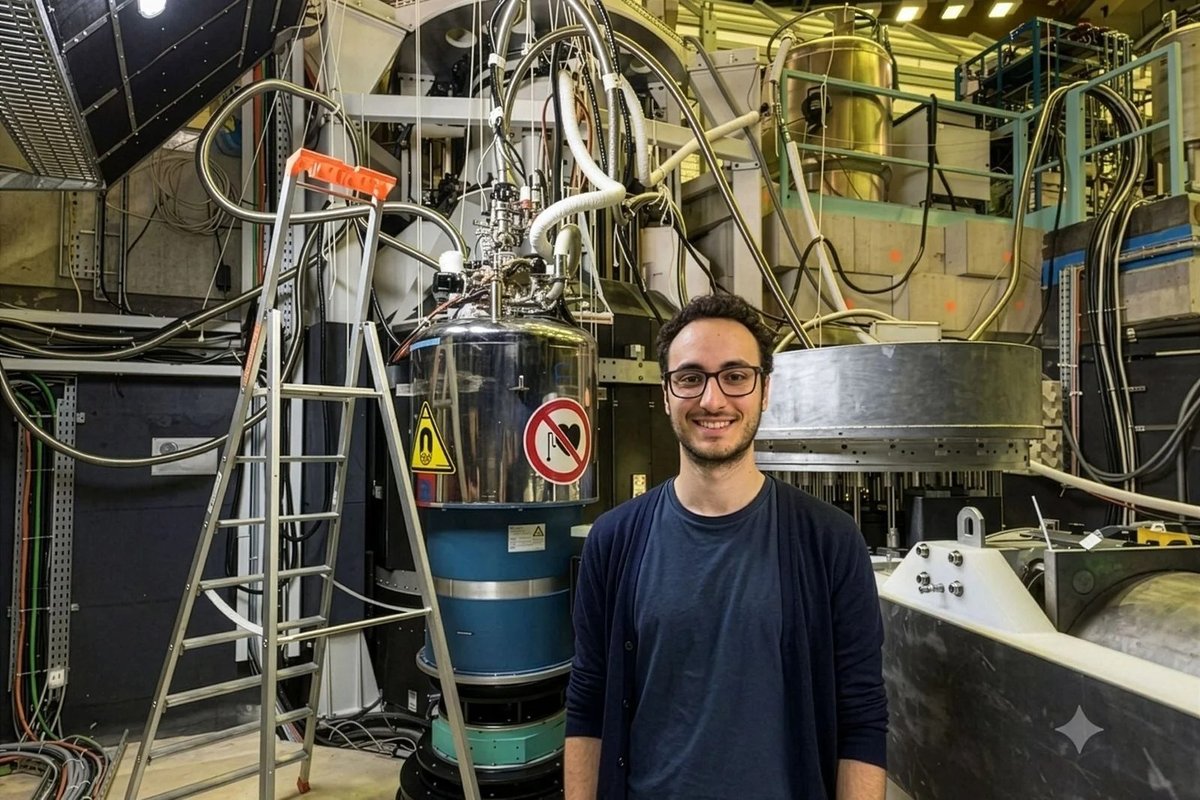
Federico Mazza, PhD student at TU Wien, who conducted the measurements at the ILL in collaboration with the local team.
Neutrons and low temperatures
For this study, the research team produced a crystal made of cerium, palladium and silicon, Ce3Pd20Si6, previously known to have a field-induced strange-metal quantum critical point.
They then used inelastic neutron scattering to probe the crystal under extremely low temperatures. In other words, they bombarded the crystal with neutrons and measured how the material responded.
The experiment focused exactly on the know quantum critical point of Ce3Pd20Si6 in a magnetic field of 1.73 tesla. At that point, the material is at the edge of a transition (linked to the breakdown of Kondo screening, a process that normally binds local electronic degrees of freedom to conduction electrons). Near this boundary, it enters the strange-metal regime.
The experiment was performed at the ILL, using the cold-neutron triple-axis spectrometer ThALES, which combines the high neutron flux characteristic of the ILL with and excellent energy resolution. The team measured the crystal’s dynamical spin response down to 60 millikelvin, under a carefully tuned magnetic field.
According to the authors, neutron scattering is uniquely suited for such studies, as for all other envisageable methods “energy resolution and the lowest accessible temperatures are still orders of magnitude away from what can be achieved with state-of-the-art INS experiments”, they state in the Nature Physics paper.
Bringing entanglement into the picture
The new result suggest that the crystal's constituents respond collectively in a way that reveals entanglement across the material. Behind the odd behaviour of strange metals may be a deeper organising principle, one in which many quantum entities act together in a highly entangled state.
To capture this collective quantum response, the researchers used a quantity from quantum information theory called quantum Fisher information, or QFI. Simply put, QFI captures how strongly a quantum system reacts to a perturbation. If particles are entangled, the system can react more strongly than the sum of its parts.
“In a normal material, one would expect a neutron to transfer its energy to an individual particle,” says Mazza, cited in the article in the TUW website. “But by analyzing the data using the quantum Fisher information, we found a response that cannot be explained in terms of independent particles. Instead, it indicates that groups of at least nine quantum-entangled entities act collectively.”
The study also shows that the concept of quantum Fisher information can be used to detect quantum entanglement even in large many-body systems. In this way, it establishes a new bridge between solid-state physics and quantum physics.
Entanglement is usually discussed for system with a small number of particles - the state of one particle depends on that of another particle, no matter how far apart they are - than for bulk, centimetre-sized samples.
“To the best of our knowledge, the pronounced scale-free increase in the QFI with decreasing temperature, as observed in our inelastic neutron scattering investigation (…) points to the largest entanglement depth reported so far in any quantum material,” the authors state in the article now published.
While pure knowledge and deep understanding are the current goals, strange metals may well find applications in quantum technologies in the future.
Reference:
Mazza, F., Biswas, S., Yan, X. et al. Quantum Fisher information in a strange metal. Nat. Phys. (2026).
https://doi.org/10.1038/s41567-026-03298-0
ILL Instrument: ThALES
ILL Contact Persons: Paul Steffens
Institutions involved in the research: Technical University of Vienna, University of Würzburg, Rice University