
How it works
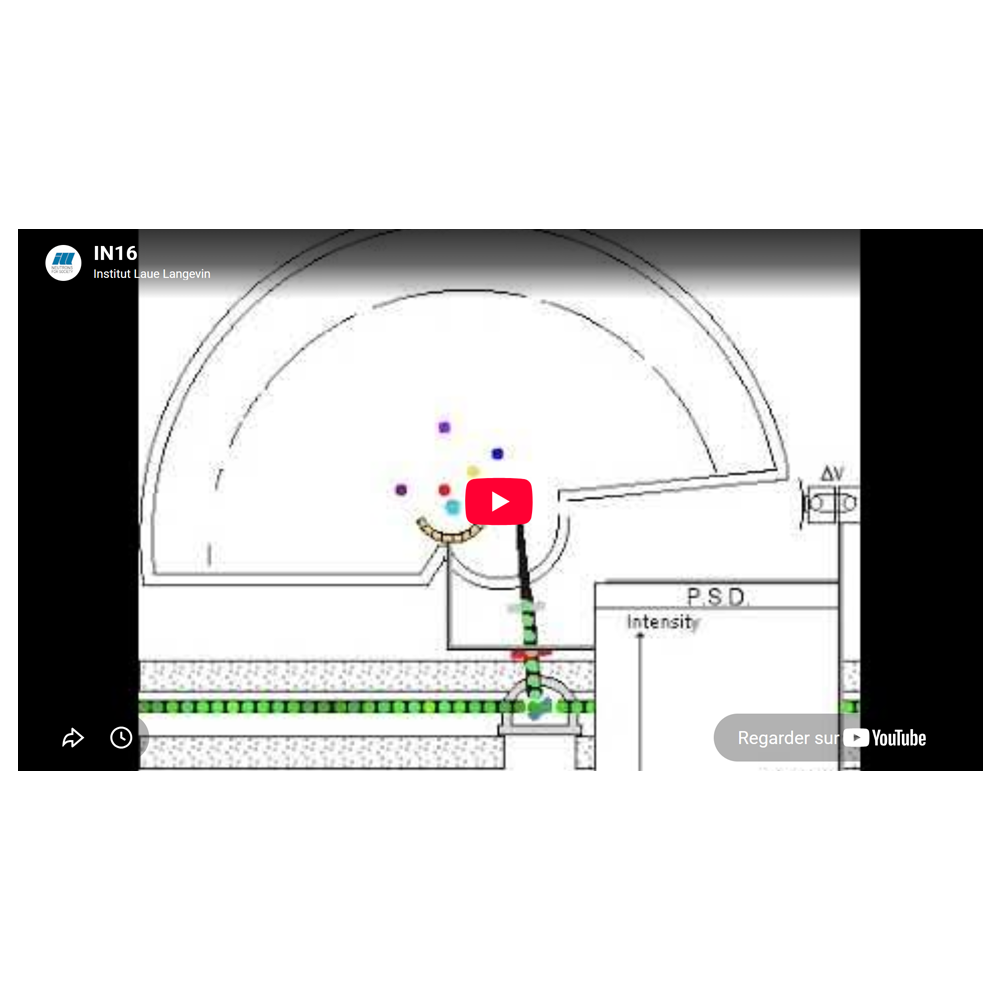
IN16B is a cold neutron backscattering spectrometer - "a variable incident energy, fixed final energy spectrometer". The simulated experiment corresponds to IN16B in guide-side-position ('low background' configuration'). For the guide-end-position ('high flux configuration') incident wavelength band is selected by a velocity selector instead of a graphite deflector:
- The polychromatic neutron beam from the reactor is deflected towards the instrument. The Bragg reflection selects neutrons in a wavelength band around 6Å. (alternatively (not shown) the neutrons pass a velocity selector and continue straight on. Imagine the focusing nose to be at the guide end).
- The neutron beam is pulsed by the "background" chopper.
- A rotating deflector sends the beam to the monochromator.
- A 90 degree Bragg relection from high quality silicon crystals gives a more precise selection of neutrons with wavelength 6Å. The selected wavelength is also determined by the speed of the monochromator, it is mounted on a Doppler drive.
- Neutrons pass back through windows in the rotating deflector, the backgound chopper is closed during this time interval. A pulsed beam of neutrons with an energy range determined by the Doppler machine is incident on the sample.
- Neutrons are scattered in all directions. Only those with a certain final energy, determined by the backscattering relection at the analyser crystals, are reflected to the detectors and counted.
Doppler monochromator
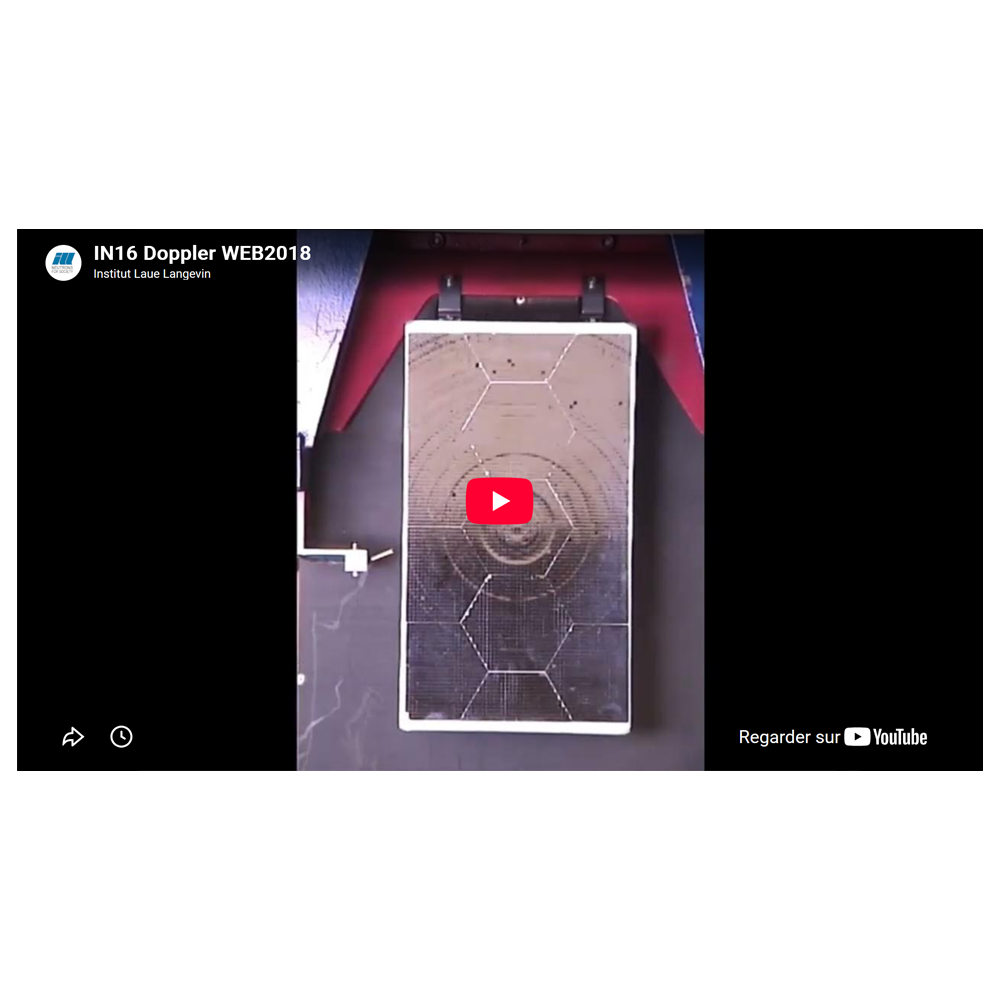
On IN16B a linear motor Doppler drive (AEROLAS) is in operation. It follows the same principle but achieves higher monochromator speeds.
The focusing monochromator shown ('polished' IN16 monochromator) is a spherical assembly of perfect single crystals (small 4x4mm2 oriented silicon single crystals Si(111) ).
When the monochromator stands still it reflects in backscattering only the neutron wavelength λ = 2d, where d is the lattice spacing of the monochromator crystals parallel to the surface.
When the monochromator moves it reflects a slightly different wavelength due to the Doppler effect, the magnitude of which is directly related to the speed of the monochromator motion:
- when it moves towards the sample it reflects a slightly shorter wavelength λ - Δλ
- when it moves backwards it reflects a slightly longer wavelength λ + Δλ.
How it works
The old mechanical Doppler drive of IN16.