SHARPER - CRG - Cold neutron time-focussing time-of-flight spectrometer

SHARPER is an inelastic spectrometer using the time-of-flight technique. The instrument is designed to access dynamic modes in condensed matter by measuring the energy exchange between a monochromatic neutron beam and the sample.
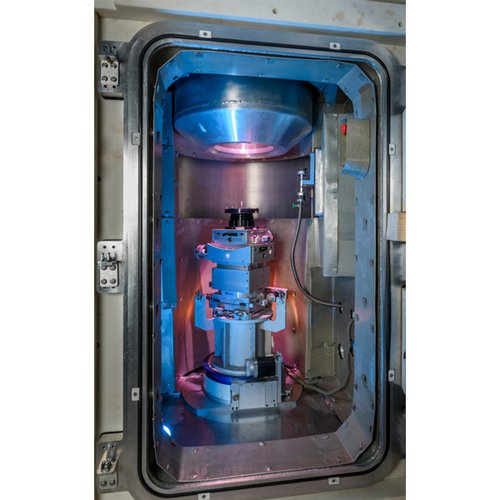
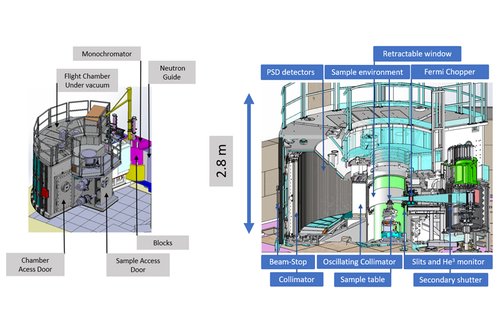
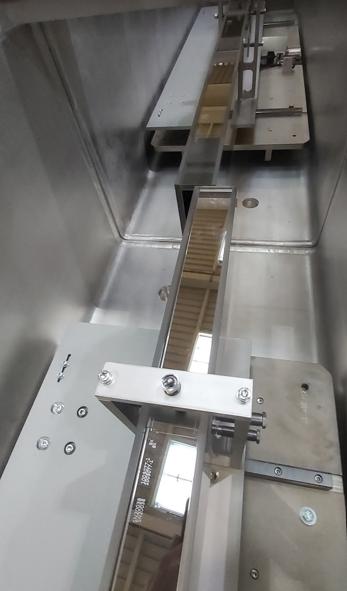
SHARPER sample chamber
Instrument description
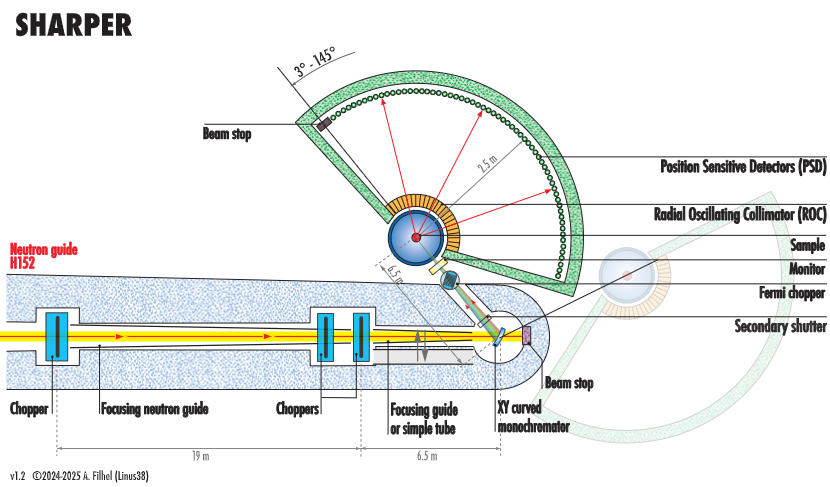
Located in ILL7 on branch H153 of the cold neutron guide H15, SHARPER is an inelastic spectrometer using the time-of-flight technique. The instrument is designed to access dynamic modes in condensed matter by measuring the energy exchange between a monochromatic neutron beam and the sample.
From the continuous, "white" beam delivered by the H15 neutron guide, a specific wavelength (and thus incident energy, Ei) is selected via Bragg reflection on a monochromator. A Fermi chopper pulses this monochromatic beam, setting the time t0 of its interaction with the sample. A timer then measures the time t taken by the scattered beam to reach detectors positioned a known distance d from the sample. The velocity v = d / (t - t0) of the neutrons provides a direct measure (Ef = 1/2·m·v2) of the scattered beam's energy. The energy transfer Ef – Ei corresponds to the energy of a dynamic mode within the sample.
A set of three disk choppers located upstream of the monochromator eliminates harmonics (integer sub-multiples) of the chosen incident wavelength that may not be fully filtered by the monochromator.
A retractable guide between this disk chopper system and the monochromator allows switching between "time focusing" (TF, guide retracted) and monochromatic mode (MM, guide in the beam). The TF mode enhances energy resolution within a narrow energy transfer region while maintaining high flux. The MM mode provides constant resolution over a broader energy transfer range but at the expense of flux reduction.
Applications
Study of dynamics and relaxation properties in condensed matter exploiting both nuclear and magnetic scattering.
- Vibrational density of states of crystalline and amorphous solids
- Dynamics of soft condensed matter such as polymers, proteins, biological membranes and gels
- Local and long range diffusion of liquids, solutions and confined systems
- Properties of quantum liquids, Fermi and non-Fermi systems
- Phase transitions and quantum critical phenomena in polycrystals and single crystals
- Spin dynamics in high-Tc superconductors
- Properties of crystal field splittings