

Highlighting neutron science as fundamental to addressing society’s Grand challenges, a new consortium takes shape in Europe
The League of advanced European Neutron Sources, LENS, hopes to guide and advocate for the European neutron user community in this current period of transition and optimism catalysed by the advent of the world’s most powerful spallation source, ESS.
The forthcoming establishment of a new strategic consortium of European neutron sources was announced on 22 June 2018 in Brussels. The League of advanced European Neutron Sources, or LENS, will bring together the trans-national European neutron source facilities with the aim to, according to the group’s charter, “facilitate any form of discussion and decision-making process that has the potential to strengthen European neutron science via enhanced collaboration among the facilities”.
The announcement came during the European Spallation Source’s (ESS) BrightnESS Closing Conference taking place at the Royal Flemish Academy of Sciences and Arts. An introduction to the initiative was given by Institut Laue-Langevin (ILL) Director Helmut Schober. [See slides at the bottom of this article]
Prospective partners in the consortium include nearly a dozen facilities in France, Germany, Sweden, Hungary, the United Kingdom, the Czech Republic and Switzerland. Other qualifying facilities may join going forward.
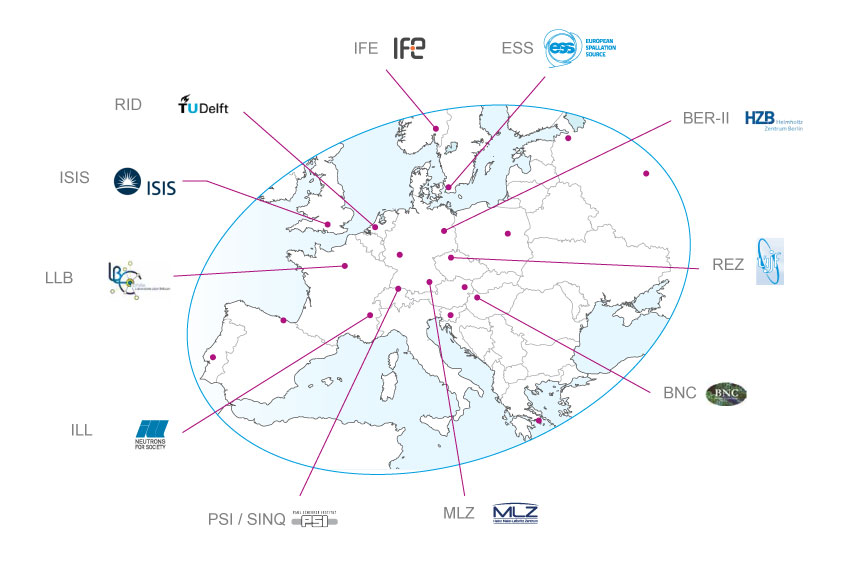
Neutron sources with international user programme in Europe
“Probing materials with neutrons stands as one of the pillars of our scientific analytical techniques,” said Schober in his introduction to the LENS consortium. “As such, neutron sources are essential to the advancement of both the research that works to directly address our society’s grand challenges and the fundamental science at its foundation.”
Most of the prospective LENS partners are national facilities, where the majority of European neutron-based research is conducted. One emphasis of the group’s activities, therefore, will be on the interaction between these national user communities and European funding organisations and their representatives. By optimising resources and closely aligning policies among partners, the LENS vision is one of continuous improvement and adaptation by neutron science facilities to the communities they serve.
The Institut Laue-Langevin is the world’s flagship centre for neutron science. It provides scientists with a very high flux of neutrons feeding some 40 state-of-the-art instruments, which are constantly being developed and upgraded. Every year, some 1500 researchers from over 40 countries visit the ILL. More than 800 experiments selected by a scientific review committee are performed annually. “Neutrons are unique as probes into matter; they can reveal what other techniques cannot see. Researchers from a variety of scientific domains ranging from solid-state physics to chemistry and biology, from the material and earth sciences to engineering and nuclear or particle physics agree on the exceptional capacities and versatility of neutron techniques”, according to Helmut Schober, director of ILL.
Other fundamental goals of the consortium include the establishment of common representation and impact promotion. By speaking with the collective weight of a common voice, LENS hopes to maintain the attention and support of European and national funding authorities to benefit the European user community as a whole.
“Europe has achieved global leadership in neutron science, and the research community is a strong one. LENS will build on this success to create an even more effective ecosystem for collaboration between facilities going forward,” said John Womersley, ESS Director General.
A major driver of LENS is to maintain complementary and sufficient overlap of the current global flagship facility, ILL in France, as long as ESS, currently in construction, has not yet reached its full operation capability.