How it works
Principle of the spin-echo technique
Spin-echo spectrometers are based on the determination of neutron velocities by using the Larmor precession of their spin in a constant magnetic field. This is a trick which decouples intensity and resolution: one can use a coarse monochromatization (5 to 15 %).
The resolution goes as λ3, so it becomes excellent at long wavelength. For example IN15 which can use 24 Å neutrons (wavelength twice the one of IN11) can reach resolution around 1 neV (240 kHz). In addition it has two options: a TOF mode of operation and a focusing mirror.
IN11 is equipped with an optional extension for using a detector bank covering 30° of scattering angle: this gives an intensity gain of 20, at the expense of a slight deterioration in energy resolution. WASP will go a step further in that direction.
The spin-echo spectrometers have made a big contribution in the understanding of the dynamics of polymer melts (concept of reptation), or the super-paramagnetic fluctuations in Fe nanoparticles.
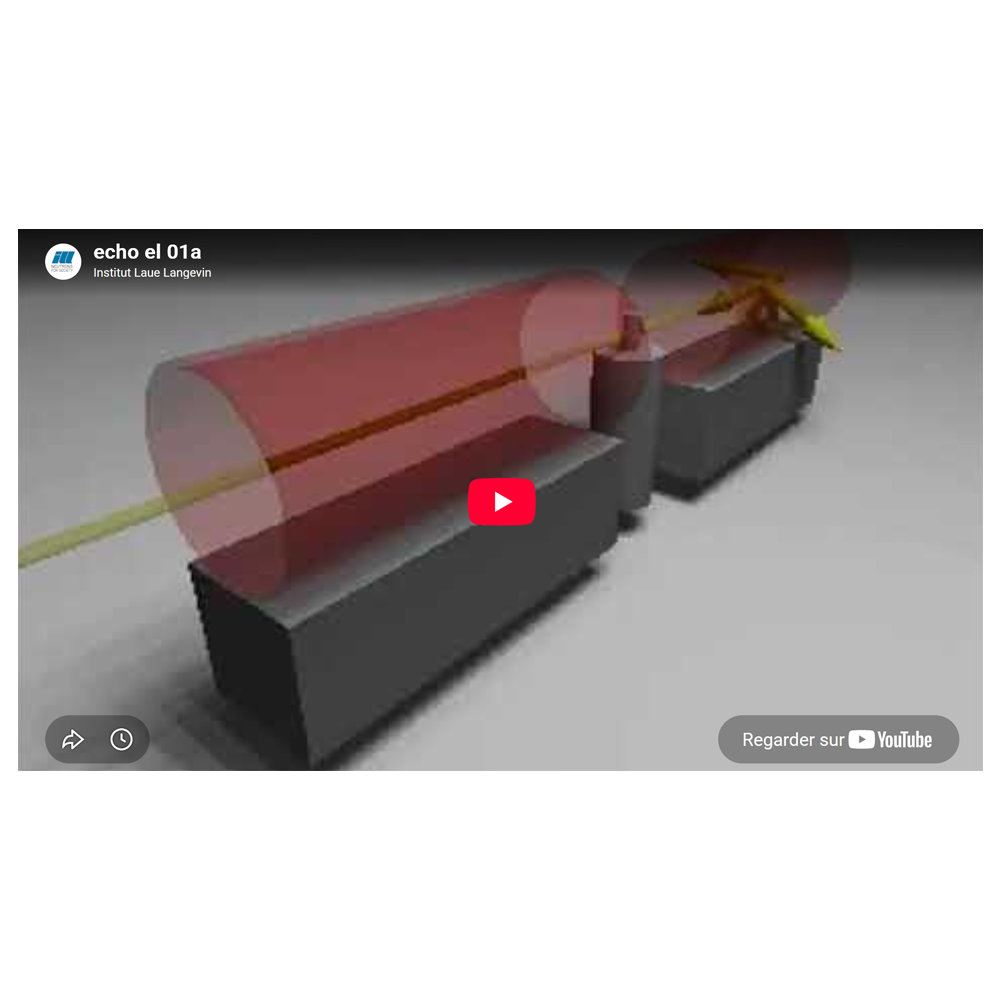
In the animation the magnetic coils have the classical shape while WASP will adopt a different geometry.