ThALES - Three Axis instrument for Low Energy Spectrometry

The ThALES project is a collaboration between ILL and Charles University, Prague.
Its construction was funded by the Czech Ministry of Science and Education.
Instrument layout
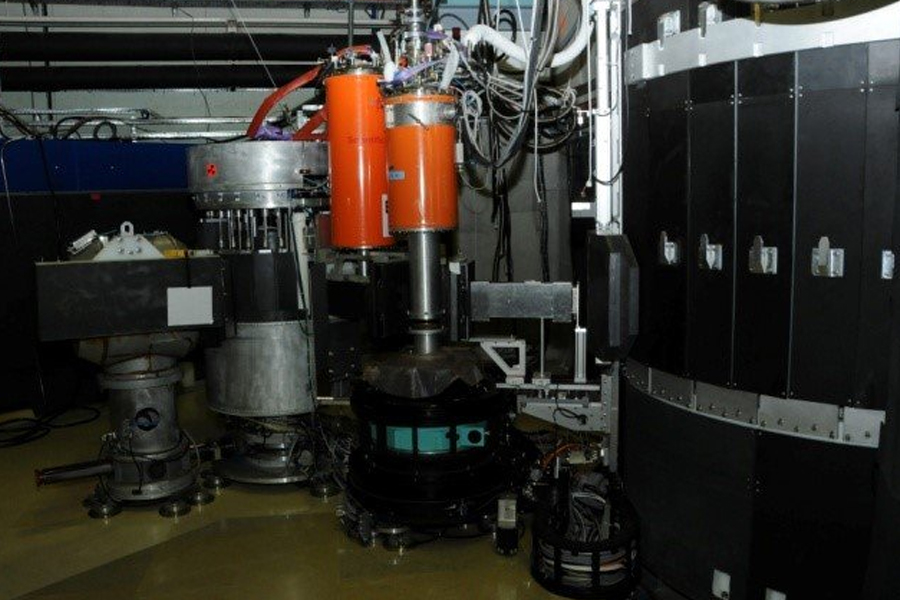
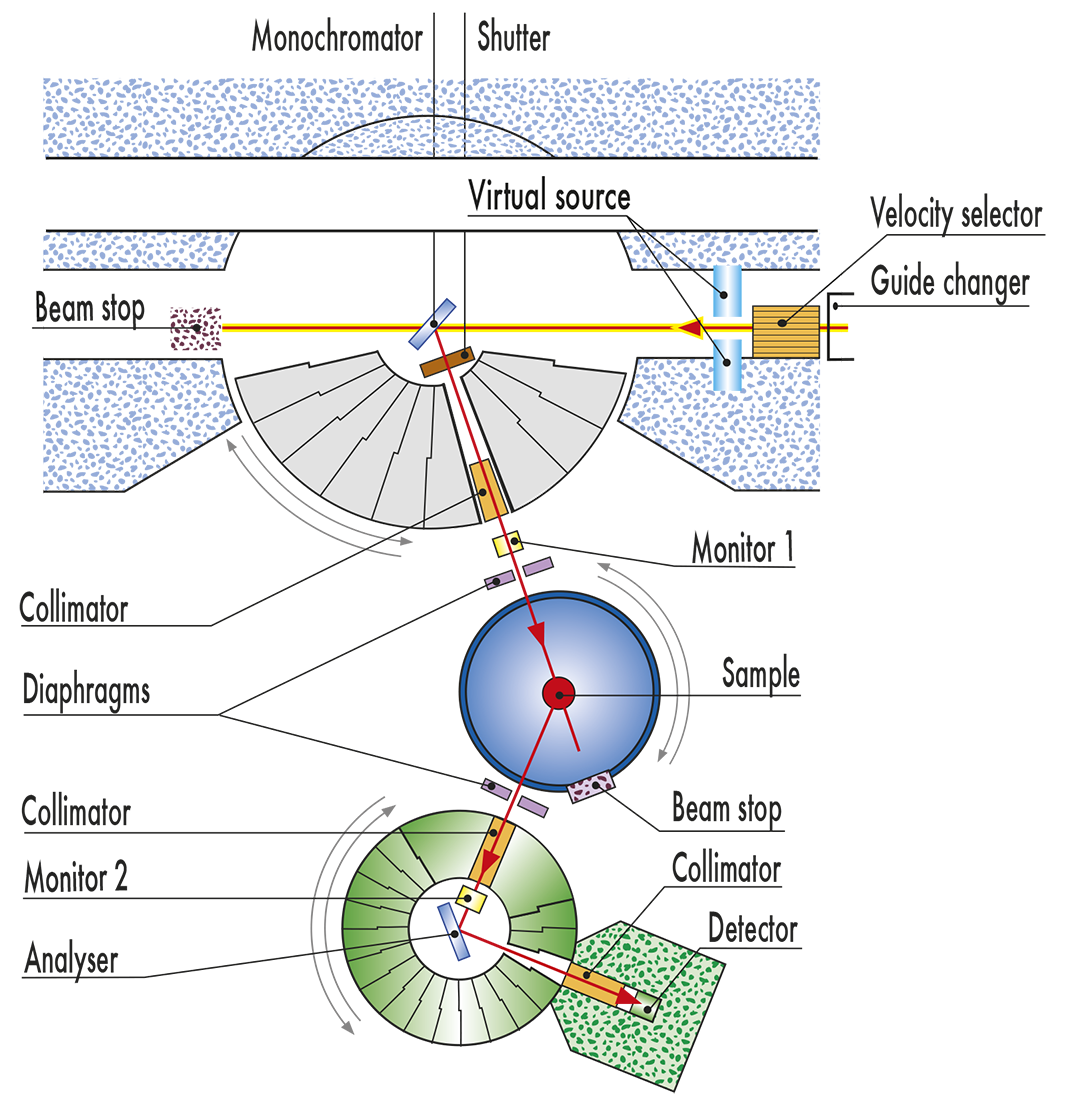
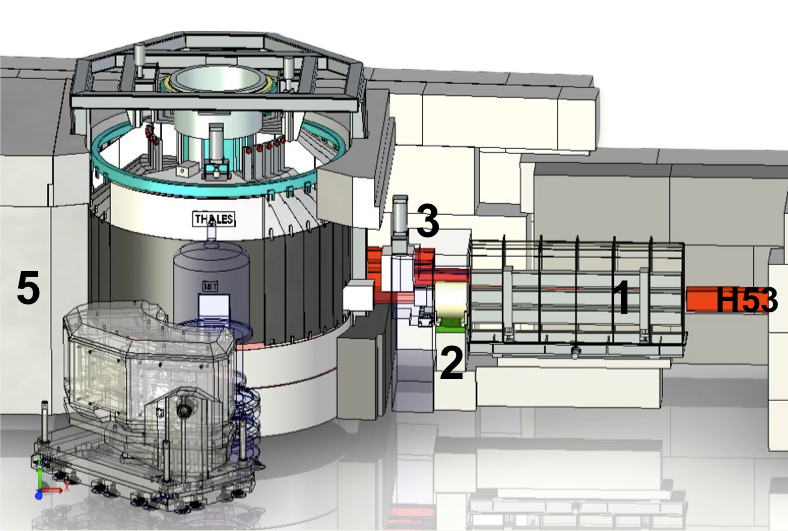
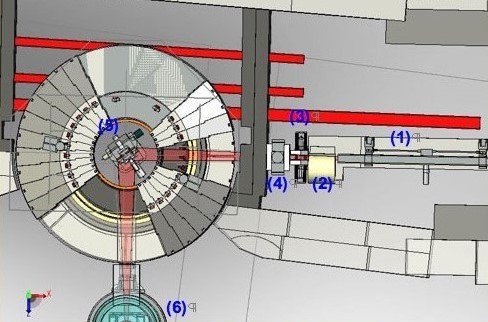
The H53 super-mirror (m=3) guide transports the neutrons from the horizontal cold source to the monochromator. The final 3m section (1) is interchangeable between a straight guide and an elliptically tapered, focusing, section.
A velocity selector (2) acts as broad band energy filter on the incoming neutron spectra for suppressing higher order contamination and lowering the general neutron background in the experimental zone. It is followed by the Virtual Source, a heavy slit with horizontal variable aperture (3).
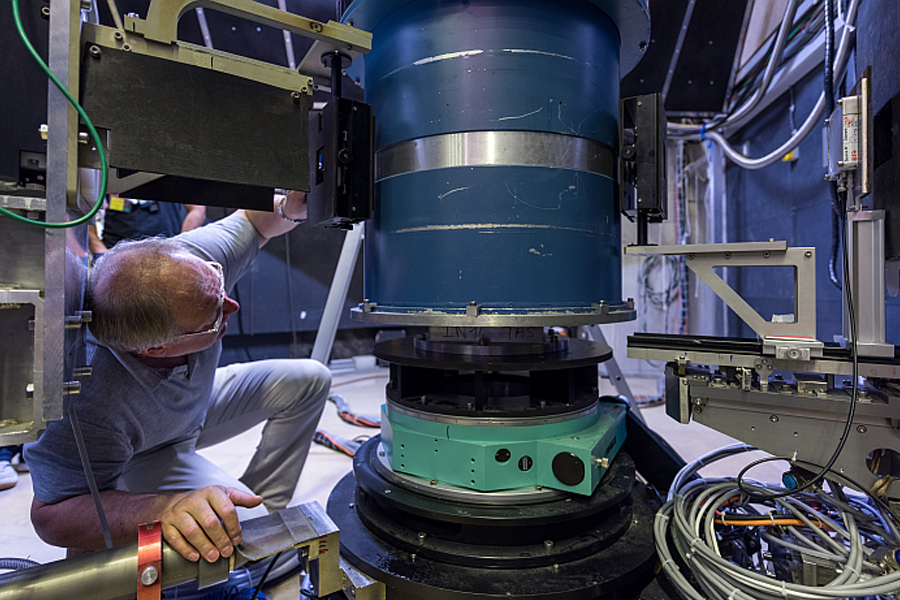
The monochromator stage (4) consists of the three monochromators PG-002, Si-111 and Heusler (for polarization analysis) with the respective positioning mechanics. Due to the large transported divergence the neutron beam at this level has a section of ≈ 25 x 20 cm2, which is focused on the sample position in the following, respecting Rowland geometry for horizontal (monochromatic) focusing.
The entire shielding of the primary spectrometer is non-magnetic for avoiding attracting forces due to stray fields of magnets used on the sample table. It consists of sandwiches of poly-ethylene, Pb and B4C rubbers.
Strengths of ThALES
The accessible momentum (Q) and energy (ħω) transfer range fits with the needed dynamical range for measuring excitations in many magnetic systems
- Typical cold TAS energy resolution from 0.05 to 0.4 meV, depending on the incoming neutron energy
- Unrivalled cold neutron flux at the sample position (2.5·108 n/cm2/s for incident energies around 10 meV) due to direct view on the high-flux horizontal cold neutron source (HCS) of the ILL and optimized neutron optics
- Clean beam (velocity selector etc) and very low background
- Flexible choice of beam conditions (different monochromators, analyzers, guides)
- Routine operation of complex sample environment
- Polarization Analysis
- Easy interchange between single analyser-detector mode (for high-flux studies in restricted regions Q and ω), and the Flatcone multiplexed analyser-detector mode
Applications
ThALES is optimized for the measurement of excitations in single crystals in the range of about 0.2 to 10 meV. With its high neutron flux, which is worldwide leading, and its very low background, it can be used to measure particularly weak signals. It allows for extreme sample environment (low temperature, high magnetic fields and pressure) and can be used with neutron polarization analysis.
Its main applications include magnetic excitations in unconventional superconductors, low-dimensional and frustrated magnets and various quantum phenomena, magneto-elastic or multiferroic materials, and heavy-fermion systems, among others. It can also be used for high-precision diffraction studies.