
Characteristics
| Reactor hall, cold guide H53 |
|---|
| 18.84 m from the cold source |
| Guide changer for 2 different guide end-sections: | |||
|---|---|---|---|
| Coating | Length | ||
| straight section | m=3 | 3 m | Exit window: width x height = 6,0 x 12,0 cm2 |
| elliptically tapered section | m=3 | 3 m | Exit window: width x height = 2,5 x 12,0 cm2 |
| Velocity selector for higher order filtering | |
|---|---|
| blades | carbon fiber with B4C coating |
| windows entrance and exit | width x height = ~ 7,0 x 12,0 cm2 |
| frequency | up to 26 000 rpm, synchronized with incident energy Ei |
| Virtual source | |
|---|---|
| Aperture | horizontal variable 0 to 4 cm, vertical fix 12 cm |
| Angular range |
|---|
| Monochromator scattering angle 34-133 degrees |
| Sample scatting angle up to 120 degrees (depending on config.) |
| Monochromators | |||
|---|---|---|---|
| Crystal | dhkl(Å) | Focusing | |
| polarised | Heusler (111) | 3.437 | Variable horizontal, fixed vertical |
| unpolarised | PG (002) | 3.355 | double focusing |
| Si (111) | 3.135 | double focusing | |
| Analysers | |||
|---|---|---|---|
| polarised | Heusler (111) | 3.437 | Variable horizontal, fixed vertical |
| unpolarised | PG (002) | 3.355 | double focusing |
| Si (111) | 3.135 | double focusing | |
| Detectors | |
|---|---|
| standard three-axis setup | He tube |
| FlatCone multiplexed option | Horizontally individual He-tubes for all 31 channels |
| Options (others than sample environment) |
|---|
| Be-filter |
| Pg002 filter |
Flux and resolution
The lay-out of the primary spectrometer respects Rowland geometry, giving best possible energy resolution for focusing Bragg neutron optics. The energy resolution δE is typically about 3% of the incoming neutron energy Ei for all monochromators. Typical values are:
δE = 0.04 (Ei= 2 meV)
δE = 0.16 (Ei= 4 meV)
δE = 0.30 (Ei= 8 meV)
With standard focusing conditions the momentum resolution δ|Q| is about δ|Q| ≈ 0.02 Å-1. If needed, δ|Q| can be considerably enhanced by beam collimation with compromises in neutron flux.
Sample environment
ThALES is compatible with most of the ILL sample environment :
- Low temperatures Tmin:
Tmin ≈ 30 mK - Vertical magnetic fields HV:
HV ≤ 15 T - Horizontal magnetic fields HH:
HV ≤ 4 T - Hydrostatic pressure (clamp cells) pmax:
pmax ≤ 20 kbar - Hydrostatic pressure (PE-cells) pmax:
- pmax ≤ 100 kbar
Polarisation
Neutrons are polarised and analysed with large focusing Heusler monochromators and analyzers.
Polarisation analysis can be done either with Helmholtz coils or with the CryoPad (for spherical polarisation analysis)
Choice of monochromator and analyser
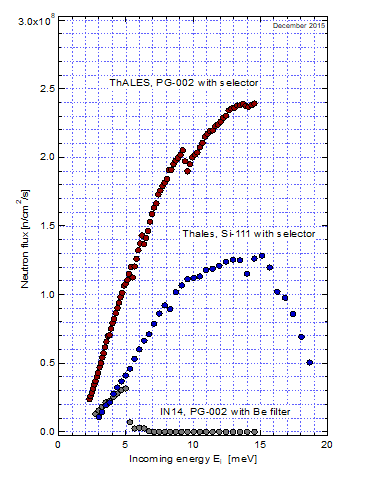
PG-002 provides the highest neutron flux.
With the Si-111 monochromator higher incident energies are accessible than with PG-002 (due to smaller d-spacing and because it can be used without velocity selector), but at very small incident or final energies its flux is strongly reduced. It generally gives better signal to noise ratio, in particular at energy transfers lower than 0.5 meV (due to the very clean tails of the elastic line).
Changing the monochromator is automatic, while the analyser has to be changed manually.
Flatcone
The FlatCone analyzer-detector unit covers a scattering angle of about 75 degrees, separated into 31 individual channels. Every channel is equipped with a bent Si-111 analyzer with fixed final energy of 4 meV. By rotating the crystal the complete scattering plane can be mapped out in a very efficient way for energy transfers up to about 10 meV. Also, vertical momentum transfers up to about 0.3·ki are possible. The Flatcone setup is particularly advantageous for measuring excitations which are broad in momentum space.